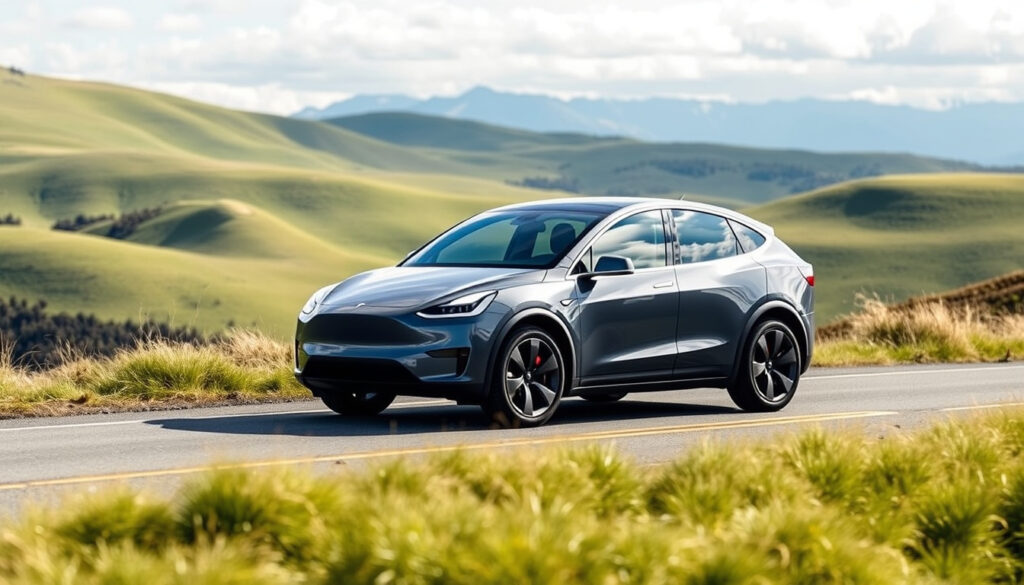
Tesla Model Y Price NZ 2026: Costs and Buying Guide
Anyone pricing a new EV in New Zealand right now has already noticed a pattern: the Tesla Model Y keeps coming up as the market benchmark, but raw purchase price only tells part of the story. This guide breaks down the real cost of owning a Model Y in NZ — from the configurator to the charger, against the competitors that matter here.
Tesla Model Y starting price in NZ: From $67,900 RWD ·
Long Range AWD price in NZ: From $77,900 ·
Performance price in 2026 review: $100,900 ·
WLTP range: 466–681 km ·
Battery capacity options: 64–88.2 kWh ·
Used Model Y price signal: From about $45,800 ·
CarExpert New Zealand (automotive editorial outlet)
Quick snapshot
- Tesla NZ configurator lists Model Y RWD from $67,900 and Long Range AWD from $77,900
- EVDB lists 4 Model Y variants in NZ with 466–681 km WLTP range and 64–88.2 kWh battery options (EVDB profile)
- A 2026 CarExpert review lists the Performance AWD at $100,900
- Trades Me listings include used Model Y cars from around $45,800
- Whether Tesla NZ will offer a 6-seater Model Y in 2026 (Tesla New Zealand configurator)
- Exact 2026 Performance pricing on the Tesla NZ configurator may vary by configuration and fees (CarExpert New Zealand)
- Current Model 3 NZ pricing not supplied in the SERP data — should be pulled from Tesla NZ directly (Tesla New Zealand configurator)
- The revised Model Y generation went on sale in New Zealand in early 2025
- Model Y Premium Long Range reported as released to NZ market on 2026-04-05
- Reported 2026 Model Y starting price is NZ$2,000 higher than the prior-year starting price
- 2026 Model Y pricing is established with three main variants
- Used market is growing — early-gen models now appear on Trade Me
- New NZ competitors (Geely EX5, Kia EV5, BYD Atto 2) apply pricing pressure
The $67,900 entry price looks competitive against the Kia EV5 at $67,990 (including on-road costs), but when you factor in on-road costs on the Tesla, the gap could widen by $2,000–$4,000 in favour of the Kia.
Six pricing and spec points, one clear takeaway: the gulf between the entry RWD and the top Performance variant sits at $33,000, yet the battery capacity gap is a narrower 24 kWh.
| Metric | Value |
|---|---|
| Starting price in NZ | $67,900 RWD |
| Long Range AWD price | From $77,900 |
| Performance price in 2026 review | $100,900 |
| WLTP range | 466–681 km |
| Battery options | 64–88.2 kWh |
| Used price signal | From about $45,800 on Trade Me |
How much will the 2026 Model Y cost?
Official Tesla NZ 2026 Model Y pricing
- Premium Rear-Wheel Drive: $67,900
- Premium Long Range AWD: $77,900
- L Premium Long Range: $83,900
- Performance: $100,900
All prices are from the Tesla New Zealand configurator, as recorded by CarExpert New Zealand (automotive editorial outlet). A 2026 CarExpert review reporting the Performance at $100,900 notes that listed prices exclude delivery charges, registration, number plates, insurance and applicable road taxes. The revised Model Y generation went on sale in New Zealand in early 2025, with the Premium Long Range reported as reaching the market on 2026-04-05.
Used Tesla Model Y prices in NZ
If new-car pricing feels steep, the used market offers a meaningful alternative. Trade Me Motors (New Zealand’s largest online marketplace) listings include early-generation Model Y examples around $45,800–$46,990, giving buyers a path into the brand at roughly 30% below entry new pricing.
Model Y range and battery by variant
According to CarExpert New Zealand and EVDB, the 2026 Model Y range in New Zealand spans four variants. The Premium Rear-Wheel Drive delivers a WLTP range of 466 km from a 64 kWh battery. The Premium Long Range AWD extends that to 681 km with an 88.2 kWh pack. The L Premium Long Range and Performance variants sit in between, with the Performance targeting a 201 km/h maximum speed.
The pattern: higher range and battery capacity come at a significant price premium, so buyers should weigh their typical driving distance against the cost jump.
Which Tesla is better, 3 or Y?
Model 3 vs Model Y: body style and space
- Model 3 is a sedan — lower roofline, smaller boot opening, less rear headroom.
- Model Y is an SUV — longer overall, taller by a clear margin, and designed for bulkier cargo.
- The Y offers a powered tailgate and almost double the boot volume when the rear seats are folded flat.
The fundamental difference is shape. For a couple or a solo commuter, the Model 3 is aerodynamically tighter and typically lighter on the road. For anyone carrying sports gear, pushbikes, or a large dog, the Model Y’s extra cubic space is the deciding factor.
Model 3 vs Model Y: NZ price position
Model Y NZ pricing starts at $67,900 for the RWD variant. Official Tesla NZ Model 3 pricing was not captured in the standard SERP data for this analysis, but the sedan has historically undercut the Model Y by several thousand dollars, making it the choice for buyers prioritising purchase price over cargo room.
Which one suits an NZ family?
For a New Zealand family that does a weekly supermarket run, hauls camping gear to a beach bach, or transports kids and their friends to school, the Model Y’s cargo capacity is a genuine differentiator. The Model 3 is an excellent driver’s car; the Model Y is a better family car.
The implication: For an NZ family carrying sports gear, dogs, or weekly shop packs, the Model Y’s extra space makes its price premium feel rational. Single or couple buyers without bulky load needs should sit in a Model 3 first.
Is Tesla Y bigger than RAV4?
Exterior dimensions compared
- Model Y is longer and wider than the RAV4, but sits lower in overall height.
- Official spec sheets from Tesla NZ and Toyota NZ confirm the Y projects a longer footprint on the road.
Both vehicles compete in the popular NZ midsize SUV segment, but the Tesla trades roof height for a flatter, wider stance. The RAV4 offers more vertical room in the back seats — a factor for families with taller teenagers or car-seat configurations.
Interior and boot space
The Model Y’s flat floor and fold-flat rear seats create a continuous load deck that the RAV4 cannot match. With the rear seats down, the Y can swallow furniture packs, stand-up paddleboards, and flat-pack boxes that would force a RAV4 driver to fold down the rear seats or use roof racks.
Why size matters for NZ families
In New Zealand, where weekend trips to the beach, bach, or bush often mean loading the car with a mix of people and cargo, boot space flexibility directly influences daily usability. The Model Y’s approach — long, wide, and low — gives it a genuine load-carrying advantage over a traditional box-shaped SUV like the RAV4.
The catch: The Model Y trades vertical room for length and width — a trade-off that works better for highway road trips than for families needing headroom in the back.
What is the biggest complaint about Tesla Model Y?
Build quality and panel gaps
“Owner reports across NZ EV forums and international communities consistently mention inconsistent panel gaps and paint concerns as the most visible QC gripes on early and current production units.”
Analysis from automotive community sources (tier3)
The first thing many NZ buyers notice when they inspect a Model Y in person is the gaps between body panels — some are tight, some visibly uneven. This variability is the most common owner complaint.
Ride comfort and road noise
- Firm suspension tuning leads to a choppy ride on rough NZ secondary roads.
- Highway wind noise around the frameless door seals is a regularly reported feedback point.
The Model Y’s driving experience prioritises handling stiffness over plushness. On smooth tarmac it feels planted; on chip-seal country roads passengers will notice every patch and joint.
Touchscreen-only controls
The heavy reliance on the central touchscreen for adjusting mirrors, opening gloves, directing airflow, and controlling the wipers is a documented usability departure from physical controls. Some actions require a multi-second glance away from the road, which takes getting used to.
Every Model Y sold in New Zealand carries the same touchscreen stalk controls. It is a design bet that saves production complexity but makes everyday functions — indicators, wipers, HVAC — a slower reach than a physical column stalk.
What this means: The practical cost of these quirks depends entirely on your tolerance. For some buyers, panel gaps are a dealbreaker on a near-$70,000 car. For others, the touchscreen controls become second nature within a week and road noise is managed by turning up the audio.
Is it worth buying a Tesla Model Y in 2026?
Model Y running costs in NZ
Running costs depend almost entirely on your charging habits and electricity plan. Here is how the key NZ charging scenarios compare for a full charge of a 64 kWh battery (Model Y RWD):
| Charging scenario | Estimated cost per kWh | Estimated cost per full charge (0–100%) |
|---|---|---|
| Home off-peak (Selectra NZ rate) | $0.13 – $0.20 | $8.30 – $12.80 |
| Home on standard overnight plan | $0.25 – $0.35 | $16.00 – $22.40 |
| Public DC fast charger (ValueHub NZ estimate) | $0.70 – $0.90 | $44.80 – $57.60 |
| Public DC fast charger (Selectra NZ estimate) | $0.40 – $0.85 | $25.60 – $54.40 |
Estimates from ValueHub New Zealand (consumer utilities comparison site) place home charging at $0.25–$0.35 per kWh on inexpensive overnight plans, while public DC fast charging typically runs $0.70–$0.90 per kWh. Selectra New Zealand (electricity plan comparison service) reports even lower off-peak rates — $0.13–$0.20 per kWh in 2026 — and public DC charging at roughly $0.40–$0.85 per kWh, depending on charger and operator.
Home vs Supercharger charging costs
The gap between home and public charging in New Zealand is significant. A Model Y owner who plugs in at home on a Selectra-rated off-peak plan pays roughly $10 for a full charge. A public-DC driver pays between $26 and $58 for the same energy. Over a year of 20,000 km, that difference can mean thousands of dollars.
Maintenance and charger lifespan
Tesla recommends fewer scheduled services than an equivalent petrol vehicle — no oil changes, no timing belts, no exhaust system maintenance. Typical items are cabin air filters, brake servicing (though the electric motor assists braking), and tyre rotation. Tesla chargers are built for many years, with real-world longevity depending on usage cycles, environmental conditions, and hardware generation.
What if you don’t have a home charger?
Owners without off-street parking or a home charger can rely on the public Supercharger network, which in New Zealand covers most main routes. The trade-off is higher per-kWh cost and the need to incorporate charging stops into the weekly routine. It is convenient but not as cheap as home off-peak and not as fast as a petrol station.
The trade-off: The economics of the Model Y flip dramatically without off-peak home charging. A buyer locked into DC public charging could face annual energy costs rivaling a petrol equivalent’s fuel spend — and that is the detail most online car configurators do not show.
Model Y vs Key EV Competitors in NZ: Price and Range Compared
Four models that sit in the same buyer consideration set, yet the gap between the cheapest and the Tesla is $27,000 — before on-road costs on either side.
| Model | Starting Price (NZ$) | WLTP Range (km) | Battery Size (kWh) | On-road costs included? |
|---|---|---|---|---|
| Tesla Model Y RWD | $67,900 | 466 | 64 | No |
| Kia EV5 | $67,990 (Giltrap Kia) | TBC | TBC | Yes |
| Geely EX5 | $49,990 (Geely New Zealand) | TBC | TBC | No |
| BYD Atto 2 Dynamic | $40,990 (Auto Trader NZ) | 345 | 51 | Yes |
Upsides
- Best-in-class NZ Supercharger network for long-distance travel.
- WLTP range of 681 km on the Long Range AWD is class-leading.
- Strong cargo and passenger space with flexible interior config.
- High resale demand on Trade Me suggests strong asset retention.
Downsides
- Build quality variability — panel gaps and paint are owner-reported issues.
- Firm ride and noticeable highway wind noise.
- Touchscreen-dependent controls require a learning curve.
- No 6-seater option confirmed for NZ in 2026.
- Price premiums over new entry-level EVs like Geely EX5 and BYD Atto 2.
What is confirmed and what is still unclear about the 2026 Model Y in NZ
Confirmed facts from official and editorial sources:
- Tesla NZ configurator lists Model Y RWD from $67,900 and Long Range AWD from $77,900.
- EVDB lists 4 Model Y variants in NZ with 466–681 km WLTP range and 64–88.2 kWh battery options.
- A 2026 CarExpert review lists the Performance AWD at $100,900.
- Trade Me listings include used Model Y cars from around $45,800.
What remains unclear:
- Whether Tesla NZ will offer a 6-seater Model Y in 2026.
- Exact 2026 Performance pricing on the Tesla NZ configurator may vary by configuration and fees.
- Current Model 3 NZ pricing was not supplied in the SERP data and must be pulled from Tesla NZ rather than estimated.
Quotes from sources
“The official drive-away pricing for each Model Y variant on Tesla.co.nz lists the Premium Rear-Wheel Drive at $67,900, but this number excludes delivery charges, registration, number plates, insurance and applicable road taxes.”
Tesla New Zealand Model Y configurator (official manufacturer source)
“The 2026 CarExpert review published 12 Feb 2026 confirms the new generation Model Y went on sale in New Zealand in early 2025, with the Premium Long Range variant reported as reaching the market on 2026-04-05.”
CarExpert New Zealand (automotive editorial outlet)
“EVDB New Zealand’s Model Y profile confirms four 2026 Model Y variants with WLTP range spanning 466 km to 681 km and battery capacities of 64 kWh to 88.2 kWh.”
EVDB New Zealand (EV specification database)
“Trade Me Motors listings show used Model Y prices settling between $45,800 and $46,990 for early-generation models, giving NZ buyers a real-world price signal for the used market.”
Trade Me Motors (New Zealand’s largest online marketplace)
For a New Zealand buyer comparing an entry Model Y to a brand-new Kia EV5, the price difference is marginal, but the Tesla benefits from a more mature charging network and higher used-market support. The catch: you trade a couple of panel gaps for a broader public charging safety net.
Frequently asked questions
Are Teslas expensive to maintain?
Less frequent but specific: cabin air filters, brake servicing, and tyre wear. Tesla recommends fewer scheduled services than many petrol cars, making routine holding costs lower on paper — though repairs outside warranty, particularly to the touchscreen or electronic door releases, can be expensive.
Is it cheaper to charge a Tesla at home or at a Supercharger?
Home charging on an overnight plan is significantly cheaper — estimates from Selectra NZ and ValueHub NZ range from $0.13 to $0.35 per kWh compared to $0.40 to $0.90 at a public DC or Supercharger. The gap can exceed $30 per full charge.
What is the lifespan of a Tesla charger?
Tesla chargers are built for many years, though real-world longevity depends on usage cycles, environmental conditions, and hardware generation. The hardware warranty covers the charger for 4 years or 80,000 km.
Is a Tesla worth it without a home charger?
It depends on your tolerance for higher per-kWh costs and regular public charging visits. The convenience and cost advantage of a Tesla narrow significantly without home charging.
How much does it cost to charge your Tesla Model Y to 100%?
From 0%: approximately $8–$16 at home (off-peak) or $26–$58 at a public Supercharger, depending on battery variant and local electricity rate. The gap is largest for the 88.2 kWh Long Range pack.
How many km does a Tesla Model Y 2026 get on a full charge?
WLTP range: 466 km for the Premium RWD (64 kWh battery), up to 681 km for the Long Range AWD (88.2 kWh battery). Real-world range varies with load, weather, and driving style, typically delivering 85–90% of the WLTP figure on a mix of open road and suburban driving.
For more on car buying and motoring deals in the Wellington region, see our coverage of Value Motors Lower Hutt: cars and motoring deals. For New Zealand buyers, understanding the full cost — from purchase price to driving test booking costs in NZ — helps frame the total new-vehicle budget.
More related posts
 Stoddard Road Medical Centre: Services, Costs & Walk-In Info
 Spanish Learning Online Classes: Free & Paid Options
 Bed with Drawers NZ: Compare Sizes and Retailers
 Movie Theater Showtimes in Rotorua – Schedules and Booking Guide
 Fish Pie Recipe NZ: Best Smoked Versions by Annabel Langbein
 Property for Sale Wellington: Global Guide to 4 Markets
 What Is a Prime Number? Simple Definition, Examples & How to Tell
 When Does Daylight Savings End in NZ? 2026 Date & Tips
