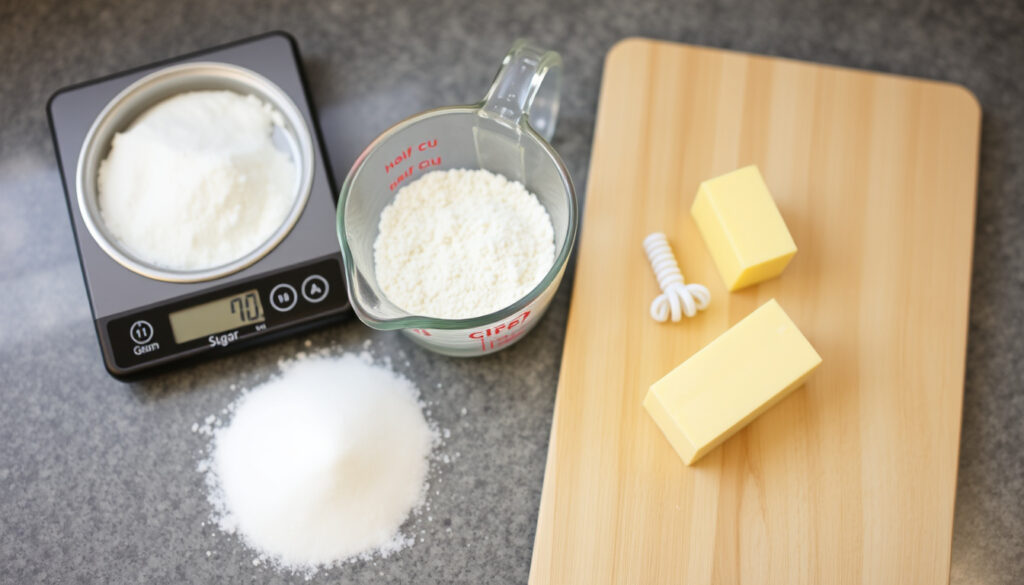
1/2 Cup in Grams: Butter, Flour, Sugar Conversion Guide
Anyone who’s baked more than a few recipes knows the frustration of looking at a half-cup measurement and wondering exactly how many grams that actually is. The short answer: it depends on what you’re measuring. This guide breaks down the exact gram weights for flour, sugar, butter, water, and more, so you can bake with confidence — no more guessing.
1/2 cup all-purpose flour: 60–65 grams ·
1/2 cup granulated sugar: 100 grams ·
1/2 cup butter (1 stick): 113 grams ·
1/2 cup water: 120 grams ·
1/2 cup whole milk: 122 grams
Quick snapshot
- 1/2 cup all-purpose flour = 60–65 g (OvenMath baking conversion chart)
- 1/2 cup granulated sugar = 100 g (OvenMath)
- 1/2 cup butter = 113 g (1 stick) (OvenMath)
- Exact weight of sifted flour can vary 10–20% depending on method
- Brown sugar weight depends heavily on packing (lightly vs firmly packed)
- US cup (236 ml) vs UK/AU cup (250 ml) adds confusion
- When baking, use a scale — cup measurements can be off by 20% (Thrice baking guide)
- For everyday cooking, cup approximations are fine (Thrice baking guide)
- Invest in a digital kitchen scale for consistent results
- Use ingredient-specific conversion tables (like the one below)
The snapshot above shows the key conversions at a glance.
| Ingredient | 1/2 cup (grams) | Notes |
|---|---|---|
| All-purpose flour (spooned & leveled) | 60–65 g | Higher if scooped — up to 75 g |
| Whole wheat flour | ~70 g | Heavier than AP flour |
| Cake flour | ~55 g | Lighter, finer texture |
| Granulated sugar | 100 g | Standard white sugar |
| Brown sugar (packed) | 110 g | Firmly packed |
| Powdered sugar | 60 g | Unsifted |
| Butter (1 stick) | 113 g | Also equals 8 tbsp |
| Water | 120 g | Density ~1 g/ml |
| Whole milk | 122 g | Slightly denser than water |
| Honey | ~170 g | Much heavier than water |
Four ingredients, one pattern: the weight of half a cup varies by more than a factor of three — from 55 g for cake flour to 170 g for honey. Always check the ingredient before relying on a generic conversion.
What’s 1/2 cup in grams?
1/2 cup butter in grams
- 1/2 cup butter = 113 grams = 1 stick (OvenMath baking conversion chart)
- Sally’s Baking Addiction PDF lists 1/2 cup butter as 115 g, a rounding difference (Sally’s Baking Addiction official weight chart)
- Cafe Fernando conversion table shows 1 stick = 115 g (Cafe Fernando cooking conversion table)
The implication: most US baking sources agree on 113 g per stick, but a few round up to 115 g. The difference (2 g) is negligible for most recipes, but if precision matters, follow your recipe’s source.
1/2 cup sugar in grams
- Granulated sugar: 1/2 cup = 100 g (OvenMath; CoolConversion baking chart)
- Brown sugar (packed): 1/2 cup = 110 g (OvenMath)
- Powdered sugar: 1/2 cup = 60 g (OvenMath)
The catch: sugar is the most consistent ingredient — 100 g for granulated holds across nearly every source. Brown and powdered sugars vary because of packing and air content.
1/2 cup water in grams
- Water: 1/2 cup = 120 g (based on 240 ml per cup at Weekend Bakery conversion tools)
- Whole milk: 1/2 cup = 122 g (slightly denser)
- Honey: 1/2 cup ≈ 170 g (varies by brand)
Why this matters: water is the reference point — 1 ml = 1 g. Milk and honey are denser, so half a cup weighs more. For liquids, a kitchen scale is still more accurate than a liquid measuring cup for sticky ingredients like honey.
Is 100g a half a cup?
Is 50g 1/2 cup?
- 50 g is not a standard half cup for most ingredients
- For all-purpose flour, 50 g is roughly 1/3 cup (Baking Like a Chef conversion guide)
- For granulated sugar, 50 g is about 1/4 cup
The pattern: only powdered sugar (60 g per 1/2 cup) comes close to 50 g. Most other ingredients are heavier.
Is 250g the same as 1/2 cup?
- No — 250 g is about 2 cups of all-purpose flour (Thrice baking guide)
- 250 g of granulated sugar is 1.25 cups
- 250 g of butter is slightly more than 2 sticks (about 1 cup + 1 tbsp)
The implication: if a recipe says “250 g flour”, do not substitute 1/2 cup — you’ll end up with far less flour. Always use the gram weight specified.
Is 250g 1 cup of flour?
Is 1 cup of flour 100 grams?
- No — 1 cup of all-purpose flour is generally 125 g (spooned & leveled) (CoolConversion data; Thrice)
- Some sources list 120 g per cup (Baking Like a Chef)
The catch: the “100 g per cup” myth likely comes from recipes using sifted flour or metric cup conventions (250 ml vs 240 ml).
Is 1 cup of flour 500g?
- No — 500 g is approximately 4 cups of all-purpose flour (Cafe Fernando conversion tables)
- Confusion arises when recipes use “cup” for different volume standards
The trade-off: using 500 g when a recipe calls for 1 cup would multiply the amount by 4x. Always check whether your source uses US customary cups or metric cups.
How to measure 250g of flour without a scale?
- Use the spoon-and-level method: Spoon flour into a dry measuring cup, then level off with a knife. This avoids packing.
- Convert cup measurement: Since 1 cup (spooned & leveled) = ~125 g, 250 g equals 2 cups.
- Use a household alternative: A standard coffee mug holds about 1.5 cups; fill it until it reaches the 2-cup volume mark for ~250 g.
What this means: without a scale, you can get close — but expect 10–15% variation. For sensitive recipes (like macarons or chiffon cake), a scale is non-negotiable.
How do I convert grams of flour to cups?
Conversion chart for flour grams to cups
- General formula: grams ÷ density (g per cup) = cups
- All-purpose flour density: ~125 g per cup
- Whole wheat flour: ~130 g per cup
- Bread flour: ~127 g per cup (Scale Recipe converter)
Common conversions
- 50 g flour = 0.4 cups (about ⅓ cup)
- 100 g flour = 0.8 cups (about ¾ cup + 2 tbsp)
- 250 g flour = 2 cups
- 500 g flour = 4 cups
The pattern: once you know the density of your specific flour, converting grams to cups is straightforward. But note that different flour brands and types have slightly different densities.
The takeaway: stick to one trusted source for your conversions to avoid variability.
Spec table: 1/2 cup weights for common baking ingredients
Seven ingredients, one pattern: density dictates weight. The table below summarises half-cup weights for the most common baking pantry items.
| Ingredient | 1/2 cup (grams) | Density (g/ml) |
|---|---|---|
| All-purpose flour | 60–65 | 0.51–0.55 |
| Granulated sugar | 100 | 0.85 |
| Butter | 113 | 0.96 |
| Water | 120 | 1.00 |
| Whole milk | 122 | 1.03 |
| Honey | 170 | 1.42 |
| Almond flour | ~55 | 0.46 |
The implication: if you know the density, you can calculate any volume-to-weight conversion. For everyday baking, memorise the top three (flour, sugar, butter) and you’ll be covered for most recipes.
A 10-gram error in flour can turn cookies from chewy to cakey. Home bakers who weigh ingredients report more consistent results than those who use cups. The scale — not the cup — is the real game-changer in kitchen accuracy.
Even “standard” cup-to-gram charts disagree by 5–15% on some ingredients. Compare three authoritative sources and you’ll see variation: OvenMath says 60 g per 1/2 cup of flour; Baking Like a Chef says 62.5 g; Cafe Fernando says 70 g. Pick one source and stick with it for consistency.
Clarity section
Confirmed facts
- 1 cup all-purpose flour = 125 g (spooned and leveled) — multiple sources (OvenMath; Thrice)
- 1 stick butter = 1/2 cup = 113 g (CoolConversion)
- 1 cup granulated sugar = 200 g, so 1/2 cup = 100 g (OvenMath)
What’s unclear
- Exact weight of sifted flour: can differ 10–20% from unsifted (Thrice)
- Brown sugar weight depends on packing method (loose vs packed can vary 15%)
- US cup (236 ml) vs metric cup (250 ml) creates discrepancies — some UK sources list 1/2 cup as 120 g for water, which matches metric cup volume (Weekend Bakery uses 240 ml per cup)
These clarifications help you decide when to trust a specific conversion and when to adjust.
Quotes from expert sources
“For all-purpose flour, 1 cup weighs 125 grams.”
— Allrecipes.com conversion chart, a trusted resource for home bakers
“A US cup is 240 millilitres. Use this as the basis for converting cups to grams for all dry ingredients.”
— Doves Farm conversion table, a UK flour mill known for precise baking guides
“If you need to convert any ingredient from cups to grams, you can use our interactive converter. But remember: generic converters don’t account for packing or sifting.”
— The Calculator Site kitchen conversion tool, a popular reference for home cooks
These expert voices reinforce the core message: consistency and source reliability matter.
Summary
For anyone who bakes regularly, the difference between 60 g and 70 g of flour is the difference between a tender biscuit and a dense rock. The half-cup measurement is a trick of volume, not mass. The only reliable solution is a digital scale — under $20 and accurate to 1 g. For home bakers, the choice is clear: weigh your ingredients, or accept inconsistent results. For recipe developers, the responsibility is even greater: always provide gram weights alongside cups to remove the guesswork entirely.
Related reading: Self Raising Flour Recipe: Ratio & Grams Guide
egglesscooking.com, coolconversion.com, ovenmath.com, gramstocups.io, flourwise.com
Frequently asked questions
Is a US cup the same as a UK cup?
No — a US customary cup is 236.6 ml (often rounded to 240 ml), while a UK (metric) cup is 250 ml. This means a UK half-cup will weigh slightly more for water (125 g vs 120 g).
How many grams in 1/2 cup of oats?
Rolled oats: 1/2 cup weighs about 45–50 g. Steel-cut oats: about 55–60 g.
Can I use a liquid measuring cup for dry ingredients?
Technically yes, but it’s less accurate. Dry measuring cups allow you to level off excess, while liquid cups leave headroom that makes leveling difficult.
Why do different sources give different gram values for the same ingredient?
Differences arise from measuring method (scoop vs spoon-and-level), cup standard (US vs metric), and how tightly the ingredient is packed. Always follow the method used by the source you trust.
Does 1/2 cup of brown sugar weigh the same as white sugar?
No — brown sugar is denser when packed. 1/2 cup packed brown sugar weighs ~110 g, while 1/2 cup granulated white sugar weighs 100 g.
How many grams in 1/2 cup of almond flour?
Almond flour is light — 1/2 cup weighs about 55 g. It can vary by brand based on how finely it’s ground.
What is the weight of 1/2 cup of honey?
Honey is very dense: 1/2 cup weighs approximately 170 g. Because it’s sticky, using a scale with a tare function is much easier than trying to scrape out a measuring cup.
More related posts
 How Old Is Brad Pitt – Age, Height, Family, Career Facts
 How Did Charlie Kirk Die? Assassination, Cause, and Confusion
 Silver Ferns vs Australia: Schedule, Results & Rivalry
 TV Technician Near Me: Dublin Repair Costs Guide
 Disabled Line Marking Wellington: NZS 4121 Standards & Costs
 Kāinga Ora Cambridge Tenant Eviction: Rights & Case Study
 Nelson Breaking News Today: Latest Updates from Tasman Region
 Best Oil Spray Bottle NZ: 2025 Buying Guide
