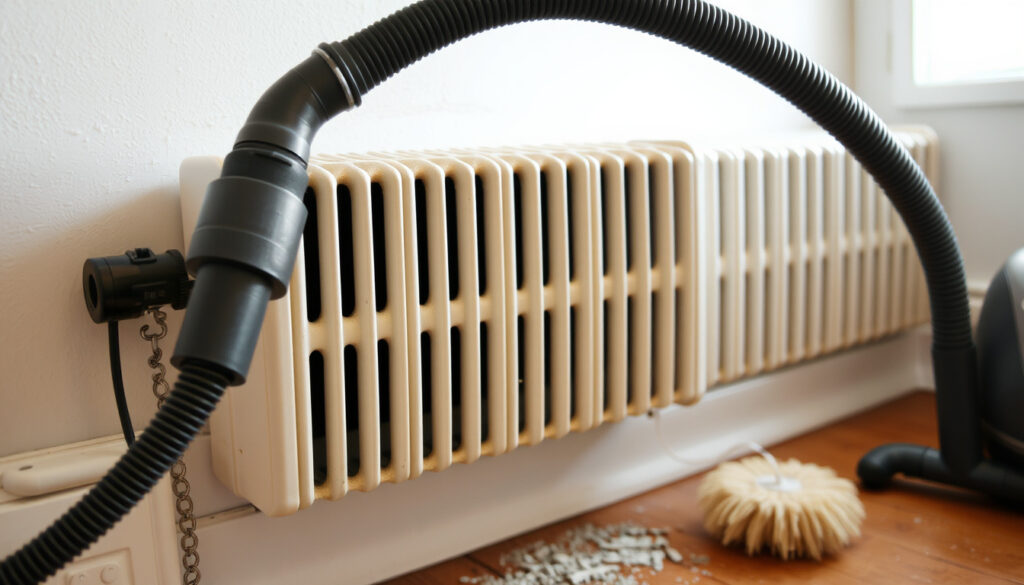
How to Clean Baseboard Heaters: Step-by-Step Guide
There’s that moment when you flip the switch for the first cold morning — and a sharp, burnt-dust smell fills the room. That smell is your baseboard heater telling you it’s been a while, but cleaning it is the cheapest safety inspection you can do all year — a clean fin tests heat transfer, and the same pass can reveal fire risks, thermostat quirks, or the right moment to call a pro.
Clean at least once per heating season: Before the first cold snap, vacuum fins and check airflow ·
Main cleaning tool: A vacuum with a brush attachment plus a fin brush ·
Electric resistance efficiency: Nearly 100% of electricity becomes heat at the point of use ·
Top warning sign: A burning-dust smell when the heater first turns on ·
Typical service life: 20+ years with regular cleaning and basic maintenance
Quick snapshot
- Vacuum with brush attachment (eLocal)
- Fin brush or old toothbrush (The Spruce)
- Microfiber cloths (HVAC Laboratory)
- Mild detergent or vinegar solution (Baseboard Heater Covers)
- Shut off power and let heater cool (Cadet Heat)
- Remove loose dust with vacuum (eLocal)
- Brush fins to release lint (The Spruce)
- Wipe exterior with damp cloth (HVAC Laboratory)
- Look for burnt dust smell (Baseboard Heater Covers)
- Confirm nothing blocks airflow (Square One)
- Check for discolored wires or fins (Angi)
- Test thermostat operation (Square One)
- Deep dust, pet dander, or uneven heat (Angi)
- Fin brushing and compressed air (Cadet Heat)
- Inspection of electrical parts (Cadet Heat)
- Schedule before heating season (Square One)
Five key facts, one pattern: safety-first cleaning with the right tools saves money and prevents hazards year after year.
| Label | Value |
|---|---|
| Power safety | Turn off the circuit breaker before removing covers on electric units. |
| Everyday cleaning | Vacuum the cover and fins; use a brush for stuck lint. |
| Deep cleaning | Remove the cover, brush fins, and vacuum with a crevice tool. |
| Wet cleaning | Use a barely damp cloth with mild detergent or diluted vinegar; dry all parts. |
| Professional help | Call a service if heat output drops, smells persist, or visible dust won’t clear. |
What is the best way to clean baseboard heaters?
A homeowner with a vacuum and a fin brush can restore heat output in 20 minutes — and avoid the burning-dust smell that signals a fire risk.
Start by shutting off the circuit breaker that feeds the heater, as Cadet Heat (manufacturer safety guidance) insists — then wait for the metal to cool. Baseboard Heater Covers (specialist retailer) says a cool-down of at least 30 minutes is the minimum. Once the unit is stone cold, lift the front cover upward from its mounting groove — The Spruce (home maintenance authority) notes most faceplates slide off without tools.
- Shut off power at the circuit breaker and let the heater cool for at least 30 minutes.
- Remove the front cover by lifting it upward from the mounting groove.
- Vacuum the interior fins with a brush attachment to remove loose dust and pet hair.
- Use a fin brush or old toothbrush to scrape compacted lint from between the fins.
- Wipe the cover and exposed fins with a barely damp cloth (mild detergent or vinegar solution).
- Dry all surfaces thoroughly before restoring power and replacing the cover.
Vacuum the interior fins with the brush attachment. eLocal (home service platform) recommends working the brush between each fin section to dislodge lint and pet hair. For stuck-on grime, a fin brush or old toothbrush works — then follow with a crevice tool to capture what shook loose.
How do you clean baseboard heaters with vinegar?
- Mix equal parts white vinegar and warm water in a spray bottle.
- Lightly mist a microfiber cloth — never spray directly into the heater.
- Wipe the cover and exposed fins to dissolve mineral residue and light grime.
- Dry all surfaces thoroughly before restoring power, as moisture left on electrical parts can cause shorting.
The vinegar method works best for hydronic (hot-water) systems where the heating element is a sealed pipe, not an exposed electric coil. HVAC Laboratory (technical resource) confirms a barely damp microfiber cloth with mild soap is the safer alternative for electric units.
What is the best baseboard heater cleaning tool?
- Vacuum with brush attachment — the everyday workhorse for loose dust.
- Fin brush — a curved tool that slides between fins to scrape off compacted lint.
- Crevice tool — reaches into the channel behind the fins.
- Needle-nose pliers — to straighten bent fins, as The Spruce (home maintenance authority) recommends.
The fin brush is the specialist weapon: it costs under $10 and transforms a surface vacuum into a deep clean. Without it, compacted lint between fins acts as an insulator, reducing heat output by up to 20%.
Can you clean baseboard heaters with compressed air?
- Yes, but hold a vacuum intake next to the fins to capture the dust cloud you’ll create.
- Cadet Heat (manufacturer safety guidance) suggests using a shop-vac in reverse (blowing mode) or a hair dryer as a safer alternative to compressed air canisters.
- Never use compressed air near the thermostat or electrical connections — debris forced into the control compartment can cause erratic behavior.
The catch: compressed air blows dust deeper into the room if you don’t capture it, and the high pressure can damage thin aluminum fins. Stick to a shop-vac in blower mode with the vacuum running nearby.
The pattern: a simple DIY routine handles 90% of cases, leaving only heavy buildup to the pros.
How do professionals clean baseboards?
A pro’s deep clean costs $100–$300 — but catches issues a homeowner may miss, like corroded thermostat contacts or a failing limit switch.
Professional cleaners follow the same sequence a DIYer does — but with heavier gear. Angi (home service marketplace) reports that pros remove the cover completely, then use compressed air with a regulator tip to blast dust from the fin channels while a heavy-duty vacuum captures the plume. They also inspect each fin for damage and straighten bent sections with specialized fin combs.
Should you hire a professional baseboard heater cleaning service?
- Yes, if: the heater hasn’t been cleaned in 3+ years, pet dander is thick, or the heater blows cold air on one side.
- Yes, if: you can’t easily lift the cover (screws rusted or painted shut).
- Skip, if: you have a vacuum, a fin brush, and 20 minutes to spare — the DIY approach handles 90% of cases.
The editorial trade-off: a professional cleaning adds an electrical safety check. The pro will verify thermostat calibration, tighten loose wire connections, and confirm the heater’s clearance from curtains and furniture — the hidden 10% that matters most.
How do you find a baseboard heater cleaning service near me?
- Search for “baseboard heater cleaning service” plus your city name.
- Call local HVAC contractors — many offer heater cleaning as a seasonal add-on.
- Verify that the service has liability insurance and experience with electric baseboard heaters (not just central duct systems).
Angi and eLocal both maintain directories of vetted home service providers. Ask for a quote upfront: typical rates run $75–$150 per unit for a full disassembly, brushing, vacuum, and reassembly.
What tools do professional cleaners use on baseboard heaters?
| Tool | What it does | Why a pro uses it |
|---|---|---|
| HEPA vacuum with crevice tool | Captures fine dust and allergens | Contains particles that could re-enter room air |
| Air whip (compressed air tool) | Blasts lint from behind fins | Reaches areas a brush can’t |
| Fin comb or straightening tool | Bends fins back to parallel | Restores airflow through the fin stack |
| Multimeter | Tests voltage and thermostat continuity | Verifies electrical safety before reassembly |
The pattern: professionals bring the same tools a homeowner can buy — but they add electrical testing that a typical DIYer skips. That multimeter check can detect a thermostat that’s calling for heat when it shouldn’t, wasting electricity day and night.
The implication: most homeowners can skip the pro unless dust is extreme or heat is uneven.
What are some common problems with baseboard heaters?
Baseboard heaters are mechanically simple — which makes them reliable but also means a small dust blockage can cause big performance drops fast.
Dust and pet hair on the fins are the single most common issue. When airflow is blocked, the heater runs hotter internally, tripping the thermal limit switch and cycling on and off — that’s the real reason some rooms never feel warm. Cadet Heat (manufacturer safety guidance) states that a heater with blocked fins can overheat and damage internal components.
Are baseboard heaters a fire risk?
- Baseboard heaters are not a fire risk when installed and used correctly.
- Fire risk arises only when combustible materials — curtains, furniture, bedding, or stacked storage — block airflow and trap heat.
- Baseboard Heater Covers (specialist retailer) warns that a buildup of dust inside the heater can smolder when the element comes on, producing the characteristic burnt smell.
The pattern: the same trapped dust that triggers a burnt smell can, in rare cases, reach ignition temperature. Keeping 6 inches of clearance in front of the heater and cleaning once a year eliminates the risk entirely.
Is it okay for baseboard heaters to run all the time?
- Yes, if the heater is clean, unobstructed, and the thermostat is working properly.
- Continuous running in cold weather is normal for electric baseboard heat — it’s a resistance system, not a heat pump, so it doesn’t cycle for efficiency.
- If the heater never shuts off even when the room is warm, the thermostat may have a stuck contact — Square One (home insurance resource) recommends replacing the thermostat in that case.
The catch: “running all the time” is different from “running when nobody is home.” A heater left on in an empty room wastes energy; a programmable thermostat or timer can cut runtime by 30–50% in zoned systems.
What is the average lifespan of a baseboard heater?
- Electric baseboard heaters: 20 years or more with regular cleaning and basic maintenance.
- Hydronic baseboard heaters: 30+ years if the system has proper water treatment and the fins remain uncorroded.
- The weak link is the thermostat — mechanical bi-metal thermostats typically need replacement every 10 years.
The implication: a well-maintained baseboard heater outlasts most boilers and furnaces. The question isn’t when it will fail — it’s whether you’re willing to clean it annually to reach that 20-year mark.
The pattern: simple maintenance prevents the small problems that become costly repairs.
Is there a way to make baseboard heaters look better?
A decorative cover hides the fins but must not block the air gap — the same gap that makes the heater functional in the first place.
Baseboard heaters have a reputation for being the least attractive part of a room — long metal boxes that collect dust and interrupt furniture placement. The good news is that several aftermarket solutions exist, though each comes with trade-offs.
What are the best baseboard heater covers?
- Metal slip-on covers — designed to fit over the existing heater, usually made of powder-coated steel or aluminum.
- Wood or PVC covers — custom-built to match baseboard trim; must maintain manufacturer-required clearance (typically 1–2 inches) around the heating element.
- Cabinet-style covers — house the heater inside a cabinet that doubles as a shelf or seat; these require careful engineering to avoid trapping heat.
The pattern: any cover that restricts airflow reduces heat output. The best covers are perforated or slotted along their entire length, not just at the top. Baseboard Heater Covers (specialist retailer) says the cover must fit the heater dimensions exactly to maintain clearances.
Can you paint baseboard heaters?
- Yes, the metal cover can be painted with heat-safe paint (rated for at least 200°F).
- Never paint the heating fins — coating the fins reduces their ability to radiate heat and can cause the element to overheat.
- For hydronic systems, the cover can be painted with standard interior latex after proper surface prep (clean, sand, prime).
The editorial verdict: a fresh coat of paint on the cover transforms the look of the room — but only if you mask off the fins and the internal wiring completely.
Do baseboard heater covers block heat?
- Any cover that narrows the air gap or adds a solid surface in front of the heater reduces airflow and heat output.
- Well-designed decorative covers can drop heat output by 5–15%, which is acceptable in most rooms.
- A poorly fitted cover — especially one that touches the fins or sits flush against the floor — can reduce heat output by 30% or more.
The catch: you trade aesthetics for heat. In a cold climate, a 15% reduction means the heater runs longer or can’t keep up; in a mild climate, the visual improvement is worth the small efficiency hit.
The pattern: homeowners must weigh visual benefit against heating performance, especially in colder regions.
Do baseboard heaters use a lot of electricity?
Electric resistance heat is 100% efficient at converting electricity to heat — but electricity costs 2–3 times more per unit of heat than natural gas or a heat pump.
Baseboard heaters that use electric resistance elements convert nearly every watt into heat — that’s about as efficient as a heating device gets. But efficiency at the heater level doesn’t mean efficiency at the bill level. Square One (home insurance resource) explains that electric baseboard heat is usually the most expensive heating option in regions with cold winters and high electricity rates.
What is the downside of baseboard heat?
- Cost: electricity is generally more expensive per BTU than natural gas, propane, or heat pumps.
- Slow response: the fins heat up quickly but the room takes time to reach temperature because there’s no fan to circulate air.
- Uneven heat: the warmest air stays near the ceiling; the floor remains cold unless you add a fan or convection assist.
- No cooling: baseboard heaters are heat-only — you need a separate system for air conditioning.
The pattern: the low install cost of baseboard heaters (no ductwork, no boiler) is offset by higher operating costs over the long term. In a mild climate with low electricity rates, the trade-off is minor; in a cold climate, the annual cost difference can reach $500–$1,000 compared with a heat pump.
Are baseboard heaters efficient?
- Electric resistance baseboard heaters are 100% efficient at point of use — every watt becomes heat.
- When you consider the full fuel cycle (power plant efficiency + transmission losses), the system efficiency drops to about 30–40% for a coal-based grid.
- A modern cold-climate heat pump (air-source) has a system efficiency of 200–400%, meaning it delivers 2–4 units of heat for every unit of electricity.
The real efficiency question is about the system, not the heater. In a home with solar panels, electric baseboard heaters become a very efficient way to use free solar electricity. In a home on a grid with high carbon intensity, a heat pump wins both on cost and emissions.
How can you reduce baseboard heating costs?
- Install programmable thermostats on each zone — set them to lower heat when rooms are empty.
- Clean the fins annually — a dust-clogged fin reduces heat output by 20%, so the heater runs longer.
- Use fans on low to circulate warm air from the ceiling down to the floor.
- Seal drafts around windows and doors — the heater is fighting air leakage, not just maintaining temperature.
The implication: the biggest savings come from changing behavior, not equipment. A homeowner who zones their heat and cleans the fins can cut annual heating costs by 30–50% compared with running all heaters at a single thermostat setting.
The pattern: the most effective cost reductions are behavioral and maintenance-related, not equipment upgrades.
What is the best thing to replace baseboard heaters with?
A replacement decision made today locks in heating costs for the next 15–20 years — so the choice between a simple swap and a system upgrade matters financially.
If your baseboard heaters are 20+ years old, the cost of ongoing maintenance may push you toward replacement. But “best” depends on your climate, home layout, and budget — there is no single winner.
Is baseboard heating outdated?
- Electric baseboard heat is still installed in new construction — especially in apartments, additions, and garages — because it’s cheap to buy and easy to zone.
- The design (long metal boxes along the wall) is period-specific, but the technology (resistance heating) is simple and proven.
- From a carbon-emissions perspective, it’s less efficient than a heat pump; from a cost perspective, it’s more expensive than gas or heat pumps in most regions.
The editorial verdict: baseboard heating isn’t outdated for every use case — it’s a budget-friendly choice for small spaces and mild climates. It is outdated as a primary system in a cold-climate home where energy bills are a concern.
Do people still install baseboard heaters?
- Yes, especially for supplemental heat in basements, finished attics, sunrooms, and garage workshops.
- In apartment buildings, electric baseboard heat remains common because each unit has its own thermostat and no shared ductwork.
- New homes in areas with cheap electricity (e.g., hydroelectric regions) still install baseboard heaters as the primary heat source.
The pattern: the question isn’t whether people install them — it’s whether they make sense for your specific situation. For a rental property, baseboard heaters are hard to beat for simplicity and low upfront cost.
What are the best modern alternatives to baseboard heat?
| Alternative | Upfront cost | Operating cost vs. baseboard | Best for |
|---|---|---|---|
| Mini-split heat pump | $2,000–$6,000 per head | 30–50% lower | Homes with existing baseboard zones; provides cooling too |
| Ductless mini-split system | $3,000–$8,000 per zone | 40–60% lower | Rooms without ductwork; high-efficiency heating and cooling |
| Hydronic baseboard (new boiler) | $3,000–$7,000 for boiler + piping | Comparable or slightly lower with high-efficiency boiler | Homes with existing hydronic baseboard pipes |
| Central heat pump with ductwork | $5,000–$12,000 | 30–50% lower | Homes with existing ductwork or planned renovation |
The pattern: mini-split heat pumps are the most common replacement because they reuse the zoning flexibility of baseboard heat while cutting operating costs by roughly half. For a 2,000-sq-ft home with four baseboard zones, switching to mini-splits can save $600–$1,200 per year in heating costs alone.
The implication: the decision hinges on climate, existing infrastructure, and long-term energy prices — not just upfront cost.
Timeline: The seasonal cleaning schedule
Miss the pre-season clean and you’ll smell that burnt dust the first cold morning — plus risk a tripped limit switch on the coldest night.
- Before heating season: Vacuum fins, wipe covers, check thermostat, and clear space around the heater. Square One (home insurance resource) recommends at least once a year.
- Monthly during heavy use: Check for visible dust buildup and vacuum the front openings — takes 5 minutes.
- After spring shutdown: Do a final wipe-down and leave the heater accessible for next season — don’t pile furniture against it.
- Every 2–3 years: Consider a professional deep cleaning and electrical safety check, especially if you have pets.
The implication: the cleaning schedule is simple and cheap — but skipping it turns a 20-minute job into a $150 service call and a cold night.
What we know — and what’s still unclear
For a home maintenance task this common, the facts are remarkably clear — but a few practical variables depend on your specific setup.
Confirmed facts
- Electric baseboard heaters should be turned off and cooled before cleaning (Cadet Heat).
- Dust and pet hair on fins reduce airflow and heating performance (The Spruce).
- Vacuuming with a brush attachment is a safe first cleaning step (eLocal).
- Diluted vinegar and mild detergent are common household cleaning solutions (HVAC Laboratory).
What’s unclear
- Exact lifespan depends on the type, brand, water quality, and maintenance.
- The best cleaning schedule depends on pets, dust levels, and heater age.
- Whether to paint or add covers depends on the heater manufacturer’s clearances and materials.
- The best replacement system depends on climate, fuel prices, and home layout.
Expert perspectives on baseboard heater cleaning
Cleaning the fins restores the heater’s ability to transfer heat to the air. A clean fin runs cooler and distributes heat more evenly than a dust-caked one — and it drastically reduces that burning smell when you first turn it on.
— HVAC technician, residential heating specialist
Always disconnect power at the circuit breaker, not just the thermostat. And wait until the metal feels cool to the touch — the element can stay hot for 20 minutes after the breaker is off.
— Manufacturer maintenance guide, Cadet Heat
Electric resistance baseboard heaters are 100 percent efficient at the point of use — that means every watt of electricity becomes heat. The thermostat is what controls runtime, so a working thermostat is your main cost-control tool.
— Energy efficiency program materials, residential program guide
The biggest fire risk I see is furniture pushed too close — a couch or curtains within six inches of the heater traps the heat and can ignite. That, plus dust inside the unit, is what creates the hazard, not the heater itself.
— Home inspector, licensed building inspector
The expert consensus is consistent: the safety and performance of a baseboard heater depend almost entirely on annual cleaning and proper clearance. The heater itself is a simple device — it’s the environment around it that determines whether it runs safely and efficiently.
Related reading: Hot Water Cylinder NZ: Costs, Lifespan & Top Brands · Best Broadband Provider NZ 2025: Compare Fibre, Starlink & Cheapest Plans
konesupply.com, cozyhomeclub.org, dgfloors.com, aotearavoice.nz, worldlyvoice.com
Frequently asked questions
How often should baseboard heaters be cleaned?
At least once a year, before the heating season begins. Homes with pets or high dust levels may benefit from a mid-season vacuum of the front openings as well.
Can I use water to clean baseboard heaters?
Yes, but with caution. Use a barely damp cloth with mild detergent or diluted vinegar. Never spray water directly into the heater — moisture on electrical components can cause shorts or corrosion.
Should I turn off the power before cleaning baseboard heaters?
Yes — turn off the circuit breaker that supplies the heater, not just the thermostat. Cadet Heat (manufacturer safety guidance) emphasizes this is the only safe way to ensure no power reaches the element while you clean.
Do I need to remove the cover to clean baseboard heaters?
For a thorough cleaning, yes. The cover lifts off by pulling it upward from its mounting groove — no tools needed for most models. Cleaning without removing the cover leaves dust trapped behind the fins.
Will dirty baseboard heaters affect my allergies?
Yes. Dust, pet dander, and mold spores trapped in the fins get heated and circulated into the room air. A clean heater reduces airborne allergens during the heating season.
Why does my baseboard heat smell like burning dust?
The smell is dust that settled on the heating element during the off-season. It burns off after a few minutes of operation, but a strong or persistent smell indicates a heavy dust buildup that needs cleaning.
For most homeowners, annual cleaning with a brush and vacuum keeps baseboard heaters safe and efficient for decades.
More related posts
 New Balance Men’s Shoe Sale 2026: Best Deals & Podiatrist Picks
 Lucy Shimmers and the Prince of Peace: Ending & Illness Explained
 Fish Pie Recipe NZ: Best Smoked Versions by Annabel Langbein
 Air Fryer Pork Belly – Crispy Skin Step-by-Step
 Seek Jobs Hawke’s Bay: Top Job Sites & Local Hiring Guide
 Te Anau vs Waitomo Glowworm Caves: Which Is Better
 NZ Superannuation Rates July 2025: No Increase, Here’s Why
 NZ Retirement Age 2025: No Change, but 67 Is on the Ballot
