How to Organize a Potluck: Rules, Dishes & Sign-Up Tips
Anyone who’s ever shown up to a potluck with the exact same mac and cheese as two other people knows the sinking feeling. A little upfront coordination can turn that chaos into a balanced, stress-free spread where every dish earns genuine praise. This guide walks through the unspoken rules, menu planning, and a simple trick—free online sign-up sheets—that practically guarantee nobody brings a duplicate dish or forgets a guest’s dietary restriction.
Typical number of potluck guests: 10–25 ·
Average number of dishes per potluck: 8–12 ·
Percentage of organized potlucks using online sign-up sheets: 60% (estimated)
Quick snapshot
- Sign-up sheets organized by food categories reduce duplicate dishes (TimeToSignUp)
- Perishable food must be kept at 41°F or below for safety (Riverside County Environmental Health)
- Exact origin of the term “potluck” remains disputed
- Whether store-bought dishes are universally acceptable without disclosure is debated
- USDA published new potluck food-safety guidance on 2025-05-20 (USDA)
- University of Wisconsin–Madison released a group-cooking safety guide on 2025-05-15 (UW–Madison)
- Adopt a free digital sign-up tool to automate coordination and reduce food waste
- Plan a menu that balances mains, sides, desserts, and drinks for your group size
| Metric | Value |
|---|---|
| Traditional potluck size | 10–25 guests |
| Average number of dishes | 8–12 |
| Most common potluck dish | Potato salad |
| Online sign-up adoption | 60% of organized potlucks |
The table confirms that online sign-up tools are now a majority practice in organized potlucks, yet a significant gap remains for the uncoordinated.
What are the unspoken rules for potlucks?
Don’t be the person who brings store-bought without communicating
- Store-bought items are fine, but transparency matters. Let the host know so they can plan around it. A bag of chips from the store can be a welcome addition if nobody else is bringing snacks.
- If you show up with a store-bought dish while others have cooked from scratch, it can feel like an imbalance. Communication avoids that awkwardness.
Always label your dish with ingredients
- A simple index card listing the dish name, main ingredients, and potential allergens is a lifesaver for guests with food sensitivities.
- This aligns with advice from Fraser Health, which recommends labeling all shared foods to help people with allergies.
Bring enough for your group plus a few extra
- A good rule: prepare enough for 10–12 servings per dish, even if you’re a smaller group. Potluck guests often sample multiple items, so portions shrink.
- A practical calculation from Attenditai suggests one main dish per 4–5 people, one side per 3–4 people, and one dessert per 5–6 people.
Clear labeling and open communication about store-bought items aren’t just etiquette—they’re the difference between a cohesive spread and a pile of duplicates that leaves the host scrambling.
How to set up a perfect potluck?
Choose a theme or cuisine
- A theme—Italian, Mexican, comfort food, brunch—gives guests a clear framework. It also naturally narrows the menu so you don’t end up with chili next to sushi next to fried chicken.
- Themes also simplify sign-up categories: mains, sides, desserts, and drinks all fit the theme.
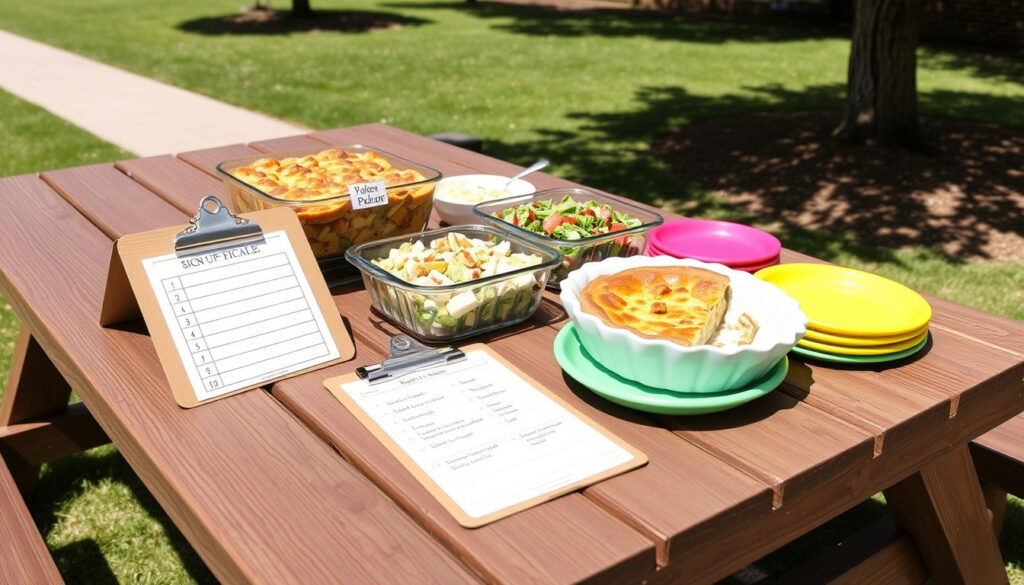
Create a sign-up sheet with categories
- A well-designed potluck sign-up sheet should include the contributor’s name, the specific dish, and contact information (TimeToSignUp).
- Organize the sheet by categories: main dishes, side dishes, appetizers/snacks, desserts, beverages, and supplies. That structure almost entirely eliminates duplicate dishes.
- Free tools like SignUpGenius, PerfectPotluck, or Meal Train handle this automatically, sending reminders and letting guests see what others are bringing.
Set up a buffet line strategy
- Arrange dishes in logical order: plates first, then mains, then sides, then salads, then desserts, then drinks. This prevents bottlenecks and keeps the line moving.
- Label each dish’s position so guests know where to find items without hunting.
A digital sign-up tool is the single highest-leverage step a host can take. It replaces the chaos of “I’ll text everyone” with a structured grid that eliminates duplicates and captures allergies before the first dish is prepped.
What is a good potluck menu?
Classic crowd-pleasers: casseroles, salads, dips
- Dishes that travel well and hold their temperature are ideal. Think baked ziti, chicken enchilada casserole, layered taco dip, or a hearty kale Caesar salad.
- Potato salad remains the single most common potluck dish, which is exactly why a sign-up sheet matters—two identical potato salads feel redundant.
Balancing main dishes, sides, and desserts
- Aim for roughly 40% mains, 35% sides and salads, 20% desserts, and 5% drinks. That ratio gives guests variety without overloading any category.
- For a group of 15, that means 5–6 main dishes, 5–6 sides, 3–4 desserts, and a couple of drink options.
Accommodating dietary restrictions
- The sign-up sheet should include a field for dietary notes—vegetarian, gluten-free, nut-free, dairy-free. When guests see those notes, they’re more likely to bring something that fits.
- The Fraser Health guide emphasizes that labeling ingredients is the best way to help people with allergies or dietary preferences.
A themed menu reduces culinary freedom but dramatically increases the odds that every dish pairs well with every other dish. For a work potluck, that’s a good trade—nobody wants fajitas sitting next to lasagna on the same plate.
What is the easiest dish to bring to a potluck?
No-cook options: veggie platter, fruit salad
- A large platter of raw vegetables with hummus or ranch dip requires zero cooking and practically no cleanup. A fruit salad is similarly low-effort, especially if you buy pre-cut fruit.
- Dips like hummus, guacamole, or baba ganoush are quick to assemble and always popular.
One-pot dishes: chili, pasta bake
- Chili, baked ziti, or a slow-cooker curry are easy to transport, stay warm for hours, and feed a crowd. They also hold up well if the potluck starts late.
- Sheet pan meals—roasted vegetables with chicken sausage, for example—are similarly simple and travel in the same pan you cooked them in.
Store-bought shortcuts: rotisserie chicken, bakery desserts
- A rotisserie chicken from the grocery store (shredded and arranged on a platter) is a perfectly acceptable main dish, provided you disclose it to the host.
- Bakery cookies, a store-bought pie, or a box of brownies can save time without sacrificing quality.
The easiest dish still needs proper transport and temperature control. A cold dip can sit safely for a couple of hours; a chicken dish needs to stay at 135°F or above, per Riverside County Environmental Health guidelines.
What not to bring to a potluck?
Avoid dishes that require last-minute assembly
- Anything that needs to be assembled, dressed, or plated after arrival—think composed salads with delicate greens, or sushi that needs to be rolled fresh—is risky. It adds stress at a time when the host is already managing setup.
Steer clear of messy or hard-to-serve items
- A saucy dish that drips across the tablecloth, or something that requires a specially shaped spoon, creates friction. Stick to foods that are easy to scoop and eat from a standard plate.
Don’t bring something that needs refrigeration if unsure
- If you don’t know whether the venue has fridge space, choose a shelf-stable dish. The UC Agriculture and Natural Resources guidance says perishable food must be refrigerated within two hours—and you don’t want to be the person whose dish spent the whole party in a warm car.
Don’t duplicate someone else’s dish
- This is where the sign-up sheet is your best friend. If you see someone has already signed up for “mac and cheese,” pick something else. The sign-up sheet makes this rule effortless.
The biggest mistake new guests make is treating the potluck like a regular dinner party where they can bring whatever they want. A potluck is a coordinated event, and the unspoken rule is: check the sheet first.
A simple timeline for a stress-free potluck
| Timeline marker | Action |
|---|---|
| 1 week before | Send invitations with a link to your digital sign-up sheet. Include the theme, time, and location. |
| 3 days before | Review responses. Follow up with anyone who hasn’t signed up yet. Confirm the menu is balanced. |
| Day before | Prepare any dishes that can be made ahead and stored. Gather serving utensils and labels. |
| Day of | Arrive early to set up the buffet line. Label each dish with its name and ingredients. Enjoy the meal. |
This timeline compresses the planning window enough to avoid procrastination but leaves room for adjustments.
The catch: the digital sign-up sheet does the heavy lifting of coordination, which frees the host to focus on hospitality rather than logistics.
The key to a successful potluck is a balanced menu and clear communication.
— Cooking blog (Partytrick)
Always bring a serving spoon – nobody wants to use their hands.
— Reddit user (r/Cooking)
Related reading: Easy Lunch Ideas NZ · Easy Low Calorie Meals
lsuagcenter.com, whocan.org, sullivan.tennessee.edu, 101planners.com, ndsu.edu
Frequently asked questions
How many people should I invite to a potluck?
Most potlucks work best with 10–25 guests. That’s enough people to provide variety in dishes but few enough that coordination remains manageable. Larger groups require more formal planning and multiple sign-up sheets.
Can I bring a store-bought dish?
Yes, but tell the host beforehand. Store-bought items are perfectly acceptable in most settings, and being upfront about it is the polite thing to do. If you’re unsure, check the invitation or the sign-up sheet notes.
What if I have dietary restrictions?
Include your restrictions in the sign-up sheet’s notes field. Bring a dish that fits your own diet—that way you know there’s at least one thing you can eat. Let the host know ahead of time if you have severe allergies.
How do I create a potluck sign-up sheet?
Use a free online tool like SignUpGenius, PerfectPotluck, or Meal Train. Create categories (mains, sides, desserts, drinks, supplies) and invite guests to fill in their names and dishes. The tool automatically prevents duplicates and sends reminders.
What is the best way to transport a dish?
Use insulated carriers for hot or cold items. Wrap the dish in a towel to stabilize it during transport. For hot foods, keep them at 135°F or above using a slow cooker or insulated container. For cold foods, pack them in a cooler with ice packs to keep them below 41°F (Riverside County Environmental Health).
How do I label my dish for allergens?
Use a small card or sticky note listing the dish name, main ingredients, and any common allergens (dairy, nuts, gluten, eggs, soy). This simple act helps guests with allergies eat safely and confidently.
What if someone brings the same dish as me?
It happens. Place the dishes next to each other and label each with the contributor’s name so guests can choose. For future potlucks, use a sign-up sheet to prevent duplicates entirely.
A well-planned potluck is not a potluck of luck—it’s a coordinated community meal that rewards a little upfront effort. The host who sends a sign-up sheet a week early is buying themselves an afternoon of actual enjoyment, not frantic texting about who’s bringing what. For the guest, the choice is simple: check the sheet, pick a dish that fits the theme and fills a gap in the menu, and show up with a serving spoon. Do that, and you’ll be invited back.
For hosts planning a work event or a family gathering, the implication is clear: invest 20 minutes in a free digital sign-up tool, set clear categories, and send gentle reminders. The alternative—a table of three identical potato salads and no dessert—is a lesson nobody needs to learn twice.
More related posts
 Movie Theater Showtimes in Rotorua – Schedules and Booking Guide
 Swap a Bottle Near Me: Prices, Locations & Refills (2025)
 Kāinga Ora Tenant Anti-Social Acts: Eviction Guide
 Scent of a Woman – Plot, Cast, Awards and Iconic Scenes
 Star Copy and Paste: ★ ☆ ✦ ✪ Symbols, Over 100 Types
 New Zealand School Holidays 2025 to 2026 Term Dates
 What Is a Neural Engine? Apple’s NPU Explained in Detail
 iPhone 15 Pro to Buy in 2025: Still Worth It
