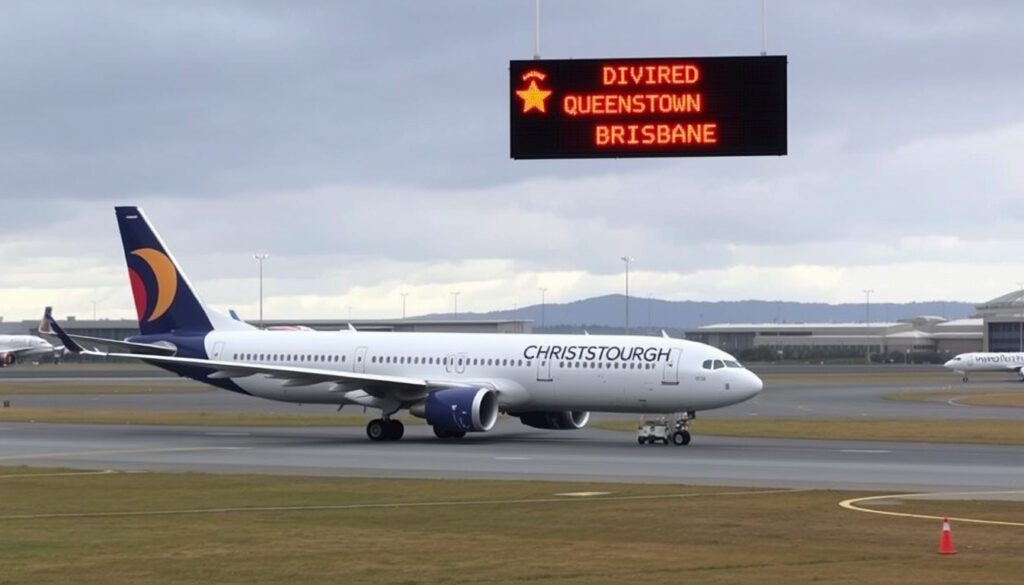
Queenstown to Brisbane Flight Diverted to Christchurch
There’s a particular kind of travel stress that hits when a flight you’d already mentally landed turns out to be going somewhere else entirely. Passengers on Virgin Australia’s VA116 from Queenstown to Brisbane lived that on 18 November 2025, when an engineering issue sent the aircraft to Christchurch instead — and the gap between confirmed facts and passenger accounts left the compensation picture murkier than most travellers expect.
Flight: VA116 · Date: 18 November 2025 · Route: Queenstown (NZQN) → Brisbane (YBBN) · Diverted to: Christchurch (CHC) · Reason: Engineering issue · Outcome: Landed safely; passengers accommodated
Quick snapshot
- VA116 was diverted to Christchurch after an engineering issue; the aircraft landed safely and passengers were accommodated overnight (1News (NZ news outlet)).
- Virgin Australia said it would cover hotel accommodation, meals and transfers in line with its guest compensation policy (Virgin Australia (carrier policy)).
- The exact fault was never disclosed; a passenger said the aircraft would not restart after inspection (The Sydney Morning Herald (Australian news outlet)).
- One passenger alleged that the entire planeload had to arrange accommodation and rebook travel themselves, contradicting the airline’s statement (The Sydney Morning Herald (Australian news outlet)). (The Sydney Morning Herald (Australian news outlet))
- Flight-tracking data showed the aircraft circling at least three times over Fiordland before diverting to Christchurch (1News (NZ news outlet)).
- The flight landed around 7pm local time; the earliest recovery flights were set for Wednesday 19 November (1News (NZ news outlet)).
- Engineering and unscheduled maintenance are treated by the airline as events within its control, which strengthens passengers’ rebooking rights (Virgin Australia (carrier policy)).
- If no suitable alternative is offered, passengers may request a travel credit or refund for the impacted flight (Virgin Australia (carrier policy)).
Seven details define the diversion, one pattern: the operational story stayed stable through the evening, while the passenger experience became the point of contention — and every operational detail below traces to the reporting of 1News (NZ news outlet).
| Detail | Value |
|---|---|
| Flight number | VA116 |
| Airline | Virgin Australia |
| Scheduled departure | Queenstown Airport (NZQN) |
| Scheduled arrival | Brisbane Airport (YBBN) |
| Actual landing | Christchurch Airport (CHC) |
| Reason for diversion | Engineering issue |
| Outcome | Landed safely; passengers accommodated |
Why are flights being diverted?
A diversion is not a failed flight; it is a decision to land short of the destination because continuing would carry more risk. The four triggers are consistent across airlines: weather, technical problems, medical emergencies, and security concerns. VA116 was a technical case — the crew reported an engineering issue and chose Christchurch as the safe option (1News (NZ news outlet)).
Common reasons for diversions
- Technical issues — the broadest category, covering warning indications, system faults and precautionary shutdowns.
- Weather — thunderstorms, crosswinds, low visibility or runway conditions at the destination.
- Medical emergencies — a passenger’s condition deteriorates to the point where time to a hospital matters more than time to the destination.
- Security concerns — the rarest trigger, but the one with the strictest procedures.
Each trigger changes what the airline owes passengers afterward. Weather is generally outside the airline’s control; technical faults are usually treated as within it (Virgin Australia (carrier policy)). That difference decides whether you get rebooked free, refunded, or left to sort it out.
Weather-related diversions
- Thunderstorms can close a runway faster than air traffic control can reroute the incoming flow.
- Strong crosswinds can exceed the aircraft’s certified landing limits, forcing the crew to pick an alternate.
- Low visibility can push an approach below minimums.
Weather diversions are usually quick: the aircraft holds, the weather passes, or the crew diverts to a nearby airport and waits. The passenger disruption tends to be measured in hours, not days.
Technical issues
- A warning light, sensor disagreement or system malfunction is enough for a crew to choose caution.
- Engineering faults are considered within the airline’s control for compensation purposes (Virgin Australia (carrier policy)).
- The threshold for diverting is deliberately low — a precautionary landing beats an in-flight emergency.
That is precisely what happened on VA116: the crew flagged an engineering issue, tracking data showed the aircraft circling as the crew assessed options, and the flight landed safely in Christchurch. The consequence was an overnight stay that nobody on board had planned for.
Medical emergencies
- Airlines carry medical kits, but crew training has hard limits on patient care.
- When a condition escalates, the captain’s priority shifts from schedule to the nearest suitable hospital.
Medical diversions are the least controversial — passengers generally accept them, and airlines usually prioritise getting the patient to care over cost.
The pattern: every diversion is a load-bearing choice, and the airline accepts a real financial hit to avoid a worse outcome. The passenger, however, bears the disruption either way — which is why the compensation rules exist.
What is happening at Brisbane Airport now?
Brisbane Airport never became the centre of this story — VA116 simply did not arrive. The operational impact fell on Christchurch, where the aircraft landed and where Virgin Australia had to organise an overnight recovery (1News (NZ news outlet)). Brisbane’s own operations continued normally, with no reporting in the immediate aftermath tying the diversion to wider delays on the airport’s flight schedule.
Current operations at Brisbane Airport
- VA116 did not land at Brisbane; the aircraft remained in New Zealand overnight.
- The diversion’s knock-on effects were felt in Christchurch, not at Brisbane’s terminals.
- Virgin Australia does not typically operate from Christchurch, which complicated the immediate recovery arrangements (1News (NZ news outlet)).
For passengers waiting in Brisbane, the practical answer is simple: the aircraft never left New Zealand, so the airport itself was never the bottleneck.
Impact of the diversion on other flights
- The aircraft sat in Christchurch overnight, meaning the airline had to arrange a recovery flight rather than a quick turnaround.
- Crew and aircraft resources were tied up in the recovery, pulling them from other parts of the network.
The wider schedule impact stayed small, but the cost of the diversion — hotels, transfers, meals, rebooking — was real, and the airline’s own policy puts those costs on its books for engineering events (Virgin Australia (carrier policy)).
Passenger updates
- Passengers were initially taken to the air bridge while the aircraft was inspected.
- When the aircraft would not restart, they were instructed to return to the terminal (The Sydney Morning Herald (Australian news outlet)).
- Virgin Australia said affected guests would receive hotel accommodation overnight, with meals and transfers covered (Virgin Australia (carrier policy)).
Do you get compensation if a flight is diverted?
Compensation for a diverted flight is not automatic, and the amount depends less on how long you were delayed than on why the diversion happened. For VA116, the key fact is that the disruption was caused by an engineering issue — a category the airline itself treats as within its control (Virgin Australia (carrier policy)).
Compensation under Australian law
- For tickets issued in Australia, Australian consumer law sits above the airline’s own policy and requires the service to be supplied with reasonable care.
- There is no fixed diversion tariff at Australian law; instead, your rights come from consumer guarantees and the airline’s published commitments.
- Virgin Australia’s policy says that for cancellations within its control, passengers are moved to the next available Virgin Australia service to the same destination without charge (Virgin Australia (carrier policy)).
In practice, that policy is the first line of protection for VA116 passengers — it treats engineering issues as airline-controlled events and guarantees rebooking without a fee.
Compensation under New Zealand law
- For a flight departing Queenstown, New Zealand rules apply, and the practical baseline is what the airline has promised in its own policy.
- Virgin Australia’s published commitments for airline-controlled disruptions — hotel accommodation, meals, transfers — align with that baseline (Virgin Australia (carrier policy)).
- The airline said affected guests would receive hotel accommodation, meals and transfers in line with its guest compensation policy (1News (NZ news outlet)).
For VA116 passengers, the practical result was the same on both sides of the Tasman: the hotel, meals and transfers were promised from the start.
When compensation is due
- Within the airline’s control — engineering issues, crew shortages, operational disruptions. Rebooking rights are strongest here.
- Outside the airline’s control — weather, air traffic control actions, security alerts. The airline’s obligations narrow.
- VA116 specifically — unscheduled maintenance and engineering issues are classified by Virgin Australia as within its control.
How to claim
- Keep the boarding pass, booking reference and any written notices from the airline.
- Photograph and itemise receipts for meals, transfers and incidentals.
- Contact Virgin Australia guest care with the flight number VA116 and the date of travel.
- Reference the guest compensation policy if the first response is slow.
- If the airline declines a claim its own policy appears to cover, escalate to the consumer regulator in the country where the ticket was issued.
The trade-off: the airline’s policy reads generously, but passenger accounts from VA116 suggest the airport experience was messier than the policy promises. The gap between policy and frontline reality is exactly where receipts and written records become your best evidence.
What happened during the Qantas Flight 72 incident?
Qantas Flight 72 is the comparison most commentary reaches for when a routine flight turns into a control emergency — and the facts are worth getting straight. In 2008, the flight experienced a sudden pitch-down event mid-route, an uncommanded nose-down movement the crew had to fight to correct. Investigators traced the fault to a software glitch in the aircraft’s flight control computers. Unlike the VA116 diversion, QF72 resulted in injuries.
Overview of Qantas Flight 72
- The event was a sudden, uncommanded pitch-down movement during cruise.
- The incident happened in 2008 and became a landmark case in flight-control safety investigations.
- The aircraft landed safely, but the contrast with VA116 is stark: QF72 involved injuries.
Causes and outcome
- The root cause was traced to a software glitch that fed incorrect data to the flight control computers.
- For passengers on QF72, the outcome involved injuries; for passengers on VA116, the outcome was a precautionary landing with no injuries reported.
Comparison to VA116 diversion
- Cause: QF72 was an internal software fault; VA116 was an engineering issue reported early in the flight.
- Outcome: QF72 ended with injuries; VA116 landed safely, and no injuries were reported.
- Crew action: QF72’s crew dealt with a sudden control emergency; VA116’s crew made a deliberate, precautionary diversion to Christchurch.
Why this matters: the two events sit on the same technical spectrum. QF72 shows the severe end, where a software fault became a physical struggle for control. VA116 shows the precautionary end, where an engineering warning produced a calm, safe landing — and that caution is exactly why the two stories ended differently.
Why does Qantas have a bad reputation?
Qantas holds an unusual position in Australian travel: professionally rated as a highly safe airline, yet regularly the subject of public frustration. The two facts coexist, and the gap between them explains most of the complaints.
Incidents affecting Qantas reputation
- Qantas Flight 72 remains the reference point — a serious control event in 2008 that ended with injuries.
- The airline has also faced criticism over labour disputes and industrial-relations battles.
- Each event lands harder in public memory than the safety statistics that follow.
Customer service complaints
- Passengers across Australian carriers frequently complain about rebooking delays and slow compensation responses.
- On VA116, a passenger alleged that the entire planeload had to arrange accommodation and rebooking themselves — the kind of frontline experience that fuels reputation damage (The Sydney Morning Herald (Australian news outlet)).
- The pattern extends beyond Qantas: service failures at the moment of disruption shape how travellers remember an airline.
Comparison with other airlines
- In safety ratings, Qantas continues to rank at or near the top among major carriers.
- In customer satisfaction, its reputation is more contested, particularly after disruption events.
- Emirates vs Qantas comparisons are among the most common airline debates, but the two are different answers to different questions.
The implication: reputation is written in the unglamorous moments — the diversion, the overnight wait, the rebooking line. Qantas’s safety record is genuinely strong, but public memory is shaped by the worst hour, not the best statistic.
How to respond when your flight is diverted
A diversion creates chaos, but the recovery is procedural. These six steps work for any airline disruption, and they map directly onto what happened to VA116 passengers at Christchurch.
- Follow crew instructions and stay inside the airline’s process. VA116 passengers were taken to the air bridge during the inspection, then returned to the terminal when the aircraft would not restart (The Sydney Morning Herald (Australian news outlet)).
- Ask for the reason in writing. The stated cause decides your compensation path: engineering issues are within Virgin Australia’s control; weather is not (Virgin Australia (carrier policy)).
- Collect receipts for everything. Virgin Australia said it would cover hotel accommodation, meals and transfers — but proving a claim requires itemised records.
- Do not book your own replacement ticket before checking rebooking rights. The airline’s policy says passengers will be moved to the next available Virgin Australia service at no charge, with a travel credit or refund available if no suitable alternative exists (Virgin Australia (carrier policy)).
- Contact guest care with the flight number and date. Reference VA116 and 18 November 2025, and note the time and outcome of every call.
- Escalate if the response does not match the policy. If the airline refuses something its own policy promises, escalate to the consumer regulator in the country where the ticket was issued.
The written policy is the ceiling; your paperwork is what makes it real. Passengers who documented every interaction held the strongest position when the reimbursement conversation started.
Travelling with children? Check the rules for young passengers before you fly — Air NZ Unaccompanied Minors Policy. Planning the replacement leg? Our Auckland Domestic Airport Parking Guide covers the practical side of getting there on time.
Timeline: how the VA116 diversion unfolded
Four moments turned a scheduled Queenstown-to-Brisbane evening into an unscheduled Christchurch overnight. The sequence is documented in the reporting of 1News (NZ news outlet).
| Date / time | Event |
|---|---|
| 18 November 2025, evening | Flight VA116 departs Queenstown Airport (1News). |
| Shortly after departure | The crew reports an engineering issue (1News). |
| Same evening | The flight diverts to Christchurch; tracking data shows circling over Fiordland before the aircraft lands safely around 7pm (1News). |
| Overnight 18–19 November | Passengers are accommodated in hotels; the earliest recovery flights are set for Wednesday 19 November (1News). |
The striking detail: the circling over Fiordland. The crew took time to assess options above the mountains before committing to Christchurch — a deliberate sequence, not a rushed emergency. The post-landing confusion belonged to the passengers: taken to the air bridge, then sent back to the terminal (The Sydney Morning Herald (Australian news outlet)).
Confirmed facts vs. what’s unclear
The public record on VA116 splits cleanly between what the airline and tracking data confirmed, and what passengers say happened afterward. That split matters because the compensation outcome depends on which version you believe.
Confirmed facts
- VA116 was diverted to Christchurch after an engineering issue (1News (NZ news outlet)).
- The aircraft landed safely and passengers were accommodated overnight (1News (NZ news outlet)).
- Virgin Australia said it would cover hotel accommodation, meals and transfers (Virgin Australia (carrier policy)).
What’s unclear
- What exactly the engineering issue was, and whether the aircraft would not restart as one passenger reported (The Sydney Morning Herald (Australian news outlet)).
- Why the passenger account of arranging their own accommodation differs from the airline’s statement (The Sydney Morning Herald (Australian news outlet)).
- Whether any passenger receives compensation beyond the hotel room (Virgin Australia (carrier policy)).
The gap between the lists is the real story: the airline’s public positions line up with the confirmed column, while the passenger experience fills the unclear column. The receipts and rebooking records will decide which column the final narrative lands in.
The contrast between the airline’s statement and the passenger account is the crux of the story:
“The flight was diverted due to an engineering issue and landed safely in Christchurch.”
— Virgin Australia spokesperson, as reported by 1News (NZ news outlet)
Passengers were initially taken to the air bridge while the aircraft was inspected; when the aircraft would not restart, they were instructed to return to the terminal.
— Passenger account reported by The Sydney Morning Herald (Australian news outlet)
Affected guests would receive hotel accommodation overnight, with meals and transfers covered in line with the airline’s guest compensation policy.
— Virgin Australia statement, as reported by 1News (NZ news outlet)
The airline’s accommodation promise and the passenger’s account cannot both describe the same night in full — and the difference matters because written records decide the outcome. Passengers who kept receipts and written messages held the stronger hand.
The contrast: one version ends with a safe landing and a free hotel; the other includes terminal confusion and passengers arranging their own rebooking. Both can be true — which is exactly why written records matter.
virginaustralia.com, blog.wego.com, traveltourister.com, fedcourt.gov.au, fedcourt.gov.au
Frequently asked questions
Why was VA116 diverted?
VA116 was diverted after the flight crew reported an engineering issue shortly after departure. The aircraft landed safely in Christchurch (1News (NZ news outlet)).
Where did VA116 land?
The flight landed at Christchurch Airport (CHC), not Brisbane. Flight-tracking data showed the aircraft circling over Fiordland before the diversion (1News (NZ news outlet)).
Was anyone injured in the diversion?
No. The aircraft landed safely, and no injuries were reported. The disruption was logistical — an unexpected overnight stay in Christchurch while the airline organised recovery (1News (NZ news outlet)).
What should I do if my flight is diverted?
Follow crew instructions, ask for the reason in writing, and keep every receipt for meals, accommodation and transfers. Before booking your own alternative travel, check the airline’s rebooking obligation — under its policy, Virgin Australia moves passengers to the next available service at no charge when the disruption is within its control (Virgin Australia (carrier policy)).
Will I get compensation for a diverted flight?
It depends on the cause. Engineering issues are classified as within the airline’s control, which keeps rebooking and refund rights intact; weather events are not. If no suitable alternative is offered, passengers may request a travel credit or refund (Virgin Australia (carrier policy)).
How long do diverted flights usually last?
Some diversions are short — the aircraft lands at an alternate, refuels and continues once conditions clear. The VA116 case became an overnight event because the aircraft would not restart after inspection and the airline had to arrange a separate recovery flight (The Sydney Morning Herald (Australian news outlet)).
Can the airline change my ticket after a diversion?
Yes. The airline can rebook you on the next available service to the same destination without charge, and if a suitable alternative is not available, you may request a travel credit or refund for the impacted flight (Virgin Australia (carrier policy)).
More related posts
 Kip & Co NZ: Where to Buy Online, Stockists, Sales & More
 Atlético Madrid vs Real Madrid Lineups: Predicted XI
 SoundHound Share Price: Is SOUN a Good Stock to Buy Now?
 NZQA Exam Timetable 2025: Key Dates for NCEA & Scholarship
 When Does Daylight Savings End in NZ? 2026 Date & Tips
 What Is a Prefix? Definition, Examples in Grammar & Names
