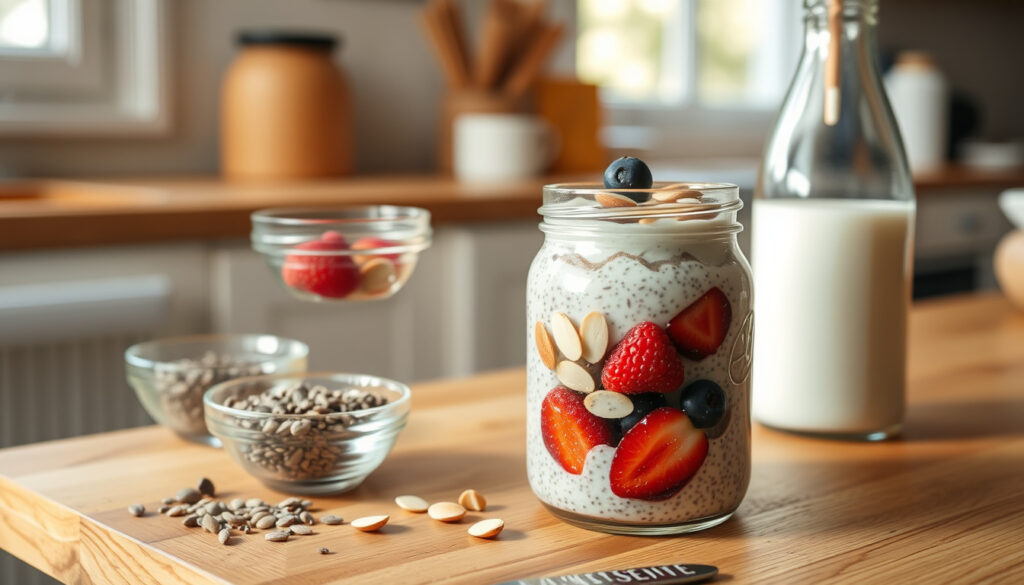
How to Make Overnight Chia: Recipe, Benefits, Tips
Anyone who has opened the fridge hoping for a ready breakfast already knows the appeal of a jar that did the work overnight. Overnight chia is that jar: seeds, milk, a stir, and a few hours in the cold turn into a pudding that MedlinePlus, U.S. National Library of Medicine says needs at least four hours to set.
Serving size: 2 tablespoons (30 g) of chia seeds ·
Calories per serving: ~120 kcal ·
Fiber per serving: ~10 g ·
Recommended soaking time: at least 4 hours, preferably overnight ·
Liquid-to-seed ratio: 4:1 (e.g., 1 cup milk to 4 tbsp chia seeds)
Quick snapshot
- Chia seeds absorb liquid and swell into a pudding-like consistency (MedlinePlus, U.S. National Library of Medicine)
- Overnight chia recipes typically use milk, vanilla, and a sweetener such as maple syrup or honey (Julie’s Eats & Treats, recipe blog)
- A common recipe serving can deliver about 12 g fiber and 10 g protein (Julie’s Eats & Treats, recipe blog)
- Whether chia seeds directly cause skin glow
- Whether chia seeds can meaningfully copy Ozempic’s appetite effects
- How quickly individual health changes appear after starting a chia habit
- At least 4 hours in the fridge until pudding-like (A Beautiful Plate, recipe publisher)
- 8–12 hours for a fully set texture (A Beautiful Plate, recipe publisher)
- 12 hours for overnight oats with chia (Food Network, recipe authority)
- Stir again about 30 minutes after making it to reduce clumping (Six Sisters’ Stuff, home cooking blog)
- Thin pudding can be thickened with more chia or yogurt; thick pudding can be loosened with milk (Six Sisters’ Stuff, home cooking blog)
- For a dairy-free dessert version, plant milk and cocoa work well (Minimalist Baker, plant-based recipe site)
Most of the variation in overnight chia comes down to two variables: how much seed you use and how long you let it sit.
| Fact | Value |
|---|---|
| Chia seed calories (per tbsp) | 60 kcal |
| Fiber per tbsp | 5 g |
| Recommended daily intake | 1–2 tablespoons |
| Ideal soaking time | 4–8 hours |
| Fully set texture | 8–12 hours (A Beautiful Plate, recipe publisher) |
| Fiber in one recipe serving | 12 g (Julie’s Eats & Treats, recipe blog) |
| Protein in one recipe serving | 10 g (Julie’s Eats & Treats, recipe blog) |
| Calcium in one recipe serving | 385 mg (Julie’s Eats & Treats, recipe blog) |
How do I make overnight chia oats?
Most overnight chia recipes follow the same skeleton: milk or non-dairy milk, chia seeds, a touch of sweetener, and a cold rest. The classic version is more ratio than technique.
The basic overnight chia recipe
- 4 tablespoons (about 60 g) chia seeds
- 1 cup milk or non-dairy milk
- 1/2 teaspoon vanilla extract (optional)
- 1 teaspoon maple syrup, honey, or another sweetener (optional)
- Pinch of salt or cinnamon (optional)
- Step 1: Stir the chia seeds and liquid together in a jar or bowl. A jar with a lid is the standard container (Garden in the Kitchen, whole-food recipe blog).
- Step 2: Let the mixture sit for about 5 minutes, then stir again to break up clumps.
- Step 3: Cover and refrigerate for at least 4 hours, and ideally 8–12 hours for a fully set texture (A Beautiful Plate, recipe publisher).
- Step 4: Check the texture in the morning; add more milk if it is too thick, or more seeds or yogurt if it is too thin (Six Sisters’ Stuff, home cooking blog).
For the actual oats version, stir about 2 tablespoons of chia into your usual overnight oats base. Food Network’s recipe calls for covering the mixture and refrigerating at least 12 hours or overnight (Food Network, recipe authority).
How to make overnight chia with yogurt
- Use half milk and half plain yogurt for a thicker, higher-protein pudding.
- Stir the yogurt in after the chia seeds have absorbed most of the liquid, or mix it in at the start if you want a looser set.
- Sweeten lightly; yogurt already adds tang.
Chia pudding with water
- Use the same 4:1 ratio, but water produces a firmer, plainer gel than milk.
- Add vanilla, cinnamon, or a pinch of salt because water does not add sweetness or creaminess.
- For a richer dairy-free texture, use coconut milk or unsweetened almond milk instead of water.
How to make overnight chia for weight loss
- Use unsweetened almond milk or another low-calorie plant milk.
- Skip sweeteners, or replace them with mashed berries.
- Keep the serving around 2 tablespoons of seeds to control calories and fiber load.
- Add a protein source, such as Greek yogurt, to make the meal more filling.
The pattern: stick to the 4:1 ratio, give it time, and the fridge does the rest.
Is overnight chia good for you?
Chia seeds are high in fiber, protein, and omega-3 fats, according to Gestational Diabetes UK, condition-specific resource. But the nutrient numbers vary so much with the recipe that blanket claims are fragile. Two Healthy Kitchens, cooking and nutrition site reports fiber per serving from 6 to 25 grams, while Milk & Honey Nutrition, dietitian-led recipe blog counts a version at about 400 calories, 25 grams fiber, 16 grams protein, and 18 grams fat.
What are the downsides of chia seeds?
- Dry chia seeds can swell in the throat if eaten without enough liquid; soaking avoids that risk.
- Too much fiber too quickly can cause gas and bloating.
- Portion size matters; chia seeds are calorie-dense at about 60 kcal per tablespoon.
What happens if I eat chia seeds every day for a week?
- You may feel fuller at breakfast because the gel slows digestion.
- Fiber can help regularity, but it can also cause bloating if you increase intake too fast.
- There is no one-week guarantee; benefits depend on the rest of your diet.
Do chia seeds act like a laxative?
- Chia fiber adds bulk to stool and can help with constipation when paired with plenty of water.
- For some people, a sudden high-fiber intake creates loose stools or discomfort.
Do chia seeds make skin glow?
- Chia seeds contain antioxidants and omega-3s that support skin health, according to condition-specific nutrition commentary.
- No direct clinical evidence says a bowl of chia pudding will make skin glow.
A serving of chia pudding can be a genuinely filling breakfast, but the difference between a light version and a 400-calorie version comes from the milk, sweetener, and toppings, not the seed itself.
What are some common mistakes people make when eating chia seeds?
The biggest failures are not about the seed; they are about liquid and time. Most “why is my chia pudding gross” moments trace back to one of three errors.
Not soaking long enough
- Undersoaked seeds stay crunchy and can feel gritty or dry.
- Soaking is the standard preparation because it softens the gel and makes the pudding smooth (you can also blend the pudding after soaking for an even silkier texture).
- A short soak leaves the mixture watery; an overnight soak gives it time to set.
What happens when chia seeds meet hot water?
- Hot water can soften chia seeds quickly, but it can also turn them into a slimy gel and may affect some heat-sensitive nutrients.
- For classic overnight chia, cool or room-temperature milk gives a cleaner texture.
How long should chia seeds soak?
- Minimum: at least 4 hours in the fridge (MedlinePlus, U.S. National Library of Medicine).
- Best texture: 8–12 hours (A Beautiful Plate, recipe publisher).
- Overnight oats with chia: at least 12 hours (Food Network, recipe authority).
Chia seeds form a thick gel as they hydrate. If the liquid ratio is too low, the pudding can become dense and hard to swallow. Measure 4 tablespoons of seeds against 1 cup of liquid before walking away.
What this means: most “failed” chia puddings are actually ratio failures. Fix the liquid before you blame the seed.
Do chia seeds work like Ozempic?
This question comes from a viral comparison, and the short answer is no. Ozempic is a prescription GLP-1 drug; chia seeds are a food that happens to form a gel.
Chia seeds vs. GLP-1 drugs
- Ozempic is a prescription medication that affects appetite and blood sugar through GLP-1 pathways.
- Chia seeds form a viscous gel that can slow digestion and promote fullness, but this is not the same mechanism.
- No published clinical evidence shows chia seeds can replicate Ozempic’s effects at any dose.
According to Eat This Much, meal-tracking site, a standard overnight chia pudding serving lands at 237 calories and 46% of the daily value for fiber. That is a useful satiety tool, not a pharmaceutical effect.
How to use chia seeds for weight loss
- Use unsweetened plant milk and skip added syrups to reduce calories.
- Add protein and fruit to make the pudding a complete meal.
- Treat chia as a satiety aid, not a medication.
Chia seeds recipes for weight loss overnight
- Chocolate chia pudding with plant milk and cocoa is a dessert-style option (Minimalist Baker, plant-based recipe site).
- Chia mixed into overnight oats is a hybrid breakfast with extra fiber (Food Network, recipe authority).
- Plain chia pudding with berries is the lowest-sugar route.
The reality: chia seeds may support weight loss by making breakfast more filling, but they do not act like Ozempic. Comparing them oversells a food and undersells a prescription drug.
What is chia seed good for females?
Chia seeds show up in female-focused nutrition conversations for three reasons: omega-3s, iron, and calcium. The nutrient profile is useful, but the promises around “glow” need a reality check.
Omega-3s and skin health
- Chia seeds are a plant source of alpha-linolenic acid, an omega-3 that supports skin barrier health.
- Antioxidants in chia seeds may help protect skin from oxidative stress, but direct evidence for a “glow” effect is limited.
Calcium, iron, and energy
- One recipe serving from Julie’s Eats & Treats provides 385 mg calcium, making it a meaningful plant-based source (Julie’s Eats & Treats, recipe blog).
- Chia seeds also contain iron, which supports energy levels, especially for women with heavier menstrual cycles.
Fiber and digestive health
- Chia seeds are rich in soluble fiber, which feeds gut bacteria and helps with regularity.
- For people managing gestational diabetes, overnight chia seeds are framed as a low-carb, high-fiber breakfast option (Gestational Diabetes UK, condition-specific resource).
The trade-off: chia seeds are a nutrient-dense addition, but they should complement a varied diet. For women, the calcium and iron content is useful; the “glow” promise is marketing.
Upsides
- No cooking and about five minutes of active prep.
- High fiber and protein in a single jar.
- Works with dairy, plant milk, yogurt, or water.
- Can be flavored sweet or savory.
Downsides
- Texture is unforgiving if the liquid ratio or soak time is off.
- Calories add up quickly with sweeteners and rich milk.
- A sudden fiber increase can cause bloating.
- As a food, it cannot replace prescription medication.
Overnight chia in five steps
- Step 1: Combine 4 tablespoons chia seeds with 1 cup liquid in a jar or bowl.
- Step 2: Stir well, wait 5 minutes, and stir again.
- Step 3: Refrigerate for at least 4 hours, ideally 8 to 12 hours (A Beautiful Plate, recipe publisher).
- Step 4: Check the texture; thin pudding can be thickened with extra seeds or yogurt, and thick pudding can be loosened with milk (Six Sisters’ Stuff, home cooking blog).
- Step 5: Add toppings just before serving so they stay fresh.
Confirmed vs. still unclear
- Confirmed: Chia seeds absorb liquid and swell into a pudding-like consistency.
- Confirmed: Overnight soaking is the standard way to make them easy to eat as a breakfast pudding.
- Confirmed: Chia seeds are safe for most people when eaten with enough fluid and as part of a balanced diet.
- Still unclear: Whether chia seeds directly make skin glow.
- Still unclear: Whether chia seeds can meaningfully replicate Ozempic’s appetite suppression.
- Still unclear: How quickly individual health changes appear after starting a chia habit.
Two preparation details matter more than the rest: the minimum soaking time and the point where the pudding is actually set.
“Combine chia seeds with non-dairy milk in a tightly closed jar and refrigerate for at least four hours, until the mixture becomes pudding-like.”
MedlinePlus, U.S. National Library of Medicine
“For a fully set texture, refrigerate the pudding for roughly 8 to 12 hours.”
A Beautiful Plate, recipe publisher
Overnight chia is not a miracle food or a drug substitute, but it is a cheap, flexible breakfast that delivers fiber, protein, and staying power when made correctly. The real test is texture: use enough liquid, soak long enough, and adjust with yogurt or milk when the gel goes wrong. For a home cook in New Zealand, the choice is clear: master the four-to-one ratio and the fridge does the rest, or another morning starts with a spoonful of gritty, under-soaked seeds.
Frequently asked questions
Is it good to soak chia seeds overnight?
Yes. Overnight soaking gives the seeds time to absorb liquid fully, which creates a smooth, pudding-like texture and avoids the gritty, dry mouthfeel.
How long do chia seeds take to show results?
For texture, around 4 hours minimum, with many recipes recommending 8 to 12 hours for a fully set pudding. For health effects, results vary and are not tied to a single overnight serving.
Does hot water destroy chia seeds?
Hot water does not destroy the seed, but it can change the texture and may degrade some heat-sensitive nutrients. If you want a classic pudding, use cool or room-temperature milk and soak overnight.
Can you eat chia seeds without soaking?
You can, but dry chia seeds can swell in the esophagus and pose a choking risk. Soaking is the safer and more digestible preparation.
What is the best liquid for chia pudding?
Any milk works — dairy, unsweetened almond, oat, coconut, or even water. Use roughly 1 cup liquid per 4 tablespoons of seeds, then adjust thickness after soaking.
How much chia seeds should I eat per day?
Most recipe servings use 2 to 4 tablespoons of seeds. Start with 1 to 2 tablespoons if you are not used to high-fiber foods, and drink plenty of water.
More related posts
 Trade Me Houses for Sale: Fees, Tips & Comparison
 ‘I Love You’ in Māori: Translation & Pronunciation
 ANZ Term Deposit Rates 2025: Compare Rates & Invest
 The Diplomat Season 4: Cast, Release Date & Filming News
 Blood Pre ure by Age: Normal Range and Guideline
 Pak n Save Hamilton: Opening Date, Hours & Online Shopping
 Fish Pie Recipe NZ: Best Smoked Versions by Annabel Langbein
 A Time to Kill 1996: Film Cast, Reviews, True Story
