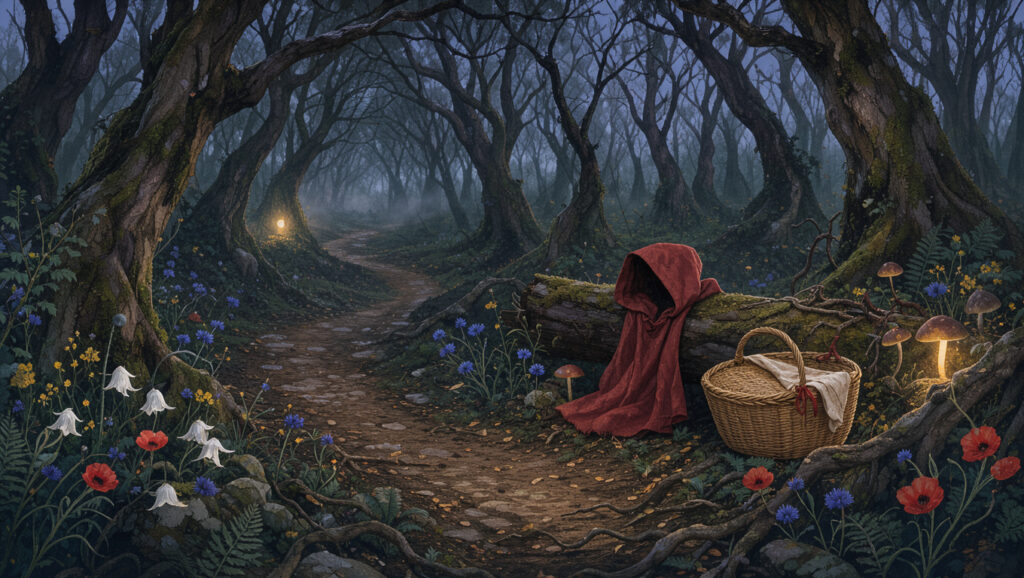
Little Red Riding Hood: Original Story, Versions and Moral
Most people remember Little Red Riding Hood as a story where the girl gets rescued, but that is not how it first reached print. Charles Perrault published his version in 1697, and in it the wolf eats the girl with no rescue at all (Encyclopaedia Britannica (reference encyclopedia)), so this article traces the story from that bleak ending to the Brothers Grimm rescue and the full texts you can read yourself.
Earliest known printed version: Charles Perrault, 1697 (Toronto Public Library (public library blog)) ·
Brothers Grimm version: 1812, Kinder- und Hausmärchen, tale titled Rotkäppchen (University of Pittsburgh (D. L. Ashliman folklore collection)) ·
Perrault ending: the wolf eats the girl, and a moral warning follows (Berkeley Fiction Review (literary criticism journal)) ·
Grimm ending: a huntsman cuts open the wolf and rescues the girl and grandmother (Encyclopaedia Britannica (reference encyclopedia))
Quick snapshot
- Perrault’s “Le Petit Chaperon Rouge” was first printed in 1697 (Encyclopaedia Britannica (reference encyclopedia))
- The Grimms printed “Rotkäppchen” in 1812 in Kinder- und Hausmärchen (University of Pittsburgh (D. L. Ashliman folklore collection))
- In Perrault’s version the girl is eaten, with no rescue (Berkeley Fiction Review (literary criticism journal))
- Scholars agree Perrault likely heard an oral folktale (Children’s Literature Association (scholarly journal)), but the dates and places of the oral versions cannot be pinned down.
- According to a Morna Daniels essay (Morna Daniels essay (British Library-derived study)), Benjamin Tabart’s verse adaptation dates to 1808, while a Toronto Public Library blog (public library blog) gives 1816.
- In 1695 Perrault offered his manuscript to Élisabeth Charlotte d’Orléans, according to a Morna Daniels essay (British Library-derived study).
- According to Wikipedia (open encyclopedia), the 1857 Grimm edition is the final and tamer version.
- Full English translations circulate online, including a Scribd copy listing Andrew Lang’s Perrault and Margaret Hunt’s Grimm (Scribd (document-sharing platform)).
- Check each translation’s edition before quoting it. (Scribd (document-sharing platform))
Eight rows set the frame, and the two endings are where the versions split hardest.
| Item | Detail |
|---|---|
| First printed version | Charles Perrault, 1697, in Histoires ou contes du temps passé (according to a Library of Innovation visitor guide (museum guide)) |
| Grimm first edition | 1812, Kinder- und Hausmärchen, tale no. 26 (University of Pittsburgh (D. L. Ashliman folklore collection)) |
| Perrault ending | The wolf eats the girl; no rescue |
| Grimm ending | A huntsman cuts open the wolf; the girl and grandmother are rescued |
| Grimm final edition | 1857, described as a tamer text (Wikipedia (open encyclopedia)) |
| Grimm translations | More than 160 languages (EBSCO Research Starters (encyclopedic reference)) |
| Oral origin | Undated; scholars think Perrault adapted an oral folktale |
| Perrault’s moral | A warning about strangers and predatory men |
What is the original story of Little Red Riding Hood?
Perrault’s text was the first literary version, and scholars agree he likely heard an oral folktale and shaped it for the French court (Children’s Literature Association (scholarly journal)). The result reads more like a warning than a bedtime story.
- Perrault (1697): the wolf eats the grandmother and then the girl, with no rescue (Berkeley Fiction Review (literary criticism journal)).
- Grimm (1812): the first edition was a scholarly work heavy with footnotes, and later editions were edited with children in mind (EBSCO Research Starters (encyclopedic reference)).
- Oral roots: Madland (1984) argues that the oral heroine was a self-confident peasant girl who could handle the wolf (University of Southern Mississippi analysis (folklore research archive)).
How did the Brothers Grimm version change the plot?
- According to the American Literature (online text edition) full text of Little Red-Cap, the Grimm version adds a mother’s warning to stay on the path and not dawdle, an element absent from Perrault.
- According to Reactor Magazine (genre fiction website), a second Grimm episode has a wiser Little Red Cap outwit another wolf with her grandmother’s help.
The implication: by 1812 the story had moved from a warning about predators to a lesson about obedience and rescue, and that is the version many readers carry with them.
What is the moral message of Little Red Riding Hood?
Perrault closes with verse, and the verse is blunt. It warns that well-bred young ladies should never talk to strangers (UC Davis Stenzel Anthology (literary text archive)).
- Perrault: according to a DePaul University honors thesis (student research), the French idiom “elle avoit vu le loup” described a girl losing her virginity, and scholars read that meaning into Perrault’s text.
- Grimm: Jack Zipes argues the Grimms cleaned up the tale for nineteenth-century bourgeois socialization (Dominican University senior thesis (literary studies)).
- Feminist critique: Bonner notes that feminist critics have called the tale an unfortunate source of negative stereotypes (Sarah Bonner (2006), Moveable Type journal article).
- Fable reading: Saintyves (1989) suggested the tale could be a fable invented to teach young girls not to talk to strangers (University of Southern Mississippi analysis (folklore research archive)).
The wolf is the same creature in both printed texts, so the moral lives in what happens to the girl. Perrault lets the wolf win and asks the listener to be careful, while Grimm lets her survive and asks her to obey.
The catch: the moral is not one thing. The sexual readings are scholarly interpretations, not established facts about what the author intended, so read them as arguments rather than conclusions.
What did Little Red Riding Hood say to the wolf?
The sources gathered for this article do not include a verified, line-by-line transcript of the dialogue. Rather than rebuild the exchange from memory, the safe approach is to check each line against a named translation.
What is Little Red Riding Hood’s most famous line?
- No single line is confirmed as the most famous in the material reviewed for this piece.
- Check any quoted line against the edition it comes from before using it.
The implication: the dialogue is the part of the tale most readers remember, and it is also the part this research can least verify. Treat any line you find online as a retelling until you see its edition.
What are some memorable quotes from Little Red Riding Hood?
Three quotes from three different speakers capture the tale’s two moral poles, and each one is tied to its source text.
And unfortunately, it is these gentle wolves who are the most dangerous ones of all.
Charles Perrault, closing moral, UC Davis Stenzel Anthology (literary text archive)
Perrault transformed a hopeful oral story about the initiation of a young girl into a tragic one of violence in which the girl is blamed for her own violation.
Jack Zipes, as cited in a Dominican University senior thesis (literary studies)
Perrault’s tale embodies complex and fundamental human concerns.
Orenstein, as cited by Sarah Bonner (2006), Moveable Type journal article
What are the lyrics to the Little Red Riding Hood nursery rhyme?
- The lyrics are not included in the material gathered for this article, so they are not quoted here.
- The nursery rhyme is a separate, shorter text and is not the same as the printed tale.
A famous line from the printed tale is not the same as a line from the rhyme, so a quote hunt can attach a line to the wrong text. Check the edition before you share it.
The implication: the quotes that hold up are the moral lines, not the dialogue. Perrault’s warning and Grimm’s obedience lesson are the parts readers can check in print.
What is the full text of Little Red Riding Hood?
A Scribd listing points to full English translations of both texts, including Andrew Lang’s 1889 Perrault and Margaret Hunt’s 1884 Grimm (Scribd (document-sharing platform)).
Is there a free Little Red Riding Hood story PDF with pictures?
- The research behind this article did not document an illustrated PDF, so verify any file before sharing it.
- Start with the translations named above, and confirm the translator and edition on the title page.
Most readers meet the rescue ending first, and a reader who stops at a picture book has met the Grimm rewrite rather than the 1697 original. Reading a full text is the only way to see what changed.
The implication: the full text separates the tale’s two lives, and a reader who checks an edition gets the story the way it was printed.
Confirmed facts
- Perrault’s version was in print from 1697, according to a Library of Innovation visitor guide (museum guide).
- The Grimms’ 1812 first edition was a scholarly work heavy with footnotes (EBSCO Research Starters (encyclopedic reference)).
What’s unclear
- The oral origin of the tale: its dates and locations are not documented.
- The exact meaning early tellers intended.
- Whether the tale rests on a specific historical event.
- How far the 1857 Grimm text moved from 1812, since sources disagree on the extent of the change.
The two endings are not a matter of taste. One leaves the girl inside the wolf, and the other turns her into the cautious survivor of the story. For parents reading this to a child, the choice is clear: read the Grimm text if the goal is rescue and obedience, or read the Perrault text with an adult ready to explain the warning.
Related reading: Snow White and the Huntsman fairy tale adaptation · Queen of Hearts costume guide
Frequently asked questions
Who published the earliest known written version of the story?
Charles Perrault published it in 1697, as the Quick snapshot above shows.
Who is the huntsman in the Brothers Grimm version?
The huntsman, sometimes called the woodsman, is the figure who cuts open the sleeping wolf and frees the grandmother and the girl. That rescue is the change that separates the Grimm ending from Perrault’s.
Who are the main characters in Little Red Riding Hood?
The main characters are the girl in the red cloak, the wolf, and the grandmother. The Grimm text adds a huntsman, who rescues the other two.
Are there movie adaptations of Little Red Riding Hood?
The sources used for this article do not document any film adaptations, so this piece does not list them.
What is the basic plot of Little Red Riding Hood?
A girl in a red cloak walks through the woods to visit her grandmother and meets a wolf. In Perrault’s version the wolf eats both of them and the story closes with a moral. In the Grimm version a huntsman cuts open the wolf and both are rescued.
More related posts
 Best Beard Trimmer NZ 2026: Tested & Compared
 Cave Stream Scenic Reserve Walk: Length, What to Wear & Tips
 Things to Do in Lower Hutt: Top Attractions & Hidden Gems
 1 Cup of Flour in Grams: Conversion Guide (120-125g)
 Best Broadband Provider NZ 2025: Compare Fibre, Starlink & Cheapest Plans
 Hunting and Fishing Timaru – Address, Hours, Phone and Store Guide
 TV Technician Near Me: Dublin Repair Costs Guide
 Snow White and the Huntsman: Was It a Hit or Flop? Cast & Sequel
