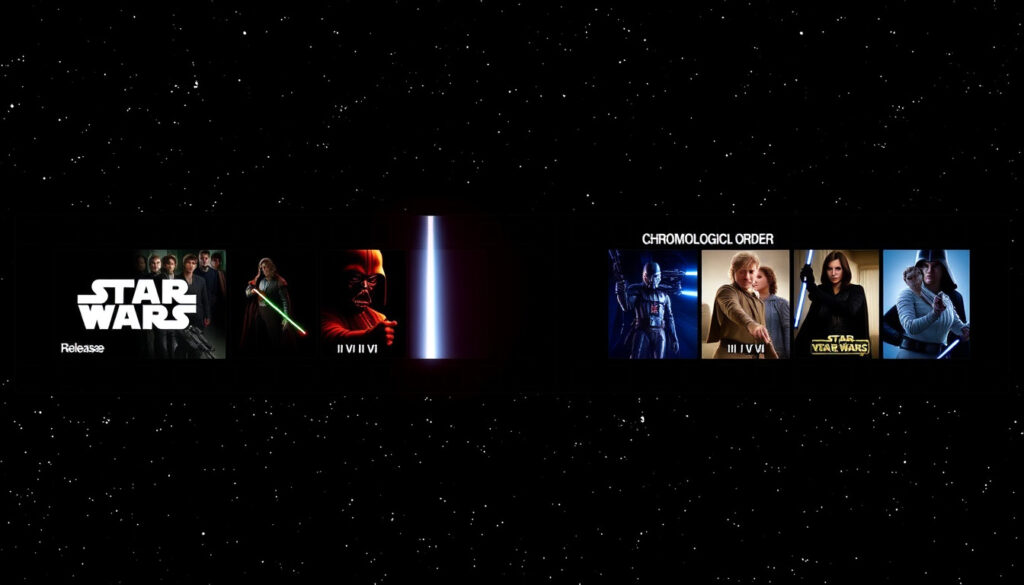
Star Wars Movie Order: Release vs Chronological Guide
There is no single “correct” order to watch Star Wars, only a trade-off between preserving narrative surprises and following the in-universe timeline. The original film hit theaters in 1977 as Star Wars before being retitled Episode IV – A New Hope (StarWars.com (official franchise site)), and this guide breaks down the two main viewing orders — release and chronological — so you can decide which path suits you best.
Total Star Wars films (as of 2024): 12 ·
Main saga episodes: 9 ·
First released film: Star Wars: Episode IV – A New Hope (1977) ·
Most recent film: Star Wars: Episode IX – The Rise of Skywalker (2019) ·
Chronological first film: Star Wars: Episode I – The Phantom Menace (1999) ·
Number of standalone films: 3 (Rogue One, Solo, The Clone Wars)
Quick snapshot
- Release order starts with Episode IV – A New Hope (1977) (StarWars.com)
- Chronological order begins with Episode I – The Phantom Menace (1999) (Rotten Tomatoes Editorial)
- The exact best order for every viewer depends on personal preference (The Popverse (pop culture editorial))
- Whether George Lucas originally planned to make the prequels first remains debated (The Popverse (pop culture editorial))
- 1977: A New Hope; 1980: Empire Strikes Back; 1983: Return of the Jedi (Wookieepedia (fan-run wiki))
- 1999: The Phantom Menace; 2002: Attack of the Clones; 2005: Revenge of the Sith (Rotten Tomatoes Editorial)
- First-time viewers most often recommended release order to preserve original twists (The Popverse)
- Disney+ offers a curated chronological list starting with The Phantom Menace (Disney+ Explore)
Here is a quick reference table of key facts about the Star Wars film timeline:
| Fact | Value |
|---|---|
| First Star Wars film released | Star Wars: Episode IV – A New Hope (May 25, 1977) (StarWars.com) |
| Most recent film | Star Wars: Episode IX – The Rise of Skywalker (December 20, 2019) (Rotten Tomatoes Editorial) |
| Total number of live-action films | 12 (including Rogue One, Solo, and The Clone Wars) (Wikipedia (community encyclopedia)) |
| Number of animated series | 5 (The Clone Wars, Rebels, Resistance, The Bad Batch, Tales of the Jedi) (StarWars.com) |
| Box office gross of the franchise | Over $10 billion (highest-grossing film franchise) (Wikipedia) |
What’s the correct order to watch Star Wars?
Release order vs. chronological order
- Release order: Episode IV, V, VI (original trilogy) followed by I, II, III (prequel trilogy), then VII, VIII, IX (sequel trilogy) (StarWars.com).
- Chronological order: Episode I, II, III, then IV, V, VI, then VII, VIII, IX (Disney+ Explore).
- Both orders have strong arguments; release order preserves the original trilogy’s narrative twists (The Popverse).
Which order is recommended for new viewers?
For someone who has never seen a Star Wars film, most fans and critics lean toward release order. As The Popverse puts it, release order preserves the original narrative reveal structure — specifically the shock that Darth Vader is Luke’s father. Chronological order can feel more linear for newcomers because it follows the story’s internal timeline, as noted by Disney+ Explore. The catch: if you already know the big twist, chronological order works perfectly.
Bottom line: Release order exists because of technological limits in the 1970s, and it remains the best way to experience the story’s most iconic twists.
Why is Star Wars 4 5 6 1 2 3?
George Lucas’s original vision
George Lucas began the story with Episode IV because the technology to realize the prequel trilogy didn’t exist in the mid-1970s (StarWars.com). The original film, released in 1977, was simply titled Star Wars and only later retitled Episode IV – A New Hope. Lucas wanted to start in medias res — in the middle of the action — and then fill in the backstory later.
The impact of the ‘I am your father’ twist
Watching in release order preserves what is arguably cinema’s most famous revelation: Darth Vader is Luke’s father. That moment in The Empire Strikes Back (1980) carries no weight if you’ve already seen the prequels, which show Anakin Skywalker’s transformation into Vader. According to Rotten Tomatoes Editorial (film review aggregator), the original trilogy’s narrative structure depends on audiences discovering the truth alongside Luke.
Bottom line: Release order exists because of technological limits in the 1970s, and it remains the best way to experience the story’s most iconic twists.
What is the chronological order of Star Wars movies?
The main saga timeline
In in-universe chronological order, the nine main saga films run: Episode I (1999), Episode II (2002), Episode III (2005), Episode IV (1977), Episode V (1980), Episode VI (1983), Episode VII (2015), Episode VIII (2017), Episode IX (2019) (Rotten Tomatoes Editorial).
Where standalone films and series fit
- Solo: A Star Wars Story (2018) takes place between Episode III and IV (Rotten Tomatoes Editorial).
- Rogue One: A Star Wars Story (2016) immediately precedes Episode IV (Rotten Tomatoes Editorial).
- Star Wars: The Clone Wars (2008 film and series) is set between Episode II and III (Wookieepedia (fan-run wiki)).
- The Acolyte (2024) is set before Episode I (source pending official release).
The pattern: standalone entries act as bridges between trilogies, filling narrative gaps that the main saga skips.
What order to watch Star Wars for the first time?
Release order for first-time viewers
The Popverse recommends release order for first-timers because it delivers the narrative twists exactly as intended. Start with Episode IV, then V, then VI, then the prequels, then the sequels. This approach means you experience the story the way audiences did between 1977 and 2019.
The Machete order alternative
A popular variant known as “Machete order” suggests: Episode IV, V, II, III, VI — skipping Episode I entirely. The idea is to use the prequels as a flashback after Empire reveals Vader as Luke’s father, then conclude with Return of the Jedi. While not officially endorsed by Lucasfilm, it has gained traction among fans for preserving the twist while adding context from Attack of the Clones and Revenge of the Sith.
Bottom line: For a first-timer who knows nothing, release order is safest because it preserves the saga’s central narrative surprises.
How to watch Star Wars movies and shows?
Including The Clone Wars and Rebels
The animated series add significant depth but are not essential for following the main saga. Star Wars: The Clone Wars (2008–2020) takes place between Episode II and III (Wookieepedia). Star Wars Rebels is set between Episode III and IV (StarWars.com).
The Mandalorian timeline placement
The Mandalorian, The Book of Boba Fett, and Ahsoka all take place after Episode VI – Return of the Jedi (1983), roughly five years after the Battle of Endor (StarWars.com). Andor is a prequel to Rogue One, set before Episode IV. For a complete viewing experience, many fans slot these into chronological order, but they are not necessary to understand the movie trilogies.
Bottom line: If you only want the films, stick to the nine-episode saga plus the two standalones. The series are optional expansions that enrich the universe but don’t change the core story.
Watching chronologically from Episode I means you’ll see Anakin’s journey from child to Vader before you ever meet Luke. You lose the reveal — but you gain a linear saga with a more traditional three-act structure in the prequel era.
Comparison: Release order vs. chronological order
Three viewing paths, one clear trade-off between preserving surprises and following the timeline.
| Order | Starting Point | Best For |
|---|---|---|
| Release order | Episode IV (1977) | First-timers who want the original experience |
| Chronological order | Episode I (1999) | Viewers who already know the twists |
| Machete order | Episode IV, then II, III as flashback | Fans who want context without spoiling the reveal |
The implication is clear: release order is best for preserving narrative mystery, while chronological order is for those who prioritize timeline coherence.
Steps to choose your viewing order
- Decide your spoiler tolerance. If you do not know the Darth Vader reveal, avoid the prequels first.
- Pick a path:
- No spoiler knowledge → Release order (IV, V, VI, I, II, III, VII, VIII, IX).
- Already know the twist → Chronological order (I, II, III, Solo, Rogue One, IV, V, VI, VII, VIII, IX).
- Want a curated experience → Machete order (IV, V, II, III, VI).
- Consider adding standalones at their chronological placement.
- Include series only if you want the full extended universe (The Clone Wars after II, Rebels after III, Andor before IV, The Mandalorian after VI).
These steps simplify the decision process, ensuring your viewing experience matches your expectations for the saga. For more detailed actor filmographies and viewing guides, check out our Rob Lowe Movies and TV Shows: Complete Filmography & Biography and Cast of Mufasa: The Lion King – Full Voice Actor List.
Timeline of Star Wars film releases
According to Wookieepedia (fan-run wiki)’s release-date list:
- 1977 – Star Wars: Episode IV – A New Hope
- 1980 – Star Wars: Episode V – The Empire Strikes Back
- 1983 – Star Wars: Episode VI – Return of the Jedi
- 1999 – Star Wars: Episode I – The Phantom Menace
- 2002 – Star Wars: Episode II – Attack of the Clones
- 2005 – Star Wars: Episode III – Revenge of the Sith
- 2015 – Star Wars: Episode VII – The Force Awakens
- 2016 – Rogue One: A Star Wars Story
- 2017 – Star Wars: Episode VIII – The Last Jedi
- 2018 – Solo: A Star Wars Story
- 2019 – Star Wars: Episode IX – The Rise of Skywalker
This timeline illustrates the gap between the original trilogy and its prequels, a gap that fuels the debate between viewing orders.
Clarity: what’s confirmed and what’s unclear
Confirmed facts
- There are 11 live-action theatrical films (9 main saga + 2 standalone) (Wikipedia).
- The original trilogy was released before the prequel trilogy because of technical limitations in the 1970s (StarWars.com).
- Watching in release order preserves the original trilogy’s narrative twists (The Popverse).
What’s unclear
- Whether George Lucas originally planned to make the prequels first remains debated among historians.
- The exact best order for every viewer depends on personal preference; no single order wins universally (The Popverse).
- The inclusion of animated series in a “movies only” watchlist is optional and varies by guide.
While some facts are settled, the best viewing order ultimately depends on what you value most in the story.
What the guides say
Release order preserves the original narrative reveal structure — the shock that Darth Vader is Luke’s father cannot be replicated if you’ve already seen the prequels.
— The Popverse (pop culture editorial) (source)
The core saga films are grouped into original, prequel, and sequel trilogies, each with its own distinct tone and era.
— Rotten Tomatoes Editorial (source)
Disney+ publishes an official chronological order that starts with The Phantom Menace, then Attack of the Clones, then Revenge of the Sith.
— Disney+ Explore (source)
These perspectives show a consensus: release order is the standard recommendation, but chronological order is a valid alternative for informed viewers.
For a first-time viewer, the safest bet is release order: you get the classic experience as audiences did, with Darth Vader’s revelation landing exactly where it should. The alternative risks flattening the saga’s most iconic surprise. For fans already familiar with the story, chronological order offers a coherent linear narrative. Choosing release order preserves the narrative punch of the original trilogy, while chronological order offers a saga-spanning linearity for those who already know its secrets.
space.com, wishesandwayfinding.com, thepopverse.com, youtube.com, reddit.com, hulu.com, imdb.com
For instance, the release vs chronological guide breaks down the saga into clear chronological and release sequences for first-time viewers.
Frequently asked questions
What is the Machete order for Star Wars?
Machete order is a fan-created viewing sequence: Episode IV, V, II, III, VI. It skips Episode I and uses the prequels as a flashback after the Vader reveal. It preserves the original twist while adding context from the prequel era.
How many Star Wars movies are there in total?
As of 2024, there are 12 live-action theatrical films: the nine main saga episodes (I-IX) plus three standalone films — Rogue One (2016), Solo (2018), and The Clone Wars (2008).
Is it better to watch Star Wars in chronological order?
It depends on your priority. Chronological order follows the in-universe timeline and is great for viewers who already know the twists. If you’re watching for the first time and want to preserve surprises, release order is better.
Do I need to watch the animated series to understand the movies?
No. The animated series (The Clone Wars, Rebels, The Bad Batch) add depth but are not required to follow the main movie storyline. They are optional expansions.
What is the best order to watch Star Wars for a first-time viewer?
Most guides recommend release order: start with Episode IV (A New Hope), then V (Empire Strikes Back), VI (Return of the Jedi), then the prequels (I, II, III), and finally the sequels (VII, VIII, IX).
Where does Rogue One fit in the Star Wars timeline?
Rogue One is set immediately before Episode IV – A New Hope. It tells the story of how the Rebellion stole the Death Star plans.
What is the release order of all Star Wars movies?
The release order: Episode IV (1977), V (1980), VI (1983), I (1999), II (2002), III (2005), VII (2015), Rogue One (2016), VIII (2017), Solo (2018), IX (2019).
More related posts
 How to Upload Contacts to Gmail: Android, iPhone & More
 Disabled Line Marking Wellington: NZS 4121 Standards & Costs
 Real Betis vs Chelsea: 2025 Conference League Final
 Cult of the Lamb Rating, LGBTQ+ Content & Gameplay
 How to Check if You Owe a Toll Road Online in NZ – NZTA Guide
 Manchester United vs West Ham Stats: Head-to-Head History
 The Honda Shop Hamilton: Reviews, Prices, Phone & Waikato Branches
 TradeMe Horses for Sale: Complete Buyer’s Guide 2025
