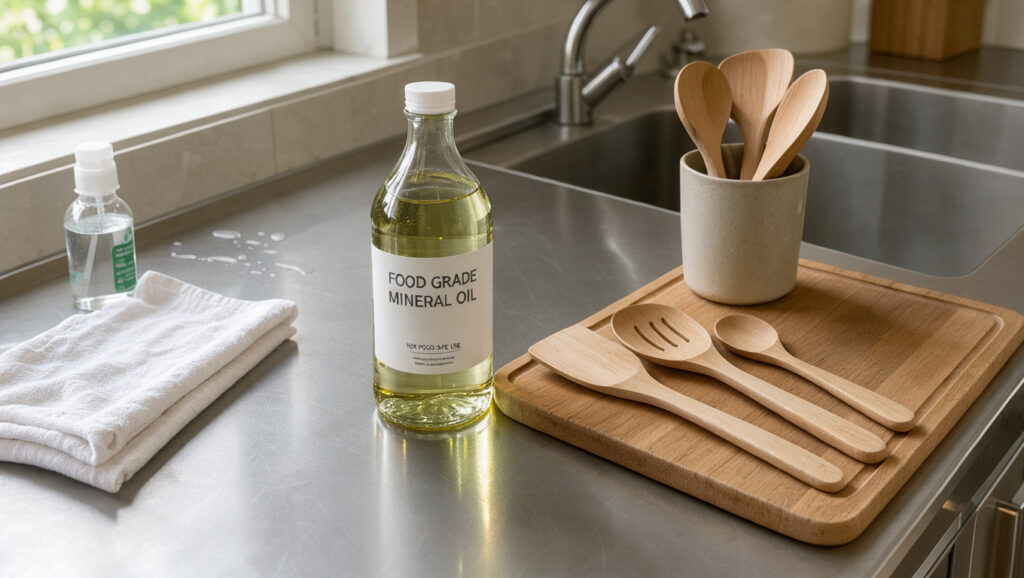
Food Grade Mineral Oil: Uses, Buying Options and Alternatives
Anyone who has shopped for board oil recently has noticed how many names one bottle can carry. Food grade mineral oil, liquid paraffin and white mineral oil describe the same petroleum-derived liquid, as Ataman Kimya’s product listing confirms, while technical oil that shares the name is a different product (WoodWiki).
Alternate name: Liquid paraffin · Regulatory listing: FDA rule 21 CFR 172.878 · Reapplication: Monthly, per Engineer Fix’s sealing guide · Irish labelling rule: Not established by retrieved evidence
Quick snapshot
- Food grade mineral oil is listed under 21 CFR 172.878 as a direct food additive for bakery release use (American Society of Baking Engineers summary). (Woodsmith food-safe finishes guide)
- Liquid paraffin and mineral oil name the same petroleum-derived liquid (Ataman Kimya). (Woodsmith food-safe finishes guide)
- Woodsmith advises buying oil labelled for food contact, because not every mineral oil label serves the same purpose (Woodsmith food-safe finishes guide).
- Whether a finished board is food safe depends on its own labelling, since KORENA’s food-safe oil journal notes the Ph. Eur. grade covers the oil specification rather than a finished board.
- Whether Tesco or Walmart currently stock food grade mineral oil was not confirmed. (KORENA’s food-safe oil journal)
- Irish labelling rules for board oil were not established by the retrieved evidence. (KORENA’s food-safe oil journal)
- Woodsmith’s food-safe finishes article is dated (Woodsmith).
- The ASBE mineral oil article was updated on (ASBE).
- Engineer Fix’s sealing guide is dated (Engineer Fix).
- An Amazon.ie chopping board oil listing claims the oil never spoils and is dishwasher safe, according to the listing itself, and this research did not verify those claims.
- Check the label for food grade wording and the name liquid paraffin before buying, since Ataman Kimya lists the two names together. (the listing itself)
- Confirm Irish retail labelling before relying on any single bottle; the retrieved evidence does not establish Irish rules. (the listing itself)
Six rows, one pattern: the same product carries several names, while the regulatory references stay tied to a single standard.
| Fact | Value |
|---|---|
| Recommended reapplication | Monthly, or sooner when wood looks dry (Dalstrong’s cutting board oil guide) |
| Alternate name in listings | Liquid paraffin (Ataman Kimya) |
| Food-grade white mineral oil, E number | E905a (Ataman Kimya) |
| Bakery release agent residue limit | Not exceeding 0.15% (ASBE) |
| Taste and scent | Unscented; scented mineral oils can leave undesirable flavours (Kitchen Warehouse’s cutting board oil listings) |
| Olive oil for cutting boards | Not recommended, because olive oil can go rancid (KORENA) |
What are food grade mineral oils?
What counts as mineral oil?
- The European Pharmacopoeia has a monograph for white mineral oil that sets quality specifications for the named substance, according to KORENA’s journal on food-safe oils.
- Woodsmith advises choosing a product labelled specifically for food-contact use, because not every product called mineral oil serves the same purpose (Woodsmith).
Four products sit under the mineral oil umbrella, and they split on one question: whether anyone has refined them for food contact.
| Product | What sources report | Food-contact status |
|---|---|---|
| Food-grade white mineral oil | Refined to remove carcinogenic polycyclic aromatic hydrocarbons, according to Mommypotamus’s non-toxic cutting board review | Labelled for food contact, which is the label to look for (Woodsmith) |
| Technical-grade mineral oil | Contains aromatic compounds that refining does not remove (WoodWiki’s mineral oil for wood guide) | Not approved for food contact, according to WoodWiki |
| Baby oil | Mineral oil with added fragrance (Beveland & Bond’s cutting board guide) | Not recommended for cutting boards because of the fragrance |
| Olive, vegetable or corn oil | Goes rancid, so these should not be used on boards (Engineer Fix) | Poor choice for board maintenance (KORENA) |
What is food grade mineral oil made of?
- Ataman Kimya’s specification page describes liquid paraffin as a transparent, colourless and odourless oily liquid of saturated hydrocarbons obtained from petroleum (Ataman Kimya specification page).
- Food-grade oil can contain antioxidant additives such as vitamin E, according to Serious Eats’ mineral oil guide.
Regulatory references sit behind the bottle label, and they carry more weight than the marketing copy on the front.
| Specification | Value | Named reference |
|---|---|---|
| Direct food additive status | Listed under 21 CFR 172.878 for bakery release and lubricant use | ASBE |
| Labelling exemption | Processing aids are exempt under 21 C.F.R. § 101.100(a)(2)(ii)(c) | ASBE |
| Indirect food contact | Permitted as a component of a non-food article under 21 C.F.R. § 178.3260 | ASBE |
| Purity tests | Food-grade liquid paraffin must meet USP XX and USP XVII test requirements | Ataman Kimya specification page |
| NSF registration | Pure white mineral oil marketed for boards is registered as food safe for incidental and direct contact | Ataman Kimya specification page |
| NSF classification | H1 lubricant approved for incidental food contact, according to WoodWiki | WoodWiki |
| Pharmacopoeia monograph | Ph. Eur. white mineral oil monograph sets quality specifications | KORENA |
The implication: a label that names a pharmacopoeia or food-contact standard carries a documented specification, while the words mineral oil alone carry none.
Bottom line: Woodsmith’s food-contact advice decides the purchase. A bottle labelled only “mineral oil” gives a buyer no food-contact assurance, while a food-grade or pharmacopoeia-graded label carries a documented specification.
Where do you buy food grade mineral oil?
Can I buy mineral oil in a grocery store?
- Stock by store and region was not verified, so the label, not the aisle, decides the purchase.
- Kitchen-supply sellers list cutting board oils with food grade and white mineral oil wording, according to Kitchen Warehouse, an Australian kitchenware retailer.
What shops sell mineral oil?
- Amazon.ie lists food grade mineral oil in search results, including a 500 ml Materialix listing that describes the product as 100% mineral oil with no additives (Amazon.ie Materialix listing).
- KORENA sells a 500 ml bottle of 100% purified white mineral oil of pharmaceutical grade, intended for oiled wooden kitchen items (KORENA).
A shelf that carries mineral oil does not prove food-contact grade. Woodsmith’s warning applies here: not every product labelled mineral oil serves the same purpose, so the wording on the bottle is the only check a buyer has.
The implication: the purchase decision happens on the label, because neither the aisle nor the bottle name gives a reliable food-contact signal.
Can I use food grade mineral oil on my skin?
Does food grade labelling mean a product is suitable for skin?
- Food grade labelling addresses food-contact suitability, and Woodsmith’s guidance ties the choice to the intended use of the product (Woodsmith).
- The retrieved evidence contains no skin-use safety testing, so any skin use needs the manufacturer’s own directions.
- Read the product label and manufacturer guidance before any skin use.
Baby oil is mineral oil with fragrance, and Beveland & Bond rules it out for boards because of that fragrance. The same added-ingredient check belongs on any product bought for skin use.
The implication: a food-contact label answers one question only, so skin use needs its own check against the manufacturer’s directions.
What can I use instead of food grade mineral oil?
What is the closest thing to mineral oil?
- Pure tung oil polymerises and cures to resist water better, according to Mommypotamus’s comparison of food-safe finishes.
- Board butter, a blend of mineral oil and beeswax, adds a surface barrier (Engineer Fix).
What is another name for mineral oil?
- Dalstrong recommends food-grade mineral oil, also called liquid paraffin, and advises against olive, vegetable and coconut cooking oils for boards (Dalstrong).
What is a brand of mineral oil?
- KORENA Oil is a 500 ml bottle of 100% purified white mineral oil of pharmaceutical grade, intended for unfinished or oiled wooden kitchen items and not for varnished wood (KORENA).
- Materialix Food Grade Mineral Oil is listed on Amazon.ie as 100% mineral oil with no additives (Amazon.ie listing).
Four options come up in the sources, and they differ mainly in how long the finish lasts before it needs attention.
| Option | How it behaves | Source note |
|---|---|---|
| Mineral oil | Stays liquid and does not cure into a hardened film | Needs regular reapplication (Woodsmith) |
| Pure tung oil | Polymerises and cures, resisting water better | Held up far better than mineral oil in one comparison, according to Mommypotamus |
| Olive, vegetable or corn oil | Oxidises and goes rancid | Advised against for boards (KORENA) |
| Board butter | Mineral oil blended with beeswax | Wax adds a surface barrier and a smoother finish (Engineer Fix) |
A board owner who wants a hardened finish should look past mineral oil, while one who wants an oil that will not go rancid will find mineral oil on the shortlist.
The trade-off: mineral oil asks for more frequent maintenance, while tung oil and board butter ask for a different finish that cures or adds wax.
How often should you oil a cutting board with food grade mineral oil?
How do you clean a hardwood chopping board before oiling it?
- Apply the oil to clean, dry wood, according to Dalstrong’s cutting board oil guide.
- Do not put oiled food-contact surfaces in the dishwasher or leave them soaking (KORENA).
- Wipe the board clean and let it dry fully, since Dalstrong’s guide calls for clean, dry wood.
- Apply food grade mineral oil, then let it soak, often overnight, and wipe away the excess (Serious Eats).
- Reapply about monthly, or sooner when a water bead test shows the surface has dried out (Engineer Fix).
A monthly schedule protects the wood, but it is also the price of choosing an oil that never cures. Boards in heavy daily use may need attention sooner; the sources do not test this.
The implication: the water test is a better guide than a fixed date, because the sources treat dry wood as the trigger for oiling again.
Confirmed facts and open questions
Confirmed facts
- Food grade mineral oil and liquid paraffin name the same petroleum-derived liquid (Ataman Kimya).
- Food-grade mineral oil is listed under 21 CFR 172.878 for bakery use (ASBE).
- Olive and sunflower oils can go rancid, making them poor choices for board maintenance (KORENA).
What’s unclear
- Current retail prices in Ireland.
- Whether Tesco or Walmart currently stock food grade mineral oil.
- Whether food grade mineral oil suits skin use, since the research contains no skin-use safety data.
- The exact composition of specific branded products, and whether Irish retail labelling follows the same terms as US or EU labelling.
The pattern: the confirmed list rests on regulatory and manufacturer data, while the open questions are the ones a shopper meets at the till.
What the sources say
Woodsmith’s guidance is that mineral oil does not cure into a hardened film and needs regular reapplication, and for cutting boards that trade-off is often reasonable (Woodsmith).
Woodsmith, woodworking magazine on food-safe finishes
Serious Eats describes the conventional method: apply mineral oil to the wood, let it soak, often overnight, and wipe away the excess (Serious Eats).
Serious Eats, food-science and cooking publication
Beveland & Bond advises against baby oil on cutting boards, because the fragrance added to mineral oil makes it unsuitable for that use (Beveland & Bond).
Beveland & Bond, cutting-board maker’s blog
The pattern: the three voices agree on reapplication and on fragrance, and they part ways on whether mineral oil is worth the upkeep. For buyers, the label settles the choice: check the bottle for food grade wording and the name liquid paraffin before paying, and pick a different board oil when the label says only mineral oil.
Related reading: How to Cook Bok Choy · How to Clean Baseboard Heaters
Frequently asked questions
Why should a wooden cutting board be oiled?
Dalstrong ties reapplication to wood that looks dry, so dryness is the signal to watch (Dalstrong’s cutting board oil guide). The research did not test other protective effects.
Does food grade mineral oil have a taste or smell?
Food grade mineral oil should be unscented, because scented mineral oils can leave undesirable flavours, according to Kitchen Warehouse.
Why is olive oil not recommended for cutting boards?
Olive and sunflower oils can go rancid (KORENA), and Dalstrong advises against olive, vegetable and coconut cooking oils for boards.
Does food grade mineral oil go rancid?
Mineral oil is a non-drying, chemically stable petroleum product that does not undergo rancidification, according to Engineer Fix.
Can food grade mineral oil be used on butcher block?
The sources do not address butcher block by name. KORENA’s pharmaceutical-grade white oil is intended for unfinished or oiled wooden kitchen items and should not be used on varnished wood (KORENA).
What should I check on a label before buying food grade mineral oil?
Look for food grade or food-contact wording, a pharmacopoeia or USP grade, and no added scent. Woodsmith advises choosing a product labelled specifically for food-contact use (Woodsmith).
More related posts
 Best Beard Trimmer NZ 2026: Tested & Compared
 Portugal National Football Team Standings 2026: Qualified
 Financial Markets Conduct Act 2013 Guide: Key Points
 Why Am I So Tired – Causes, Symptoms and Solutions
 When Does Daylight Savings End in NZ? 2026 Date & Tips
 Knox Jolie-Pitt: Twin, Gender, and Brad Pitt Relationship
 Google Tic-Tac-Toe: How to Play and Beat Impossible Mode
 The Fish Box Taupo: Menu, Hours, Reviews & Dog Info
