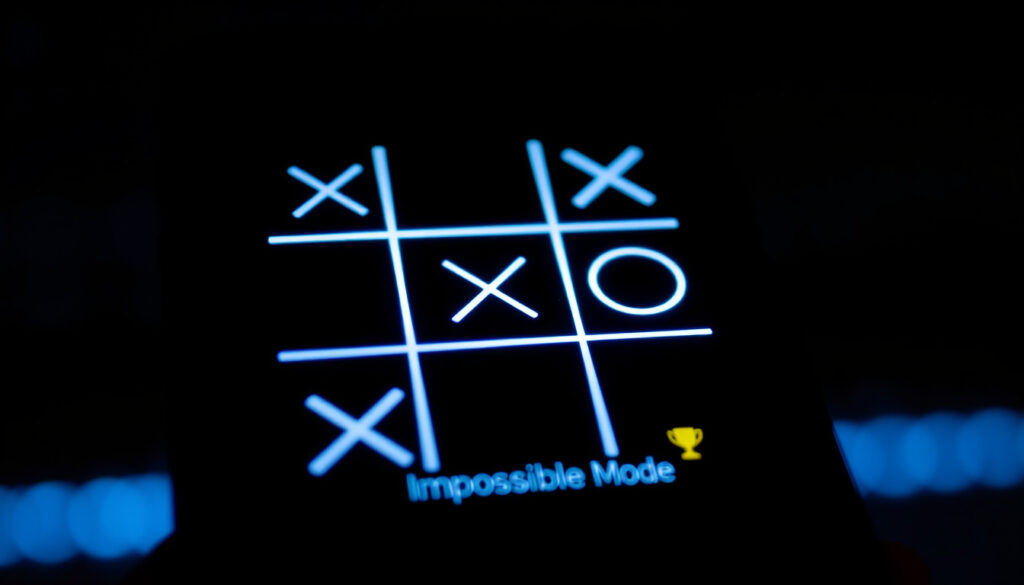
Google Tic-Tac-Toe: How to Play and Beat Impossible Mode
Anyone who has typed ‘tic tac toe’ into Google knows how easily five quiet minutes disappear into a 3×3 grid. The widget looks like a throwaway, but its hardest mode hides a real puzzle: a perfect-play AI that, as Spin on Web (online games explainer) puts it, leaves a draw as the only optimal result. Understanding that ceiling changes what winning means — and why the smart goal against Impossible mode is to survive perfectly.
Default grid size: 3×3 · Difficulty levels: 3 · Total modes: 4 (incl. 2-player) · Perfect-play outcome: Draw · Win condition: Three in a row
Quick snapshot
- Searching “tic tac toe” in Google loads a playable widget straight into the results page (OmniGames Blog (casual gaming blog)).
- The widget offers a difficulty setting you choose before the first move (LinkedIn Pulse (professional publishing platform)).
- “Impossible” is the hardest mode and is presented as unbeatable in normal play (wikiHow (practical how-to guide)).
- Whether Google plans to add 4×4 or 100×100 boards to its built-in game.
- The exact algorithm behind Impossible mode — reportedly a minimax-style search.
- Whether the Impossible AI can be baited into an unforced error over a long session.
- 2017: tutorials already document the search-widget game (Instructables (maker community tutorials)).
- 2020: community videos discuss Impossible mode and UI-bypass tricks (YouTube (community video tutorials)).
- Newer guides still document the same core modes and rules. (Instructables (maker community tutorials))
- Third-party apps and sites keep adding 4×4 and 100×100 grid variants (Chrome Web Store (browser extension directory)).
- Google’s official widget remains a 3×3 board, so large-grid play means leaving Search. (Chrome Web Store (browser extension directory))
- Expect Impossible-mode guides to keep teaching draw-forcing play, because the AI doesn’t lose. (Chrome Web Store (browser extension directory))
Six rows, one pattern: the rules fit on a napkin, but the math behind them fills textbooks.
| Fact | Value |
|---|---|
| Default grid | 3×3 (Instructables (maker community tutorials)) |
| Google Search modes | Easy, Medium, Impossible, 2-player |
| Win condition | 3 in a row |
| Draw condition | Full board, no winner |
| Known possible games | 255,168 (Spin on Web (online games explainer)) |
| Perfect-play result | Draw |
How do you play Google Tic Tac Toe?
If you can type a search, you can start a game. The whole setup takes about ten seconds and stays inside Google’s results page.
How do you open Google’s Tic Tac Toe game?
- Open Google Search in any browser, or the Google app on your phone.
- Type “tic tac toe” or “tic-tac-toe” into the search box; the playable widget appears in the results (OmniGames Blog (casual gaming blog)).
- Pick a mode on the widget, then tap an empty square to place your mark. The same search works on mobile, and a 2024 guide confirms you can also reach it by typing the game’s name into Chrome’s search bar (Urban Digital (tech how-to blog)).
- Play until someone makes three in a row or the board fills, then use the reset option to start a new round.
Which modes are available?
- Easy and Medium give the AI room to misplay, which makes them the sensible entry points.
- Impossible is the hardest AI; the widget’s label is literal, and guides present it as unbeatable in normal play.
- The start screen’s difficulty selector appears before the grid does (LinkedIn Pulse (professional publishing platform)). A separate “Play against a friend” option skips the AI for same-device play.
Which one should you pick? Easy and Medium are fine for learning the rhythm of the game. Impossible is where the actual lesson lives: it punishes every careless move and forces you to think one move ahead.
What happens when the board fills up?
- If neither player completes a line, the game is a tie.
- A play-again option lets you restart after a win, loss, or draw.
How do you play Google Tic Tac Toe with two players?
Local two-player mode is the least documented part of the widget, and the one most people discover by accident.
How do you select Play against a friend?
- On the start screen, choose “Play against a friend” before the grid appears.
- The AI is skipped entirely, and both players share the same 3×3 board on one device.
The widget doesn’t referee turns for you — the honor system applies, which makes it a good option for a shared desk or a phone passed back and forth.
Who starts in two-player mode?
- X always moves first, then O (Urban Digital (tech how-to blog)).
- Players alternate one move at a time, placing marks only on empty squares (YouTube (community video tutorials)).
- Occupied squares cannot be reselected, so every move shrinks the board.
Can you play two-player on the same device?
- Yes — Google’s built-in widget is local pass-and-play, meaning the same screen and keyboard are shared.
- No online matchmaking appears in the Google Search version, so a remote game needs a third-party site.
The trade-off: pass-and-play is the most social mode Google offers, and also a reminder that the widget stops short of true online multiplayer.
What is Google Tic Tac Toe impossible mode?
Every difficulty label in the widget is a promise. “Impossible” is the only one that is mathematically true.
Why is Impossible mode called impossible?
- The mode is the hardest setting in Google’s game, presented as unbeatable in normal play.
- The name is literal: a perfect AI never misses, so the human’s ceiling is a draw.
Does the computer use perfect play?
- Guides describe Impossible mode as a minimax-style perfect-play AI — an opponent that, under optimal play from both sides, turns Tic-Tac-Toe into a draw (Spin on Web (online games explainer)).
- Minimax evaluates every legal continuation and always chooses the move that leaves the human with the worst possible options.
That sounds more intelligent than it is. The AI is not improvising; it is recalling the outcome of every branch of the game tree, and tic-tac-toe has a small enough tree for that to be exhaustive.
What is the best possible result?
- With optimal play on both sides, the best possible result is a draw — the same ceiling a perfect AI enforces.
- Winning would require the AI to make a mistake, which is exactly what the mode is named to exclude.
“Impossible” is not a difficulty curve; it is a solved-game engine. Because every legal position has been analyzed, the AI does not need to think like a human — it only needs to avoid losing lines.
What this means: the name on the button is the honest result. The best any player can do against a perfect opponent is walk away with a draw.
How do you beat Google Tic Tac Toe impossible mode?
The honest answer is that you do not beat it — you survive it. The strategy that works is the one that refuses to lose.
What is the best first move in Impossible mode?
- Start in a corner or the center to keep your options open.
- The center and corner starts are the strongest squares in standard tic-tac-toe.
Against a perfect AI, the center and corner starts are not about attacking; they are about keeping every line open so the AI never has a forced sequence to exploit.
How do you block a fork?
- A fork is a move that creates two separate winning threats at once.
- The core playbook is to aim for a draw by avoiding mistakes and blocking every two-in-a-row threat before it becomes a fork (Google Solitaire (casual game resource)).
- Every time the AI puts two marks in a line with one empty square, that empty square is the only move that matters.
Can you force a win against Impossible mode?
- No. If the AI plays perfectly, a human win requires an AI mistake, which is what Impossible mode is built to prevent.
- The best guaranteed outcome is a draw, the same mathematical ceiling covered in the Impossible section above.
Forcing a win against Impossible mode is the fastest way to lose it: every offensive move leaves a defensive gap, and a perfect AI converts any gap into a loss. The draw is not a consolation prize; it is the score.
The implication: redefine the goal before you start. A draw against Impossible mode is what a win looks like when the opponent is perfect.
Can you play 4×4 or 100×100 Tic Tac Toe on Google?
Short answer: not in the official widget. The searches are real, the demand is real, and the boards live somewhere else.
Does the official Google search game have a 4×4 mode?
- No. The visible Google Search widget is the same standard 3×3 board listed in the key facts above.
- No built-in 4×4 or 100×100 option appears in the game’s start screen.
What do searches for 100×100 Tic Tac Toe mean?
- Related searches for “google tic tac toe 100×100” reflect interest in larger grid variants, not an official Google mode.
- Players searching for those terms are usually looking for custom implementations that scale the rules to a bigger board.
Where can you play large-grid Tic Tac Toe?
- Third-party apps, extensions, and websites fill the gap (Chrome Web Store (browser extension directory)).
- Those variants adapt the rules to the larger board, which is why they are usually implemented as separate games rather than hidden Google modes.
The 3×3 grid is what makes Google’s widget instantly playable — and what makes it a poor fit for players who want more room to maneuver. Larger boards trade that instant clarity for strategic depth.
The pattern: searches for 4×4 and 100×100 tell Google that players want more than a solved 3×3 game, and the third-party market has answered even though the official widget has not.
What’s confirmed and what’s unclear
Separating the widget’s documented behavior from the community lore keeps the strategy honest.
Confirmed facts
- Google Search displays a playable Tic-Tac-Toe widget (Instructables (maker community tutorials)).
- The widget offers a difficulty selector before play (LinkedIn Pulse (professional publishing platform)).
- Impossible mode is presented as unbeatable in normal play (wikiHow (practical how-to guide)).
- With perfect play, standard Tic-Tac-Toe ends in a draw — the mathematical ceiling covered in the Impossible section above.
What’s unclear
- Whether Google plans to add 4×4 or 100×100 boards to its built-in game.
- The exact algorithm inside Impossible mode; guides describe it as minimax-style, and the widget itself does not say.
- Whether the Impossible AI can be baited into an unforced error over a very long session.
- Community videos claim the mode can be bypassed by editing browser state rather than outplaying the AI, including changing the displayed difficulty label (YouTube (community video tutorials)).
Why this matters: the confirmed list is what you can build a strategy on. The unclear list is what you should stop worrying about until Google says otherwise.
What the sources say
Two independent guides land on the same verdict about Google’s hardest mode, which makes the conclusion harder to dismiss.
“Impossible is the hardest mode, and it is presented as unbeatable in normal play.”
“A practical strategy against Impossible mode is to aim for a draw by avoiding mistakes and blocking every two-in-a-row threat.”
The through-line: the sources agree that Impossible mode is both the simplest explainable AI and the hardest one to play against, because a perfect opponent leaves exactly one escape — the draw. The real lesson of Google’s tic-tac-toe is that a solved game makes the difficulty label honest. Easy and Medium let you win, while Impossible teaches that a perfect opponent leaves exactly one escape — a draw. For anyone who grew up treating tic-tac-toe as a children’s pastime, the choice is clear: learn the perfect-play pattern and accept the draw as a genuine result, or keep chasing a win that a minimax AI will never hand you.
alucare.fr, play.google.com, youtube.com, googlesolitaire.me
Frequently asked questions
Is Google Tic Tac Toe free?
Yes. The widget runs inside Google Search, and no mode — including Impossible — requires a purchase or subscription.
Can I play Google Tic Tac Toe on my phone?
Yes. The game runs in the mobile browser’s search results, and a 2024 guide confirms you can reach it by typing the game’s name into Chrome’s search bar (Urban Digital (tech how-to blog)).
Do I need a Google account to play Google Tic Tac Toe?
No. The game loads directly from the search results page, before any account prompt appears (OmniGames Blog (casual gaming blog)).
What is the difference between Easy, Medium, and Impossible?
Easy and Medium let the AI make mistakes. Impossible plays optimal moves, which means the best human result is a draw — the difference is a forgiving algorithm versus a perfect one.
Does Google Tic Tac Toe have online multiplayer?
No. The two-player option is local pass-and-play on one device, and no online matchmaking appears in the widget.
Can I play Google Tic Tac Toe without downloading an app?
Yes. The game runs entirely in the browser through Google Search, so there is nothing to install. The Chrome Web Store also lists a Tic Tac Toe extension for anyone who prefers an installable version (Chrome Web Store (browser extension directory)).
More related posts
 FC Barcelona vs Inter Milan Lineups: Complete Historical Comparison
 Lawn Mowing Business for Sale: Pricing & Evaluation Tips
 New Balance Sale NZ: Best Deals & Discounts
 Therica Wilson-Read: Age, Husband, Witcher Role & Movies
 Members of Red Hot Chili Peppers – Current Lineup and Full History
 Trade Me Houses for Sale: Fees, Tips & Comparison
 Sugar Free Chocolate NZ: Best Picks at Countdown & More
 Cave Stream Scenic Reserve Walk: Length, What to Wear & Tips
