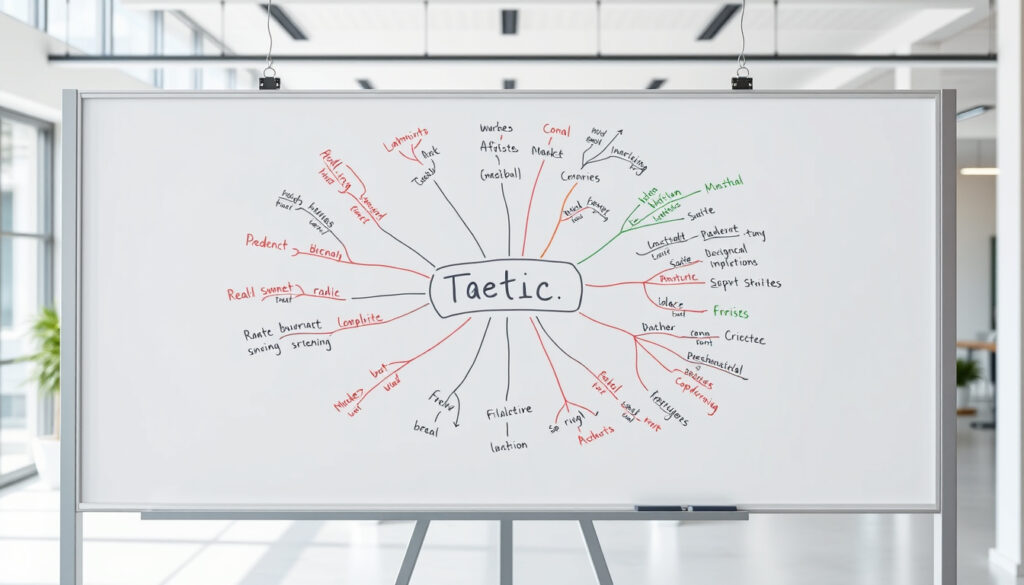
What Is a Mind Map? Definition, Examples, and How to Create One
If you’ve ever stared at a blank page and felt your thoughts scatter, a mind map provides the simple structure you’ve been missing. This visual technique, popularized by author Tony Buzan in the 1970s, turns a central idea into a branching diagram that mirrors how your brain naturally connects concepts.
“A mind map is a powerful graphic technique that provides a universal key to unlocking the potential of the brain.” — Tony Buzan, author and mind map proponent
Origin: Tony Buzan, 1970s ·
Purpose: Visual organization of information ·
Common uses: Note-taking, brainstorming, problem-solving ·
Key components: Central idea, branches, keywords, colors, images
Quick snapshot
- Mind mapping is a creative way of organizing, exploring, and remembering information (Mind Tools)
- Mind maps use a central idea with radiating branches and keywords (Mind Tools)
- Whether mind maps are more effective than linear notes for all learners
- The exact impact of colors on memory retention
- Which digital tool is best for every use case
- Modern mind mapping popularized in the 1970s by Tony Buzan
- AI tools like ChatGPT are now being explored for automated mind map generation
The table below lays out core attributes of mind mapping in a concise reference format.
| Attribute | Detail |
|---|---|
| Inventor | Tony Buzan |
| Year of popularization | 1970s |
| Key components | Central image, branches, keywords, colors, images |
| Common formats | Paper, whiteboard, digital software |
| Popular tools (2025) | MindMup, XMind, Canva, MindMeister |
What is a mind map and example?
Core definition
At its simplest, a mind map is a diagram for visually organizing information around a central concept. It uses a non-linear, radial structure rather than the top-to-bottom flow of traditional notes. According to Mind Tools (career and learning resource), mind mapping is a highly visual ideas-generation technique that mirrors how the human mind works.
A typical mind map places the main topic at the center of the page with lines branching outward to subtopics, as described by StudySmarter (online study platform).
“A mind map is a diagram used to visually organize information around a central idea. It consists of a central topic with branches radiating outward to represent related concepts.” — Wikipedia on mind map definition
Real-world example: planning a vacation
Imagine you’re planning a trip to Japan. You’d write “Japan Trip” in the center of the page. From there, you’d draw branches for “Flights,” “Hotels,” “Food,” “Activities,” and “Budget.” Each of those main branches would then have sub-branches — “Activities” might split into “Temples,” “Museums,” and “Shopping.” This is exactly the kind of structure recommended in MindMeister’s guide to mind map examples.
The mind map’s power comes from its spatial layout — showing relationships visually is what separates it from a bulleted list.
Visual diagram characteristics
Mind maps branch radially around the page in a circular form. This radial arrangement is what allows the brain to see connections at a glance, rather than having to parse a linear sequence.
The implication: a mind map is not just a note-taking trick — it’s a way to model the associative nature of thought itself.
What is the purpose of a mind map?
Note-taking and study aid
For students, mind maps turn dense lecture notes into a memorable visual. The technique is described as a creative way of organizing, exploring, and remembering information by Mind Tools. Instead of transcribing everything, you capture only the essential keywords and their relationships.
Brainstorming and idea generation
Because it’s a brainstorming method, you don’t need to worry about structure or a polished final product when you start, says the University of Southern Maine Learning Commons. The free-form nature encourages creativity by letting ideas flow without judgment.
Problem-solving and decision-making
When you’re facing a problem, the mind map’s visual structure helps you see all the angles. By placing the problem at the center and branching out into causes, constraints, and potential solutions, patterns emerge that might stay hidden in a linear list.
What this means: the purpose of a mind map is never just documentation. It’s a thinking tool that forces you to clarify relationships between ideas.
How to create a mind map?
Creating a mind map is straightforward. The process involves four key steps, each building on the last.
- Start with a central idea: Begin with a blank page or screen and write your main concept in the center. The University of Southern Maine Learning Commons suggests putting the concept in the middle and adding connected ideas as they come to mind. For example, a student might write “Photosynthesis” in the center of the page.
- Add main branches: Draw lines radiating outward from the center for your major categories. In the photosynthesis example, those branches would be “Definition,” “Process,” “Importance,” and “Examples.”
- Expand with sub-branches: For each main branch, add sub-branches for supporting details, examples, or questions. MindMeister recommends expanding each main branch this way to build depth. The key is to use keywords rather than full sentences — a single word or short phrase per line.
- Use keywords, colors, and images: To boost memorability, incorporate colors, icons, and images. The University of Southern Maine Learning Commons notes that tutorials commonly advise using these visual cues to make the map easier to remember. Color-coding branches by theme helps you navigate the map at a glance.
The most common beginner mistake is writing full sentences instead of single keywords. If your map looks like a paragraph, you’ve lost the visual advantage.
The trade-off: a good mind map takes deliberate effort to keep concise. It’s tempting to keep adding detail, but the power lies in distillation.
What three things must a mind map have?
Three components are universally agreed upon by mind mapping guides. Here’s the breakdown:
- A central image or topic: The core idea sits in the middle of the page. Instructables (DIY community) advises beginning with a central image representing the subject.
- Branches radiating outward: Main branches connect to the center, and sub-branches connect to the main branches, creating the radial structure.
- Single keywords on each branch: Each branch should contain a single key word or short phrase, not a full sentence. Instructables recommends using one word per line for key branches.
Why this matters: these three elements work together to create clarity. Remove any one of them, and the map degrades into a list or a confusing spiderweb.
What are the common mistakes in mindmapping?
Even with the right structure, mind maps can go wrong. Here are the most frequent pitfalls identified by educators and researchers.
Overcrowding with too much text
The most common student mistake is trying to put too much information into the map, turning it into a wall of text. InnerDrive (educational coaching resource) identifies this as a frequent problem. Students often use sentences instead of concise keywords, which defeats the purpose of the visual format.
Using too many colors without purpose
Colors should differentiate themes, not decorate. When colors are applied randomly, they distract rather than organize. A student-research article reported mistakes including incorrect coloring and placing branches incorrectly, according to Paedagogia (Universitas Sebelas Maret journal).
Not using images or symbols
Mind maps work better with visual cues. Skipping images and icons removes a key memory aid, making the map harder to recall later.
Forgetting to connect ideas logically
Some students make mind maps that are too linear, which weakens the radial structure. Others fail to extend branches or write the central idea at the edge of the page instead of the center — both mistakes documented in the Paedagogia student research.
If you’re a student, the biggest risk is treating the mind map as a final product rather than a thinking process. The University of Southern Maine emphasizes that it’s a brainstorming method — embrace the mess early on.
The pattern: every common mistake stems from the same root cause — forgetting that a mind map is meant to be a visual hieroglyph, not a text document.
Summary
Mind maps work because they align with how the brain naturally associates ideas — radiating outward from a central concept rather than moving in a straight line. For students facing dense study material, the choice is clear: commit to the discipline of single keywords and visual branches, or continue wrestling with walls of linear text that offer no visual anchor.
Frequently asked questions
Can ChatGPT do mindmaps?
Yes, you can use ChatGPT to generate the structure and content for a mind map. You can ask it to outline main branches and sub-branches for a topic, then transfer that structure into a mind mapping tool. However, ChatGPT produces text, not visual diagrams, so you’ll still need to arrange the branches yourself in a dedicated tool.
What is the best tool to create a MindMap?
The best tool depends on your needs. For quick, collaborative brainstorming, MindMeister is popular. For a free, browser-based option, MindMup works well. For more polished visual design, Canva offers mind map templates. For students, pen and paper remains a low-friction option for practicing the technique.
What is a mind map for students?
A mind map for students is a study and note-taking aid that visually organizes a topic around a central idea. It’s used to capture lecture notes, plan essays, and revise for exams by showing relationships between concepts. The visual structure helps improve memory retention by connecting keywords and images.
What is a mind map in psychology?
In psychology, a mind map is studied as a cognitive tool that reflects how the brain organizes information — through associative connections rather than linear sequences. It’s often used in educational psychology to examine how visual organization impacts memory and learning outcomes.
What is a mind map for kids?
A mind map for kids is a simple, visual way to organize ideas for school projects or creative thinking. It starts with a picture or word in the center, with colorful branches radiating outward for related ideas. Because it uses images and colors, it’s often more engaging for children than a traditional outline.
What is a Mind Map diagram?
A mind map diagram is a visual representation of information that places a central topic in the middle and uses branching lines to connect related subtopics. It’s a non-linear structure that shows relationships between ideas at a glance, making it easier to see the big picture.
What is a mind map in NotebookLM?
In NotebookLM, Google’s AI-powered research tool, a mind map is a visual feature that automatically generates a diagram of your notes and sources. It clusters related concepts together, helping you see connections across your research without manually building the map.
What is a mind map simple definition?
A mind map is a diagram used to visually organize information around a central idea. It consists of a central topic with branches radiating outward to represent related concepts, using keywords and images to make the information easier to remember.
More related posts
 Rabbit Ranch Pinot Noir: Price, Taste & Value
 When Is Spring in New Zealand? Seasons by Month Guide
 Do I Have ADHD? Signs, Symptoms, and Self-Assessment Guide
 6 Weeks From Today: Date, Days & Milestones
 How Old Is Brad Pitt – Age, Height, Family, Career Facts
 170 AUD to NZD: Live Rate & Conversion (March 2025)
 How to Calculate Interest on a Home Loan: Formulas & Examples
 Te Paki Sand Dunes: Height, Entry Fees, and Sandboarding
