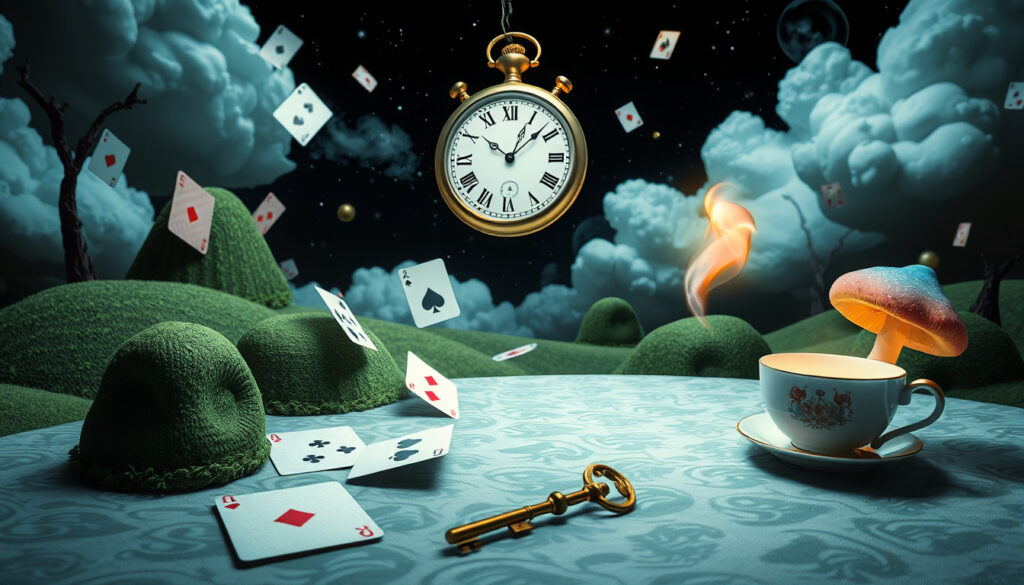
Alice in Wonderland Characters: List, Meanings, Symbolism
A girl falls down a rabbit hole and meets a grinning cat, a frantic rabbit, and a queen who wants to chop off heads, but the characters in Alice’s Adventures in Wonderland have been puzzling readers since 1865 and carry more meaning than a simple children’s story might suggest. This article breaks down the main Alice in Wonderland characters, what they symbolize, and the modern psychological interpretations that keep popping up in online discussions.
Books featuring Alice: 2 main (1865, 1871) ·
Primary characters in the original book: 12+ distinct named characters ·
Most referenced character after Alice: Queen of Hearts ·
Disney animated adaptation year: 1951 ·
Character based on real person: The Dodo (Lewis Carroll) ·
Rule 42 origin: Alice’s Adventures in Wonderland, Chapter 12
Quick snapshot
- Alice is the protagonist of both books (Wikipedia (encyclopedia))
- The Queen of Hearts is the primary antagonist (TheCollector (arts & culture publisher))
- Rule 42 appears in Chapter 12 (Wikipedia (encyclopedia))
- Original illustrations by John Tenniel (Encyclopaedia Britannica (reference publisher))
- Whether any character represents a specific mental illness (no author confirmation)
- Whether Alice is autistic (speculative interpretation only)
- Exact origin of the phrase “mad as a hatter” in relation to the character
- Whether the Duchess is a satire of domestic tyranny or a more complex figure is debated
- First published in 1865 (Encyclopaedia Britannica (reference publisher))
- Disney adaptation released in 1951 (Encyclopaedia Britannica (reference publisher))
- Over 150 years of reinterpretation (Encyclopaedia Britannica (reference publisher))
- Increasing interest in psychological readings of the characters (The Magic Faraway Tree: Age Suitability & Controversy)
- New adaptations continue to be released (e.g., Tim Burton’s 2010 film) (The Magic Faraway Tree: Age Suitability & Controversy)
- Ongoing academic analysis of Victorian satire (The Magic Faraway Tree: Age Suitability & Controversy)
- Related reading: The Magic Faraway Tree: Age Suitability & Controversy
Six key facts about the book and its creator set the stage for understanding the characters.
| Fact | Value |
|---|---|
| First appearance | 1865 (Alice’s Adventures in Wonderland) |
| Author | Lewis Carroll (Charles Lutwidge Dodgson) |
| Original illustrator | John Tenniel |
| Number of chapters | 12 |
| Adaptations count | Hundreds of films, plays, and TV shows |
| Disney voice actors | Kathryn Beaumont (Alice), Ed Wynn (Mad Hatter) |
Who are the most important characters in Alice in Wonderland?
Alice
- Alice is the protagonist and only consistent human character throughout the books (Wikipedia (encyclopedia)).
- She is a curious and logical young girl who falls into Wonderland.
White Rabbit
- The White Rabbit is the catalyst for Alice’s journey — his frantic dash down the rabbit hole pulls her into Wonderland.
- He is always late, nervous, and hurried, embodying the pressure of time.
Queen of Hearts
- The Queen of Hearts is the primary antagonist, known for ordering executions for minor offenses.
- Her signature line, “Off with their head!”, has become iconic.
Cheshire Cat
- The Cheshire Cat is known for its distinctive grin and its ability to appear and disappear at will (Culture Frontier (literary analysis site)).
- It gives Alice cryptic advice and embodies the absurdity of logic.
Mad Hatter
- The Mad Hatter hosts the chaotic tea party and speaks in nonsensical riddles (Open Library of Humanities (academic publisher)).
- He is permanently stuck at 6 o’clock — tea time — and embodies madness.
March Hare
- The March Hare is as mad as the Hatter and co-hosts the tea party, offering unbirthday gifts (Open Library of Humanities (academic publisher)).
- His behavior is a marker of irrational chaos.
Caterpillar
- The Caterpillar sits on a mushroom, smokes a hookah, and asks Alice the pivotal question: “Who are you?”
- He is a figure of identity questioning and transformation.
King of Hearts
- The King of Hearts is a weaker counterweight to the Queen’s tyranny, often portrayed as meek and ineffectual (Wikiwand (encyclopedia aggregator)).
- He presides over the trial of the Knave of Hearts.
The core cast of Wonderland is not a random assortment of oddities. Each character serves a distinct thematic role: the White Rabbit drives the plot, the Queen creates conflict, the Cheshire Cat questions reality, and the Mad Hatter embodies the confusion of Wonderland’s rules. Together they form a complete narrative ecosystem.
The implication: every character is a deliberate tool for Carroll’s satire of Victorian society.
What do each of the characters in Alice in Wonderland represent?
Symbolism of Alice
- Alice is commonly interpreted as a symbol of childhood curiosity, self-discovery, and the transition from childhood to adulthood (TheCollector (arts & culture publisher)).
- Her growth and shrinking reflect the physical and emotional changes of growing up.
Symbolism of the White Rabbit
- The White Rabbit is widely read as a symbol of curiosity, fantasy, escape, and urgency tied to time pressure.
- His constant checking of the pocket watch represents the anxiety of being late.
Symbolism of the Queen of Hearts
- The Queen of Hearts is often interpreted as a symbol of arbitrary adult authority, harsh punishment, and Victorian-style rule enforcement (TheCollector (arts & culture publisher)).
- Her irrational rage makes her a critique of autocratic power.
Symbolism of the Cheshire Cat
- The Cheshire Cat is commonly interpreted as a symbol of ambiguity, paradox, and elusive meaning (Culture Frontier (literary analysis site)).
- Its disappearing act and riddles challenge Alice’s (and the reader’s) assumptions about reality.
Symbolism of the Mad Hatter and March Hare
- The Mad Hatter is frequently interpreted as a symbol of madness, absurdity, and social disorder (Open Library of Humanities (academic publisher)).
- The March Hare is usually grouped with the Mad Hatter as a marker of irrational behavior and comic chaos (Open Library of Humanities (academic publisher)).
- Together they represent the breakdown of logical social conventions.
The symbolism is rich but not always consistent. The same character can be read as a critique of Victorian education (Alice), a warning about time anxiety (White Rabbit), or a satire of royal authority (Queen of Hearts). The interpretations are layered, not fixed.
The pattern: each character’s symbolism is a lens, not a single truth.
Who is the villain in Alice in Wonderland?
The Queen of Hearts as antagonist
- The Queen of Hearts is the most frequently cited villain in the story.
- She orders beheadings for minor offenses such as picking the wrong flowers or contradicting her.
The Knave of Hearts as a scapegoat
- The Knave of Hearts is put on trial for stealing tarts, a plot point that parodies the justice system (Wikipedia (encyclopedia)).
- He is essentially a scapegoat for the Queen’s arbitrary wrath.
Other threatening characters
- The Jabberwock appears in the poem “Jabberwocky” in Through the Looking-Glass but is not a main character in the first book (Wikipedia (encyclopedia)).
- The Duchess and the Cook also display violent tendencies.
Wonderland does not have a standard villain in the Disney sense. The Queen of Hearts is the closest, but the real antagonist is the absurd, rule-bound environment itself. Alice is fighting against a world that makes no sense.
What this means: the true conflict is between Alice’s logic and Wonderland’s absurdity.
What mental illness do the characters in Alice in Wonderland represent?
Alice and possible autism traits
- Some readers interpret Alice’s literal-mindedness and discomfort with social rules as autistic traits, though this is not confirmed by the author.
- These interpretations are speculative and not part of original analysis.
The Mad Hatter and bipolar disorder
- The Mad Hatter’s erratic behavior, rapid mood swings, and nonsensical speech are commonly linked to bipolar disorder in pop psychology (Open Library of Humanities (academic publisher)).
- Again, this is a modern reading, not an original intent.
The Queen of Hearts and narcissistic personality
- The Queen of Hearts’ rage fits, need for total control, and lack of empathy are associated with narcissistic traits.
- Her “off with their head” command reflects a pattern of devaluation.
The White Rabbit and anxiety disorder
- The White Rabbit’s panic over being late, his obsessive checking of the time, and his nervous stammer reflect generalized anxiety.
- He is the embodiment of time pressure stress.
The Cheshire Cat and dissociation
- The Cheshire Cat’s ability to disappear and reappear, along with his detached, cryptic commentary, are sometimes linked to dissociative experiences (Culture Frontier (literary analysis site)).
- His grin remaining after the rest of him vanishes is a powerful image of fragmentation.
These psychological readings are popular online, but they are not supported by Carroll’s own statements. Treating them as definitive interpretations risks over-reading the text. They are useful as lenses, not diagnoses.
The catch: these interpretations are speculative, not authoritative.
What is rule 42 in Alice in Wonderland?
Text of Rule 42
- Rule 42 states: “All persons more than a mile high must leave the court” (Wikipedia (encyclopedia)).
- It is invoked by the King of Hearts to expel Alice from the courtroom because she has grown tall.
Context in the story
- It appears in Chapter 12 of Alice’s Adventures in Wonderland.
- The rule parodies arbitrary legal and social rules that can be changed to suit those in power.
- Alice famously retorts that the rule is “nonsense” and refuses to leave, asserting her own sense of justice.
Rule 42 is a perfect example of Carroll’s satire of the Victorian legal system. The rule is invented on the spot to get rid of Alice, and she calls it out as absurd. It’s a small moment that encapsulates the book’s critique of arbitrary authority.
The implication: rule 42 is a microcosm of Wonderland’s arbitrary justice.
What are the other notable Alice in Wonderland characters?
The Caterpillar
- The Caterpillar asks “Who are you?” and smokes a hookah.
- He is a figure of identity questioning and transformation.
The Duchess
- The Duchess is a domestic tyrant with a baby that turns into a pig (Culture Frontier (literary analysis site)).
- She oscillates between harshness and absurd affection.
The Mock Turtle
- The Mock Turtle tells a sorrowful story about his education and is a symbol of melancholy and nostalgia.
- His name is a pun on “mock turtle soup”.
The Gryphon
- The Gryphon escorts Alice to the Mock Turtle and later to the trial.
- He is a guide-like figure that helps mediate Wonderland’s strange logic.
If you enjoy fantasy characters, check out our guide to How to Train Your Dragon Live-Action: Release Date, Cast, and Rumors Explained.
Confirmed facts
- Alice is the protagonist of both books. (Encyclopaedia Britannica (reference publisher))
- The Queen of Hearts is the primary antagonist. (TheCollector (arts & culture publisher))
- Rule 42 appears in Chapter 12. (Wikipedia (encyclopedia))
- Original illustrations by John Tenniel. (Wikipedia (encyclopedia))
What’s unclear
- Whether any character represents a specific mental illness (no author confirmation).
- Whether Alice is autistic (speculative interpretation only).
- Exact origin of the phrase “mad as a hatter” in relation to the character.
- Whether the Duchess is a satire of domestic tyranny or a more complex figure is debated.
“Who cares for you?” said Alice, in a voice as loud as a lioness. “You’re nothing but a pack of cards!”
— Alice, in Chapter 12 of Alice’s Adventures in Wonderland
…the whole thing is a dream, but that does not prevent it from being a very real and vivid dream, full of the keenest pleasures and most poignant anxieties.
— Lewis Carroll, in a preface to a later edition
For readers searching for deeper meaning, the takeaway is clear: the characters in Wonderland are not just whimsical oddities. They are carefully crafted symbols that critique Victorian society, explore identity, and question authority. The modern psychological interpretations add another layer, but they should be treated as thought experiments, not definitive readings. For anyone who wants to understand why these characters endure, the best starting point is still the original text — and a willingness to sit with the absurd.
youtube.com, scribd.com, simple.wikipedia.org, mymythos.org, en.wikipedia.org, youtube.com, riomaisseguro.rio.rj.gov.br, youtube.com, enotes.com
Beyond the well-known figures, the full list of Alice in Wonderland characters offers a deeper look at every character’s role and symbolism.
Frequently asked questions
What is the meaning of the Cheshire Cat’s grin?
The Cheshire Cat’s grin is often interpreted as a symbol of ambiguity and paradox. It represents the idea that things can exist without a clear foundation — a grin without a cat. This aligns with the book’s theme of questioning reality.
Why does the Queen of Hearts say “off with their head”?
The Queen of Hearts uses this phrase habitually to assert her absolute authority. It is a parody of arbitrary power and the cruelty of the justice system in the Victorian era.
What is the Mad Hatter’s real name?
In Carroll’s original text, the character is simply called “the Hatter.” The name “Mad Hatter” is a popular addition from later adaptations. Carroll never gives him a personal name.
Are Alice in Wonderland characters based on real people?
Some characters are believed to be based on real people. The Dodo is often thought to be a self-portrait of Lewis Carroll, who had a stammer and would say “Do-do-dodgson” (his real surname). Other characters may have been inspired by Oxford acquaintances.
How many books did Lewis Carroll write about Alice?
Lewis Carroll wrote two books about Alice: Alice’s Adventures in Wonderland (1865) and Through the Looking-Glass, and What Alice Found There (1871).
What is the Jabberwock?
The Jabberwock is a fearsome creature from the poem “Jabberwocky” in Through the Looking-Glass. It is often depicted as a dragon-like monster and is slain by a hero. It is not a main character in the first book.
What does the Caterpillar symbolize?
The Caterpillar is often read as a symbol of identity questioning and transformation. His question “Who are you?” is central to Alice’s journey of self-discovery. He also represents the process of change, as caterpillars turn into butterflies.
More related posts
 Te Paki Sand Dunes: Height, Entry Fees, and Sandboarding
 Best WiFi Extender NZ: Top Picks for 2025
 5 Ways to Increase Weight Loss on Wegovy: Proven Tips
 Cheap SIM Deals Vodafone: Best Ireland Plans Compared
 Flight from Wellington to Auckland: Time & Cost
 Alexandra Daddario Movies and TV Shows – Complete Guide Ratings 2024
 Learn to Fly 3: Play Free Online, Mobile & Steam 2025
 Kāinga Ora Tenant Anti-Social Acts: Eviction Guide
