One World Trade Center: History, Facts, and Visitor Guide
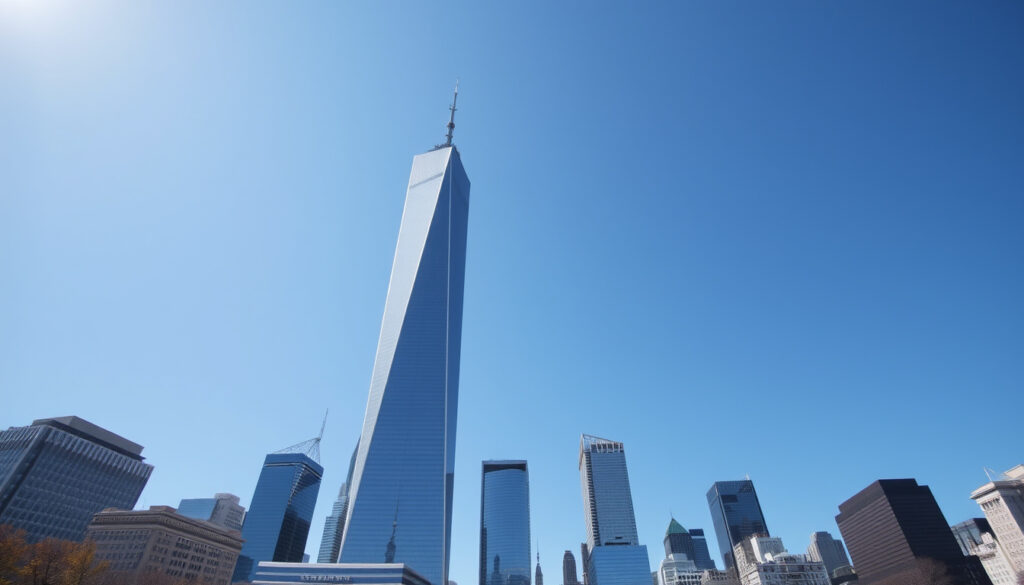
When the original Twin Towers fell on September 11, 2001, the site in Lower Manhattan became a canvas for grief, memory, and rebuilding. The tower that rose in their place—One World Trade Center—was never just another skyscraper; standing at 1,776 feet, it carries the weight of a nation’s recovery and a city’s resolve.
Height: 1,776 ft (541 m) ·
Floors: 104 ·
Year Completed: 2014 ·
Construction Cost: $3.9 billion ·
Architect: David Childs
Quick snapshot
- One World Trade Center is the primary tower of the rebuilt World Trade Center complex (Britannica, encyclopedic reference)
- Height of 1,776 feet was chosen to symbolize the year of the Declaration of Independence (CNN, major news network)
- It officially opened on November 3, 2014 (Britannica, encyclopedic reference)
- One World Observatory opened on May 29, 2015 (CNN, major news network)
- The exact number of unidentified remains from 9/11 still being recovered
- Whether the original Twin Towers would have remained structurally sound indefinitely if not attacked
- 1973: Original Twin Towers completed (9/11 Memorial & Museum, official memorial institution)
- 2001: Twin Towers destroyed (9/11 Memorial & Museum, official memorial institution)
- 2004: Groundbreaking for One World Trade Center (9/11 Memorial & Museum, official memorial institution)
- 2014: Official opening (9/11 Memorial & Museum, official memorial institution)
- Continued role as a global symbol of resilience
- One World Observatory is expected to maintain high visitor numbers annually
| Specification | Value |
|---|---|
| Height (with antenna) | 1,776 ft (541 m) |
| Floors | 104 above ground + 5 below |
| Year Completed | 2014 |
| Construction Cost | $3.9 billion |
| Architect | David Childs (Skidmore, Owings & Merrill) |
| Observatory Floors | 100–102 |
| Observatory Height | ~1,250 ft above ground |
| Location | 117 West Street, Lower Manhattan |
What happened to the One World Trade Center?
Construction timeline
- Groundbreaking took place on April 27, 2006 (Wikipedia, community-maintained reference)
- Structural topping out at 1,776 feet occurred in 2013
- The tower officially opened on November 3, 2014 (Britannica, encyclopedic reference)
Opening and naming
From the start, the tower was referred to as the Freedom Tower in public discourse. Its official name—One World Trade Center—was chosen to reflect the rebuilding of a single, unified tower on the footprint of the original complex. The building opened for tenants in November 2014, and One World Observatory followed in May 2015 (CNN, major news network).
The tower’s construction timeline—from a hole in the ground to the tallest building in the Western Hemisphere in just eight years—is a concrete measure of institutional resolve, not just architectural ambition.
What is so special about the One World Trade Center?
Architectural design and height
- The total height of 1,776 feet (541 m) was deliberately chosen to reference the year the Declaration of Independence was ratified (CNN, major news network)
- The roofline reaches 1,362 feet, matching the elevation of the original South Tower
- With the observatory included, the height is 1,368 feet—matching the original North Tower’s elevation (CNN, major news network)
Sustainability and safety features
One World Trade Center achieved LEED Gold certification, reflecting its energy-efficient design and sustainable materials (LEED, green building certification authority). The building also includes state-of-the-art security systems, such as a reinforced concrete core and extra-wide emergency stairwells, setting a new standard for high-rise safety in the United States.
One World Observatory
Spanning floors 100 through 102, the observatory offers 360-degree views of New York City and New Jersey (Britannica, encyclopedic reference). On clear days, visibility can extend up to 45 miles (TripTins, travel guide). It is the only observatory located in downtown Manhattan.
The observatory’s height deliberately echoes the lost towers—1,368 feet matching the North Tower—yet its modern glass and steel silhouette is distinctly different. The building honors the past without replicating it.
Why do they call it One World Trade Center?
Historical naming of the original World Trade Center
The original World Trade Center opened in 1973 with two towers. The name “World Trade Center” was intended to signal global commerce. After 9/11, the rebuilt complex kept the name to maintain continuity, but the new main tower was designated “One World Trade Center”—a single tower where two once stood.
Reason for ‘One’
- The number “One” signifies unity and singularity, a departure from the twin-tower concept
- It also matches the original building-numbering scheme: the North Tower was 1 World Trade Center, the South Tower was 2 World Trade Center
- Restoring the “One” label ties the new building directly to the original complex’s legacy
Symbolism of the number
The height of 1,776 feet is the most overt symbolic gesture. But the tower also aligns with the footprints of the original towers: the antenna reaches 1,776 feet, while the roofline and observatory elevations echo the destroyed towers’ heights (CNN, major news network).
Is the One World Trade Center the same as the Twin Towers?
The new tower prioritizes safety and symbolism over the twin-tower model in five key ways.
| Feature | One World Trade Center | Original Twin Towers |
|---|---|---|
| Number of towers | Single tower | Two towers |
| Height | 1,776 ft (roofline 1,362 ft) | North: 1,368 ft; South: 1,362 ft |
| Architectural style | Modern glass curtain wall | Modernist with aluminum louvers |
| Security features | Reinforced concrete core, wider stairs | Standard steel frame |
| Official opening | 2014 | 1973 (North), 1975 (South) |
| Visitor attraction | One World Observatory (floors 100–102) | South Tower observatory (Dec 1975–2001) |
The implication: One World Trade Center is fundamentally different in design, purpose, and security—though its height and location deliberately echo the originals.
How did the twin towers fall so perfectly?
Structural engineering details
- The Twin Towers were designed with a perimeter tube structure of closely spaced steel columns
- Boeing 767 aircraft struck the North Tower at 8:46 a.m. and the South Tower at 9:03 a.m. (9/11 Memorial & Museum, official memorial institution)
- The impacts damaged the core columns and released jet fuel that ignited fires
Impact of the planes
The planes carried approximately 10,000 gallons of fuel per aircraft. The resulting fires weakened the steel structures across multiple floors, causing floor trusses to fail and initiate the “pancake” collapse sequence.
Progressive collapse theory
The National Institute of Standards and Technology concluded that the collapse was due to fire-induced structural weakening, not explosives, as some theories claim. The tower collapses were “progressive”—as one floor failed, the next fell in a chain reaction, a process that lasted about 10 seconds for the South Tower and 11 for the North Tower (9/11 Memorial & Museum, official memorial institution).
The engineering lesson from 9/11 was clear: fire resilience must be central to modern skyscraper design. One World Trade Center’s reinforced concrete core and extra-wide stairways are a direct response to those failures.
Timeline signal
- 1973: Original Twin Towers completed (9/11 Memorial & Museum, official memorial institution)
- September 11, 2001: Twin Towers destroyed in terrorist attacks
- 2004: Groundbreaking for One World Trade Center (then called Freedom Tower)
- 2013: Structural topping out at 1,776 feet
- 2014: One World Trade Center officially opens
- 2015: One World Observatory opens to the public (CNN, major news network)
Confirmed facts
- One World Trade Center is the tallest building in the Western Hemisphere (CNN, major news network)
- The tower has 104 floors and stands 1,776 feet (541 m) tall (Britannica, encyclopedic reference)
- It opened in 2014 on the site of the original World Trade Center (SOM, architectural firm that designed the tower)
- One World Observatory draws crowds comparable to the original South Tower observatory
What’s unclear
- Exact number of unidentified remains from 9/11 still being recovered
- Whether the original Twin Towers would have remained structurally sound indefinitely if not attacked
Perspectives on One World Trade Center
“The height of the building—1,776 feet—was chosen specifically to evoke the Declaration of Independence. It’s a number every American recognizes.”
– David Childs, architect of One World Trade Center (SOM, architectural firm that designed the tower)
“One World Trade Center is more than an office tower; it is the centerpiece of the revitalized World Trade Center site, a symbol of resilience and renewal for the entire region.”
– Port Authority of New York and New Jersey (Port Authority, building owner and operator)
newyorkpass.com, new-york-city-travel-tips.com, rd.com, en.wikipedia.org, de.wikipedia.org
For a deeper look at the building’s design and observatory, check out this comprehensive One World Trade Center guide.
Frequently asked questions
How tall is One World Trade Center?
One World Trade Center stands 1,776 feet (541 m) including its antenna (CNN, major news network).
When did One World Trade Center open?
The tower officially opened on November 3, 2014 (Britannica, encyclopedic reference).
How many floors does One World Trade Center have?
The building has 104 stories above ground and 5 basement levels (Britannica, encyclopedic reference).
Can you visit the One World Observatory?
Yes, the observatory is open year-round on floors 100–102. Tickets can be purchased online (One World Observatory official site).
How much did it cost to build One World Trade Center?
The total construction cost was approximately $3.9 billion (CNN, major news network).
Who designed One World Trade Center?
David Childs of the architecture firm Skidmore, Owings & Merrill designed the tower (SOM, architectural firm that designed the tower).
Is there a memorial at the World Trade Center site?
Yes, the 9/11 Memorial & Museum is located adjacent to the tower, with two reflecting pools in the footprints of the original Twin Towers (9/11 Memorial & Museum, official memorial institution).
What is the difference between One World Trade Center and the Freedom Tower?
“Freedom Tower” was the early working name; the official name is One World Trade Center. The two terms are often used interchangeably in popular culture (Tiqets, travel resource).
One World Trade Center is not just a replacement—it is a deliberate, forward-looking structure that honors the past while redefining the skyline. For anyone visiting New York, the decision to experience the observatory is straightforward: the views are unmatched, the history is palpable, and the building itself stands as a concrete statement of resilience. For structural engineers and architecture enthusiasts, the tower’s design innovations—from its symbolic height to its safety features—make it a must-study example of post-9/11 construction. The tower is open, the observatory is waiting, and the story of Lower Manhattan continues to unfold.
More related posts
 Madison De La Garza: Baby Loss, Demi Lovato, and New Film Career
 How to Make Matcha Latte: Recipe, Health Comparison & Tips
 Best Places for Birdwatching in Ireland: Top Sites & Maps
 What Does BV Discharge Look Like? Gray, Thin, Fishy Odor
 The Warehouse Blenheim Road: Hours, Contact & Location
 How to Lose Weight: Science-Based Strategies for Lasting Results
 Nelson Breaking News Today: Latest Updates from Tasman Region
