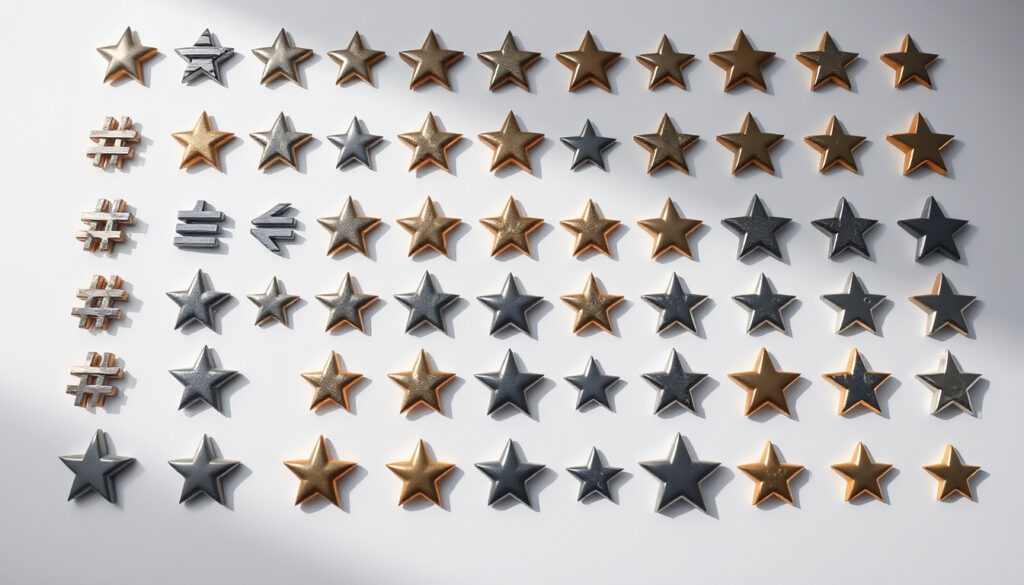
Star Copy and Paste: ★ ☆ ✦ ✪ Symbols, Over 100 Types
You’ve probably stared at a star symbol and wished you could just copy it into your bio, caption, or message. The good news is there are over 100 distinct star characters in Unicode, ready to use in seconds.
Star symbols available: Over 100 distinct Unicode star characters ·
Most copied star emoji: ⭐ (U+2B50) ·
Common platforms: Instagram, Twitter, Discord, text messages ·
Star symbol range: U+2605 to U+2B51 in Unicode
Quick snapshot
- Unicode standard includes multiple star characters (Wikipedia – Unicode block reference)
- Star emoji renders differently on Apple, Google, and Samsung devices (Symbl.cc – star symbols collection)
- All major social media platforms support Unicode star symbols (symbol reference site i2Symbol)
- Exact rendering of 3D star symbols is platform-dependent and not standardized (symbol reference site i2Symbol – rendering note)
- Some older devices may not display newer star emoji (Symbl.cc – compatibility notes)
- Star symbols have been part of Unicode since version 1.1 (1993) (Wikipedia – Miscellaneous Symbols)
- Expect wider support and more star variations in future Unicode releases (Symbl.cc – future outlook)
“Star symbols have been part of Unicode since version 1.1 (1993)” — Wikipedia
Five key facts summarize the landscape of star symbols across platforms.
| Fact | Detail |
|---|---|
| Most popular star symbol | ★ (U+2605) – Black star |
| Most popular star emoji | ⭐ (U+2B50) – White medium star |
| Total star symbols in Unicode | Over 60 distinct characters |
| Year star emoji added | 2010 (Unicode 6.0) |
| Platform with most star support | All modern operating systems and browsers |
What are the most popular star copy and paste symbols?
Aesthetic stars: ★ ☆ ✦ ✧
Aesthetic star symbols are text characters, not emoji. According to symbol reference site i2Symbol, the filled black star ★ (U+2605) and the outline star ☆ (U+2606) are the two most commonly copied. The pinwheel star ✦ (U+2726) and the four-pointed star ✧ (U+2727) are also popular for decorative text.
- ★ – U+2605 (black star)
- ☆ – U+2606 (white star)
- ✦ – U+2726 (black four-pointed star)
- ✧ – U+2727 (white four-pointed star)
Aesthetic stars give you a monochrome, font-driven look. For Instagram bios, they blend seamlessly with text and won’t trigger emoji resize.
Emoji stars: ⭐ 🌟 ✨
Star emoji are multi-code point sequences. As noted by Unicode symbol database Symbl.cc, the white medium star ⭐ (U+2B50) is the most used emoji star, followed by the glowing star 🌟 (U+1F31F) and the sparkles ✨ (U+2728). These render in color on modern devices.
- ⭐ – U+2B50
- 🌟 – U+1F31F
- ✨ – U+2728
Special stars: ✡ ✵ ✪
Beyond the common set, Unicode includes the Star of David ✡ (U+2721) and circled star ✪ (U+272A). Symbol catalog fSymbols lists over 20 additional variants such as the pinwheel star ✵ (U+2735) and the eight-pointed star ✶ (U+2736).
How to copy and paste big and small star symbols?
Big star symbols: ★ ⭑ ⭒
Size is not a Unicode property — it depends on the font and surrounding text. Still, some characters appear larger: the black star ★ is often bigger than smaller variants like the small star ﹡ (U+FE61). According to social media symbol tool AestheticBio, the heavy black star ⭑ (U+2B51) and the heavy white star ⭒ (U+2B52) appear proportionally larger on most screens.
Small star symbols: ﹡ ⁕ ✶
For subtle decorations, use the small asterisk-like star ﹡ (U+FE61) or the five-pointed star ⁕ (U+2055). The eight-pointed star ✶ (U+2736) also works as a compact accent. Star symbol collection EmojiCombos recommends combining small stars with larger ones for layered text effects.
Using font size to scale stars
You can increase the apparent size of any star symbol by applying a larger font size (e.g., font-size: 2em in CSS). For plain-text environments like Instagram captions, wrapping the star in asterisks or spaces can visually enlarge it. Symbol catalog fSymbols notes that all star symbols scale uniformly with text.
- Select the star symbol you want from the lists above.
- Copy the character (CTRL+C on Windows, Cmd+C on Mac).
- Paste it into your document or social media field (CTRL+V / Cmd+V).
- Adjust font size in your editor if needed to control apparent size.
Where can I find shooting star and special star symbols?
Shooting star: ☄ 🌠
The shooting star emoji 🌠 (U+1F320) and the comet ☄ (U+2604) are the standard options for “wish” posts. Aesthetic symbol aggregator CuteInternet includes these in their star collection. Text alternatives like ⇢⋆ are also used for a trailing star effect.
White star: ☆ ⚝
White star variants include the outline star ☆ (U+2606), the circled white star ✩ (U+2729), and the six-pointed star ⚝ (U+269D). Symbol catalog fSymbols lists them as minimalist options for clean designs.
3D star: not directly Unicode, use combination
A true 3D star is not a single Unicode character. According to Symbol creativity guide AestheticTextSymbols, users create 3D-like effects by stacking stars or using emoji like 🌟 with shadow text. Combinations such as ✧*̣̩⋆̩*̣̩ are popular in Discord and social bios.
Shooting star symbols vary widely across platforms — the comet ☄ may appear as a simple dot on older phones, while 🌠 is consistently rendered across iOS and Android since 2016.
How to use star symbols on Instagram and social media?
Instagram bio star symbols
Star symbols are widely supported in Instagram bios. Social media symbol tool AestheticBio provides ready-made combinations like ˖⁺‧₊˚ ˚₊‧⁺˖✮ and °✩ ⋆·˚ ༘ * 🔭 ✶࿐ that fit neatly under a username.
Star symbols in captions and comments
In captions, star symbols can act as bullet points or dividers. For example, ★ rating lists (★★★☆☆) are common. Star symbol collection EmojiCombos confirms that all Unicode stars paste directly into Instagram, Twitter, and Facebook comment fields.
Best star combinations for aesthetic profiles
Popular combos include ⋆。°✩ (from EmojiCombos) and ⋆⭒˚.⋆ ˚⋆𐙚。⋆ (from EmojiCombos Star Symbol). Layering a big star ★ with small stars ⁕ creates a textured look. Symbol creativity guide AestheticTextSymbols recommends mixing sizes: start with a large ★ then add smaller ✶ around it.
Platform compatibility note: All major social platforms accept Unicode star symbols without issue. Use copy-paste for quick deployment.
What is the difference between star emoji and star symbols?
Unicode text stars vs emoji stars
Text stars (★, ☆, ✦) are single Unicode code points. Emoji stars (⭐, 🌟, ✨) are multi-code point sequences that trigger platform-specific design. As Wikipedia – Miscellaneous Symbols reference explains, text stars are monochrome and font-dependent, while emoji stars are colored and designed by each operating system.
Rendering differences on different devices
Star emoji appearance varies: Apple uses a glossy 3D look, Google uses a flat 2D style, and Samsung uses a more rounded design. Unicode symbol database Symbl.cc documents these variations, noting that the same ⭐ can look quite different across devices.
When to use each type
Use text stars for compatibility — they render the same everywhere. Use emoji stars when you want color and visual emphasis, but be aware of cross-platform inconsistencies. For professional or design-heavy contexts, text stars are safer; for casual social posts, emoji stars add charm.
“Star emoji renders differently on Apple, Google, and Samsung devices” — Symbl.cc
Confirmed facts
- Unicode standard includes multiple star characters Wikipedia
- Star emoji renders differently on Apple, Google, and Samsung devices Symbl.cc
What’s unclear
- Exact rendering of 3D star symbols is platform-dependent and not standardized AestheticTextSymbols
- Some older devices may not display newer star emoji Symbl.cc
- All major social media platforms support Unicode star symbols (but some legacy platforms may restrict characters) i2Symbol
- Total star symbols in Unicode is debated – sources cite over 60 or over 100 distinct characters Symbl.cc
Editor’s note: The distinction between text stars and emoji stars is often overlooked. For a foolproof approach, stick with text stars for any platform where consistency matters — your ★ will look the same on an iPhone, a Samsung Galaxy, or a desktop browser.
Frequently asked questions
Can I use star symbols in passwords?
Yes, most websites accept Unicode characters in passwords, including star symbols. However, some legacy systems may restrict to ASCII. Always test before relying on a star symbol in a critical password.
Are star symbols free to use commercially?
Yes, all Unicode star symbols are in the public domain. You can use them in branding, design, social media, and product descriptions without restriction.
How do I type a star symbol on my keyboard?
On Windows, hold Alt and type 9733 (★) or 9734 (☆) on the numeric keypad. On Mac, press Option+Shift+K for ★ or Option+J for ☆. For emoji, use the emoji picker (Windows: Win+. ; Mac: Ctrl+Cmd+Space).
What is the difference between ★ and ☆?
★ (U+2605) is a filled black star; ☆ (U+2606) is an outline (hollow) white star. They are often used together for rating scales: ★★★☆☆.
Do star symbols work in Instagram comments?
Yes, all Unicode star symbols work in Instagram comments. Copy-paste them directly. They may appear slightly smaller than emoji but are fully supported.
Can I combine star symbols with other text art?
Absolutely. Use star symbols alongside decorative text art like ⁂ ☾ ⋆*・゚:⋆*・゚ from AestheticTextSymbols for unique designs on Discord, TikTok, and Instagram.
Why does my star emoji look different on Android vs iPhone?
Each operating system designs its own emoji set. The ⭐ emoji on Apple uses a glossy 3D look; Google uses a flat 2D star; Samsung uses a rounded, softer style. This is normal and expected.
More related posts
 Car Theft Karangahape Road Auckland: Incident Details
 Wellington Airport Arrivals and Departures – Live Status
 1 Cup of Flour in Grams: Conversion Guide (120-125g)
 Disabled Line Marking Wellington: NZS 4121 Standards & Costs
 Is 1 a Prime Number – Definitive Answer and Reasons
 Mens Polo Shirts NZ: Best Brands, Prices & Buying Guide 2025
 Waikato Institute of Education: Courses, Costs & Pathway
 Scent of a Woman – Plot, Cast, Awards and Iconic Scenes
