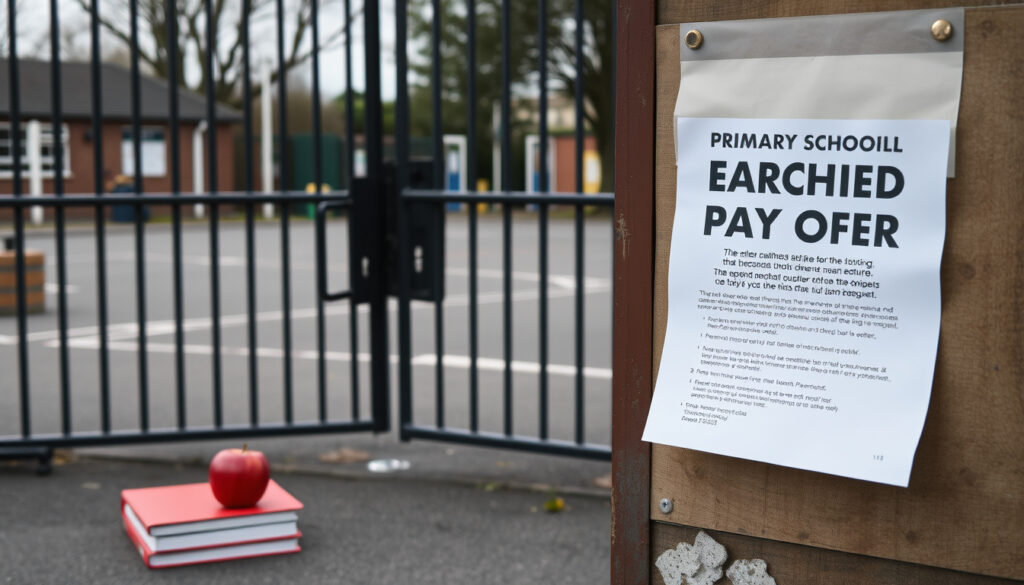
NZEI Primary School Teachers Strike: Pay Offer Rejected
Two pay offers, two rejections, and a strike ballot put classrooms on notice before a facilitated settlement landed on 26 March 2026 and was ratified on 2 April 2026. New Zealand’s primary school teachers rejected the government’s latest offer on 17 December 2025 — after rejecting a September deal and approving a one-day strike for Wednesday 31 May — and the arc from rejection to settlement matters for parents and the 2026 pay round.
Union: NZEI Te Riu Roa · Latest pay offer: Rejected by primary school teachers (17 Dec 2025) · Settlement: Reached 26 Mar 2026, ratified 2 Apr 2026 · One-day strike: Wednesday 31 May · Meeting ban: 1–30 June, outside 8.30am–4.30 · Strike vote trigger: 8 Sept 2025 pay offer rejection
Quick snapshot
- Latest pay offer rejected on 17 December 2025 (Ministry of Education (workforce agency)).
- Earlier offer rejected on 8 September 2025 (NZEI Te Riu Roa).
- Facilitated settlement reached on 26 March 2026 (Ministry of Education (workforce agency)).
- Agreement ratified on 2 April 2026 (Ministry of Education (workforce agency)).
- No official 2026 teacher-shortage projection appears in the supplied bargaining record (Ministry of Education).
- The full list of ballot-approved bans beyond 30 June is not disclosed (NZEI Te Riu Roa).
- The exact terms of the 17 December 2025 offer are not detailed in the collective-agreement record (Ministry of Education).
- 8 Sept 2025 — first offer rejected; strike ballot announced (NZEI Te Riu Roa).
- 16 Sept 2025 — ballot closes; strike resources published (NZEI Te Riu Roa).
- 17 Dec 2025 — latest offer rejected (Ministry of Education).
- 26 Mar 2026 — settlement reached; ratified 2 Apr 2026 (Ministry of Education).
- Agreement runs 2 April 2026 – 2 October 2028 (Education Circular 2026/09).
- 2.5% salary increase from 2 April 2026 (Education Circular 2026/09).
- Further 2.0% (2.1% at steps 9–10) from 28 January 2027 (Education Circular 2026/09).
- $1,000 phased unit increase by 2 October 2028 (Ministry of Education).
The sequence had one pattern: each rejection tightened the dispute, and the settlement released the pressure.
| Label | Value |
|---|---|
| Union | NZEI Te Riu Roa — represents primary and area school teachers in New Zealand (NZEI Te Riu Roa) |
| First rejection | 8 September 2025 (NZEI Te Riu Roa) |
| Rejected offer (steps 1–8) | $1,300 flat increase in year one, $1,200 in year two — roughly 2.7%–4.1% over two years (NZEI Te Riu Roa) |
| Rejected offer (steps 9–10) | 2.5% in year one, 2.1% in year two (NZEI Te Riu Roa) |
| Latest rejection | 17 December 2025 (Ministry of Education) |
| Approved strike action | One-day strike on Wednesday 31 May; ban on meetings outside 8.30am–4.30 from 1–30 June (NZEI Te Riu Roa) |
| Facilitated settlement | Reached 26 March 2026 (Ministry of Education) |
| Ratification | Members voted yes on 2 April 2026 (Ministry of Education) |
| Salary at settlement | 2.5% from 2 April 2026 (Education Circular 2026/09) |
| Next increase | 2.0% from 28 January 2027; 2.1% at steps 9–10 (Education Circular 2026/09) |
| Agreement term | 30 months, 2 April 2026 – 2 October 2028 (Education Circular 2026/09) |
Why are teachers considering strikes?
Teacher strikes rarely arrive without warning. The New Zealand sequence follows a familiar escalation: a pay offer that the union argues falls short, a membership vote, and then a ballot on industrial action.
NZEI Te Riu Roa’s role
- NZEI Te Riu Roa is the union representing primary and area school teachers across New Zealand (NZEI Te Riu Roa (primary teachers’ union)).
- Collective agreement offers are put to members for ratification, as required under section 51 of the Employment Relations Act 2000 (NZEI Te Riu Roa settlement terms).
That ratification step is the engine of the dispute. When members vote an offer down, the union goes back to bargaining — or, if the gap holds, takes the dispute to members through a strike ballot. Both happened here.
The rejected pay offer
- Primary teachers rejected the first offer on 8 September 2025 and moved toward a strike vote (NZEI Te Riu Roa).
- The rejected offer proposed flat increases of $1,300 for teachers on pay steps 1–8 in the first year and $1,200 in the following year (NZEI Te Riu Roa).
- NZEI said that represented roughly 2.7%–4.1% over two years for steps 1–8 (NZEI Te Riu Roa).
- For steps 9 and 10, the offer provided a 2.5% increase in the first year and 2.1% in the second (NZEI Te Riu Roa).
The union’s public position was direct: teachers rejected the offer because it did not meet cost-of-living pressures and did not provide sufficient support for teachers and students (NZEI Te Riu Roa). The dollar figures explain the reaction. Flat increases of $1,300 and $1,200 are easy to model on a payslip — and easy to compare against the weekly cost of groceries and rent.
Approved strike actions
- Members approved a one-day strike on Wednesday 31 May (NZEI Te Riu Roa).
- They also approved a ban on meetings outside 8.30am–4.30 from 1 to 30 June (NZEI Te Riu Roa).
- NZEI published strike posters, flyers, and social media tiles on 16 September 2025 (NZEI Te Riu Roa).
The approved actions were designed to be disruptive without closing every classroom: a single strike day to show membership strength, and a ban on out-of-hours meetings to slow the school admin calendar. The published toolkit suggests the union expected a real campaign, not a gesture.
The rejected offer promised roughly 2.7%–4.1% over two years for teachers on steps 1–8; the ratified deal delivers 2.5% from April 2026 and another 2.0% (2.1% at steps 9–10) from January 2027, plus a $1,000 unit increase. The settlement improved on the offer members turned down.
What is the expected teacher shortage in New Zealand in 2026?
Search behavior around the strike keeps circling back to one forward-looking question: will New Zealand have enough teachers in 2026? It is the kind of question that turns a labor dispute into a staffing forecast.
Why 2026 is the focus
- The 2026 teacher-shortage question is the forward-looking half of the strike story: pay today, staffing next year.
- The Ministry’s collective-agreement record — the most authoritative public document in this dispute — contains no 2026 shortage projection (Ministry of Education (workforce agency)).
That gap matters. A strike is the visible symptom; the shortage projection is the part that predicts whether the symptom returns. Without an official figure, the 2026 question stays a search query rather than a policy number.
How shortages connect to strikes
- When the union names cost-of-living pressure as the reason for rejecting a deal, retention and recruitment are the natural next concern (NZEI Te Riu Roa).
- The settled agreement answers with a 30-month pay path — a longer commitment than the rejected offer (Education Circular 2026/09).
The causal link is straightforward: if teachers believe pay has fallen behind, some leave, and the 2026 classroom count is where that shows up. The official record, however, is quieter than the public demand for answers.
What the supplied sources confirm
- The Ministry’s negotiation pages document the settlement but do not publish a numeric 2026 teacher-supply forecast (Ministry of Education).
- The education circular sets out pay rates and term dates, not staffing projections (Education Circular 2026/09).
- The union’s settlement documents focus on pay and ratification, not supply-side planning (NZEI Te Riu Roa settlement terms).
The 2026 shortage question is running ahead of the official data. Any specific 2026 shortage number circulating online is commentary or a projection, not a figure from the Ministry’s bargaining record.
How much do primary school teachers earn in NZ?
The pay question is the one teachers and parents actually calculate. The supplied documents confirm the direction of pay over the next two years, even though they don’t list every dollar value on every step.
NZ primary teacher pay
- The settlement continues the Unified Base Salary Scale that covers trained teachers (Ministry of Education (workforce agency)).
- From 2 April 2026, salaries rise by 2.5% (Education Circular 2026/09).
- From 28 January 2027, most steps rise a further 2.0%; steps 9 and 10 rise 2.1% (Education Circular 2026/09).
- Units — the allowances for leadership and specialist duties — increase by $1,000 on a phased basis by 2 October 2028 (Ministry of Education).
Two increases in two years plus a unit bump is a deliberate shape: a multi-year wage path the government can budget against, rather than a single settlement bump.
International pay questions
- International comparisons are part of the wider pay conversation, even though they sit outside New Zealand’s official record.
- The New Zealand figures in the official record are the percentages above; the full dollar schedule is not part of the supplied strike coverage.
Benchmarking is natural, but the comparison only works if base salaries are visible on both sides. The percentages confirm the trajectory; the dollar values would confirm the starting line.
Remaining data gaps
- The circular confirms percentages and dates but leaves the full step-by-step dollar table outside the supplied excerpt (Education Circular 2026/09).
- The union’s rejection notice explains why the first offer failed — cost of living and classroom support — but the government’s full counter-costings are not in the public record (NZEI Te Riu Roa).
For a teacher working out their own pay, the honest calculation is: percentages are public, the exact dollar rates sit in the official pay scale the Ministry administers, and the headline path is 2.5% now, 2.0% next year (2.1% at the top steps).
Strike timeline: from rejection to ratification
Eight dates, one pattern: the dispute escalated through ballots, then resolved through facilitation within seven months.
| Date | Event | Reference |
|---|---|---|
| Primary teachers reject the government’s offer and move toward a strike vote | NZEI Te Riu Roa | |
| September 2025 | Strike ballot opens the day after the rejection announcement | NZEI Te Riu Roa |
| Ballot closes; NZEI publishes strike posters, flyers, and social media tiles | NZEI Te Riu Roa | |
| Government’s latest pay offer rejected | Ministry of Education | |
| Facilitated settlement reached | Ministry of Education | |
| NZEI members ratify the agreement | Ministry of Education | |
| Further 2.0% increase takes effect (2.1% at steps 9–10) | Education Circular 2026/09 | |
| Agreement expires; $1,000 unit increase fully phased | Ministry of Education |
The pattern is the story: two rejected offers escalated the dispute, a facilitated settlement resolved it, and the ratified agreement replaced the strike calendar with a pay calendar. The gap between the December rejection and the March settlement was the pressure valve.
The agreement runs to 2 October 2028. The $1,000 unit increase phases in by then, which gives union negotiators a concrete benchmark — and employers a fixed expiry date — for the next round.
The next bargaining round therefore starts with a known pay floor and a fixed expiry date, giving both sides a planning target for 2028.
What’s confirmed and what’s not
Confirmed facts
- Primary teachers rejected the government’s latest pay offer on 17 December 2025 (Ministry of Education (workforce agency)).
- Primary teachers rejected an earlier offer on 8 September 2025 and moved toward a strike vote (NZEI Te Riu Roa).
- Members approved a one-day strike on Wednesday 31 May and a meeting ban from 1 to 30 June (NZEI Te Riu Roa).
- A facilitated settlement was reached on 26 March 2026 and ratified on 2 April 2026 (Ministry of Education).
What’s unclear
- No official 2026 teacher-shortage figure appears in the supplied Ministry and union documents (Ministry of Education).
- The full list of ballot-approved bans beyond 30 June is not disclosed (NZEI Te Riu Roa).
- The exact terms of the 17 December 2025 offer are not detailed in the collective-agreement record (Ministry of Education).
- Whether the approved strike dates went ahead or were stood down is not confirmed in the supplied records (NZEI Te Riu Roa).
The balance leans toward confirmation: the sequence of rejection, ballot, and settlement is fully documented. The uncertainty sits at the edges — shortage forecasts, strike-date outcomes, and the government’s internal costings.
What the union and the ministry said
Teachers rejected the offer because it did not meet cost-of-living pressures or provide sufficient support for teachers and students.
— NZEI Te Riu Roa (primary teachers’ union), on the rejected offer
A facilitated settlement for the Primary Teachers’ Collective Agreement was reached on 26 March 2026.
— New Zealand Ministry of Education (workforce agency), negotiation record
Members voted to ratify the primary-teacher agreement on 2 April 2026.
— New Zealand Ministry of Education (workforce agency), ratification record
Two institutions, one story: the union pushed, the ministry facilitated, and the members voted. The statements that matter are the ones tied to dates, because they mark the points where the dispute changed direction.
What the settlement means
The settlement ends the immediate strike threat and replaces a question mark with a 30-month pay path (Ministry of Education (workforce agency)). For parents and school leaders the timing is the story: the 2.5% increase lands on 2 April 2026, in the middle of school-year budget planning (Education Circular 2026/09). For a teacher weighing two years of ballots, the implication is clear: treat the 2.5% and 2.0% increases as the guaranteed floor, measure them against your own cost of living, or plan for another ballot in 2028.
Related reading
- NZEI Te Riu Roa: Primary teachers reject government offer to vote on strike
- New Zealand Ministry of Education: Primary Teachers’ Collective Agreement negotiation
- New Zealand Ministry of Education: Education Circular 2026/09
- NZEI Te Riu Roa: Primary Teachers’ Collective Agreement — Terms of Settlement (PDF)
These four records form the primary paper trail for the dispute; together they cover the rejection, the settlement, the pay path, and the ratification detail.
Related reading: NZEI Te Riu Roa – Primary teachers reject government offer to vote on strike · New Zealand Ministry of Education – Primary Teachers’ Collective Agreement negotiation
education.govt.nz, workforce.education.govt.nz, education.govt.nz, wsws.org
Frequently asked questions
What is NZEI Te Riu Roa?
NZEI Te Riu Roa is the union representing primary and area school teachers in New Zealand, and it leads collective bargaining on their behalf (NZEI Te Riu Roa).
What did the NZEI ballot approve?
Members approved a one-day strike on Wednesday 31 May and a ban on meetings outside 8.30am–4.30 from 1 to 30 June (NZEI Te Riu Roa).
When did primary teachers reject the government’s latest pay offer?
Primary school teachers rejected the latest pay offer on 17 December 2025 (Ministry of Education).
What happened after the 8 September 2025 rejection?
NZEI announced a strike ballot; it opened the day after the rejection announcement and closed on 16 September (NZEI Te Riu Roa). Strike resources were published the same day the ballot closed.
What strike resources did NZEI publish?
On 16 September 2025, NZEI published strike posters, flyers, and social media tiles for members (NZEI Te Riu Roa).
Is an official 2026 teacher shortage figure available?
No official numeric projection for a 2026 teacher shortage appears in the supplied Ministry and union documents (Ministry of Education).
For parents, the useful takeaway is that the classroom calendar for 2026 is now set by a ratified agreement, not by a strike ballot.
More related posts
 Portugal National Football Team Standings 2026: Qualified
 Hot Water Cylinder NZ: Costs, Lifespan & Top Brands
 Kip & Co NZ: Where to Buy Online, Stockists, Sales & More
 What Does BV Discharge Look Like? Gray, Thin, Fishy Odor
 Christian Horner Net Worth 2025: Payout, Salary & Comparison
 ANZ Term Deposit Rates 2025: Compare Rates & Invest
 Chicken Salad Recipes NZ: Tips from Bourdain & Ramsay
 Salt Gun for Flies: Do They Work? UK Legality, Range, Worth
