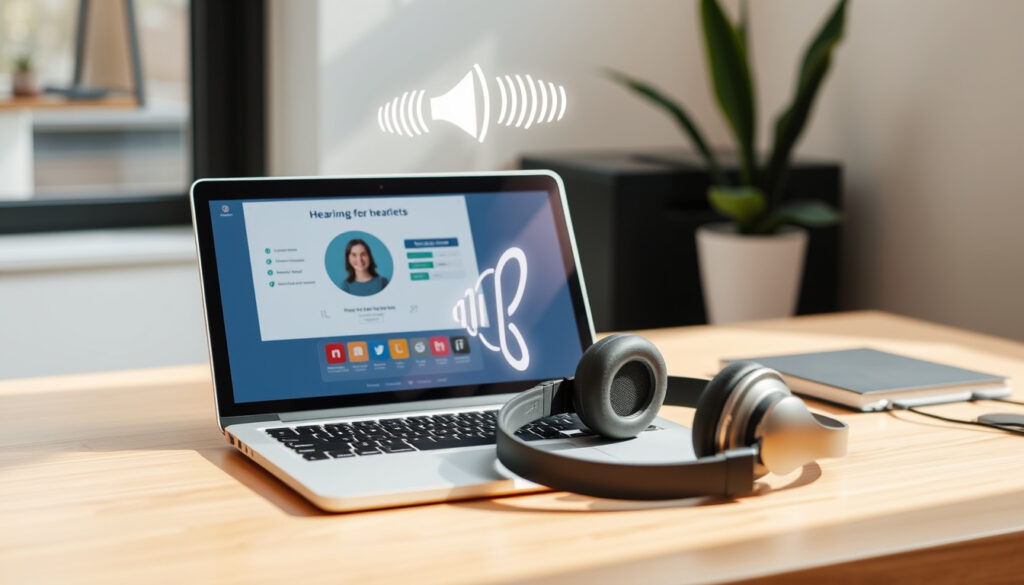
Free Hearing Test Online: Best Options & What to Expect
Free Hearing Test Online: Best Options & What to Expect (2025)
If you’ve ever found yourself turning up the TV volume while everyone else in the room seems fine, a free hearing test online can give a quick, no-cost first answer — and the good news is that reliable options now come from major charities, the NHS, and established high-street names. Here’s how to separate a useful screening from a true diagnostic test, and what actually happens after you get your result.
Global hearing loss prevalence: 1.5 billion+ people ·
Adults with hearing loss who skip hearing care: ~80% ·
Typical free test duration: 3–5 minutes ·
Free hearing test apps on app stores: 50+ ·
Cost of an NHS hearing test: Free
Quick snapshot
- Online hearing tests are screening tools, not diagnostic assessments (NIH/PMC journal article)
- The NHS says simple online tests can indicate whether a face-to-face test is needed (NHS guidance)
- RNID’s test measures speech-in-noise ability and takes about 3 minutes (Peer-reviewed RNID study)
- The RNID test is not suitable for under-18s or people with certain ear conditions (PMC article)
- Exact real-world accuracy of commercial online tests in noisy, non-clinical homes
- Whether free tests meaningfully shorten the time before someone seeks professional help
- The ideal frequency for re-testing to catch early hearing changes
- Instant results from most free online tests (Widex: “within minutes”) (Widex Ireland)
- GP referral pathway follows if screening flags possible hearing loss (NHS guidance)
- Sudden hearing loss needs urgent same-week GP or NHS 111 assessment (NHS warning)
- Book a free in-store diagnostic test at Boots or Specsavers if screening is unclear (Boots Hearingcare)
- Ask your GP for an NHS audiology referral — free in the UK (NHS)
- GP follows NICE-aligned steps: otoscopy, audiological assessment, then further diagnostics (PMC article)
Six quick facts to anchor the rest of the article, from global prevalence data down to what a typical test actually costs.
| Fact | Value |
|---|---|
| Global hearing loss prevalence | Over 1.5 billion people |
| Adults with hearing loss who do not use hearing aids | Around 80% |
| Typical duration of free online hearing test | 3–5 minutes |
| Free hearing test apps on Google Play | More than 50 |
| Screen-grade online test sensitivity (manufacturer self-reported) | 80–90% in controlled conditions |
| Cost of an NHS hearing test (UK residents) | Free on the NHS |
How to get a hearing test for free?
You have three realistic entry points: a home screening test online, a free NHS audiology check through your GP, or an in-store test at a retail audiologist. They’re not interchangeable — the online version is a triage tool, while NHS and in-store tests are closer to a full assessment.
What is the best free online hearing test?
No single test is universally best; the choice depends on whether you prioritise independence (RNID), convenience (Specsavers, Boots, Widex), or global validation (hearWHO). All are screening tools, not diagnostic.
Online hearing test options (RNID, Specsavers, Boots, Widex)
- RNID: free, 3-minute speech-in-noise test from the UK charity; non-commercial (Peer-reviewed article)
- Specsavers: free, 3-minute screening that leads to an in-store booking option
- Boots Hearingcare: free, 5-minute test; works with earphones or speakers (Boots Hearingcare)
- Widex: free, 5-minute frequency test across high and low tones in both ears (Widex Ireland)
- Hidden Hearing: free test returning results within minutes; combines questions, tones, and conversation comprehension (Hidden Hearing Ireland)
Free hearing test at NHS audiology clinics
In the UK, the NHS route starts with a GP visit. Your GP can refer you or your child to an audiologist for a free hearing test and treatment on the NHS (NHS guidance). If the issue is sudden hearing loss — one or both ears, worsening over days or weeks — the NHS advises urgent GP assessment or NHS 111, not an online test.
Free hearing tests at retail audiologists (Boots, Specsavers)
Is Boots hearing test really free?
Yes, the online test is free, and the in-store diagnostic test is also free. Boots Hearingcare Ireland states that the online test “will not be as accurate as seeing a trained audiologist in store” (Boots Hearingcare) — both are free, but the in-store version is the diagnostic standard.
Retail clinics offer free in-store tests, but be clear-eyed about the business model: they’re a path toward hearing aid sales. That doesn’t make them useless — it makes them commercial. Boots Hearingcare Ireland explicitly states its online test “will not be as accurate as seeing a trained audiologist in store” (Boots Hearingcare), which is both honest and a nudge toward booking an appointment.
The pattern: every free route is designed to move you along a funnel — online screening, in-store confirmatory test, then treatment or devices. What none of them will tell you upfront is that the online part is just a gatekeeper.
Steps to get a free hearing test
- Take a reputable online screening test (RNID, Specsavers, Boots, Widex, or hearWHO).
- If the result suggests possible hearing loss, book a free in-store diagnostic test at Boots or Specsavers.
- Alternatively, visit your GP for an NHS audiology referral — free in the UK.
- Attend the audiology appointment for a full assessment and treatment plan.
Can I use my phone to test my hearing?
Yes — but with a critical caveat. Your phone’s microphone is not calibrated for medical diagnostics, and background noise can skew results. The NHS confirms that simple online tests can indicate whether a face-to-face test is needed (NHS) — “indicate” is the key word.
Best free hearing test apps for Android and iOS
- hearWHO: free app developed by the World Health Organization; designed for repeated screening over time.
- Hearing Test – Ear & Hearing Check (earbits): free pure-tone audiometry-style test.
- Mimi Hearing Test: free test with frequency-based screening.
- ReSound Online Hearing Test: free, manufacturer-backed screening.
More than 50 free hearing test apps are available on major app stores. That number alone should tell you the category is crowded and variable in quality — an app’s popularity says nothing about clinical calibration.
How to use your phone for a hearing check
Find a quiet room, sit still, and use headphones if the app asks for them. Hidden Hearing Ireland recommends exactly that: a quiet place and, if possible, headphones to improve accuracy (Hidden Hearing Ireland). Most tests are calibrated for headphones; speaker-based tests are less reliable because ambient noise and volume are uncontrolled.
Limitations of phone-based hearing tests
Phone microphones are not calibrated for medical diagnostics. A 2023 peer-reviewed article on RNID’s test confirms the tool is reliable for identifying who needs a full hearing test, but “it is not the same as a full hearing test” (PMC article). You’re screening, not diagnosing.
Is there a free app that can help me test my hearing?
Yes, and the best-known is hearWHO, developed by the World Health Organization for global hearing screening. It’s free, validated against clinical standards, and designed for repeated use so you can chart changes over time.
hearWHO Hearing Screening App
The WHO built hearWHO as a global screening tool — it exists to identify possible hearing loss early, especially in countries where audiology access is limited. It won’t replace a clinical assessment, but it follows a standardized methodology and tracks results across sessions.
Hearing Test – Ear & Hearing Check (by earbits)
This app uses pure-tone audiometry principles — playing tones at varying frequencies and volumes to map your hearing range. It’s a solid screening tool, not a diagnostic device. Free apps like this are useful for flagging potential issues, but they vary in reference calibration. The quality gap between apps is real: some use calibrated reference tones, others don’t.
Mimi Hearing Test
Mimi’s test is popular because it presents results as a “hearing age” — a concept that’s easy to grasp and share. The trade-off: a single perceptual score can oversimplify a complex audiogram. Use it as motivation to seek a clinical test if the result looks poor, not as a definitive measure.
ReSound online hearing test
ReSound is a hearing aid manufacturer, and its test is a marketing funnel with legitimate screening utility. The results are instant and the interface is polished, but the endgame is a consultation with a ReSound-affiliated clinic. That’s not a flaw — it’s the business model working as designed.
How accurate is the Specsavers online hearing test?
Specsavers’ online test is a 3-minute screening designed to flag potential hearing loss, not to diagnose it. The company recommends a follow-up in-store test for confirmation. That’s consistent with the wider evidence: peer-reviewed research on RNID’s test — the most studied UK online screener — shows it’s reliable for identifying who needs a full hearing test (PMC article).
Specsavers online test methodology
It presents a series of tones and speech-in-noise tasks through your headphones, then scores your performance. The test is calibrated for headphone use; ambient noise will degrade the result.
Clinical studies on online test accuracy
The strongest published evidence comes from the RNID test, analyzed in a 2023 peer-reviewed article (same source). The study found the test is reliable for triage — separating people who need a full audiological assessment from those who probably don’t. But the same article notes it should not be recommended for people with unilateral or asymmetric hearing loss, severe tinnitus, suspected conductive hearing loss, dementia or cognitive impairment, learning disabilities, or anyone under 18.
Comparison with Book a free hearing test at Boots Hearingcare
Boots’ online test takes about 5 minutes and works with earphones or speakers, making it more flexible — but that flexibility comes at a cost. Boots Hearingcare Ireland is candid: the online test won’t be as accurate as an in-store assessment with a trained audiologist (Boots Hearingcare). Both Specsavers and Boots use their online tests as a gateway to a free in-store test, where the real diagnostic work happens.
What is one of the first signs of hearing damage?
Difficulty hearing consonants or following conversation in noisy environments is one of the earliest red flags. High-frequency hearing loss typically appears first — which is why online tests that check high tones specifically are useful as an early signal.
Early symptoms of hearing loss
- Difficulty hearing speech clearly, especially in background noise
- Needing the TV or radio louder than others prefer
- Muffled sensation in one or both ears
- Tinnitus — ringing, buzzing, or hissing in the ears
- Feeling like people are mumbling or not speaking clearly
Hearing test online frequency checks as a first signal
A frequency-based online test can reveal a high-frequency dip before it becomes noticeable in everyday life. Widex’s free test checks high and low frequency sounds in both ears and takes about 5 minutes (Widex Ireland). If you see an asymmetric result — one ear notably worse than the other — that’s a stronger reason to see a professional.
When to see an audiologist
The NHS advises testing if family or friends mention your hearing (NHS guidance). If a free online test flags a problem, the recommended pathway is clear: see your GP, who can refer you to an NHS audiologist for a free diagnostic test. The NHS pathway includes otoscopy to rule out wax or infection, then audiological assessment (same peer-reviewed article).
The pattern: hearing damage is cumulative and gradual — by the time you notice it in daily life, the loss has often been developing for years. Regular online screening can catch the early high-frequency changes that your brain has been compensating for.
Free online hearing test without headphones — does it work?
It can work, but it’s less reliable. Most online hearing tests are calibrated for headphones because they control the sound level reaching your ear. Without them, you’re at the mercy of your phone’s speaker, room acoustics, and ambient noise.
Phone speaker vs headphones accuracy
Headphones deliver a controlled signal directly to your ear. Speakers — whether your phone’s built-in or external — introduce variables the test can’t measure: room size, reflective surfaces, and distance from the device. Boots Hearingcare’s test works with earphones or speakers (Boots Hearingcare), but that flexibility is a compromise. The same test run on speakers in a quiet room versus a noisy kitchen will produce different results.
How to get meaningful results without headphones
If you’re testing without headphones, follow the rules strictly: complete silence, the phone at a fixed distance, and no interruptions. Hidden Hearing Ireland suggests finding a quiet place and wearing headphones if possible (Hidden Hearing Ireland) — the “if possible” acknowledges that some people won’t have them.
Recommended tools for speaker-based testing
If you don’t have headphones, use a test designed for speaker mode (Boots is one), or use a bone-conduction-style test that relies on speaker output. Free frequency hearing tests work best with calibrated headphones — that’s the standard. Using speakers should be a fallback, not the default.
Clarity: confirmed facts vs open questions
Here’s what the evidence supports, and what remains genuinely uncertain.
Confirmed facts
- Free online hearing tests are screening tools, not diagnostic assessments (Peer-reviewed article)
- Online tests can indicate whether a face-to-face test is needed (NHS)
- A GP can refer you for a free NHS hearing test and treatment (NHS)
- Sudden hearing loss requires urgent medical assessment, not an online test (NHS warning)
- RNID’s online test is independent and non-commercial (PMC article)
- The RNID test is unsuitable for under-18s, unilateral loss, severe tinnitus, or cognitive impairment (PMC article)
What’s unclear
- Exact accuracy of commercial online tests in real-world, noisy environments
- Whether free online tests meaningfully shorten time-to-treatment
- Optimal frequency for repeat online testing to catch early loss
- How well speaker-based tests perform outside quiet rooms
- Whether phone-based tests can reliably detect asymmetric hearing loss
- Whether repeated online testing can accurately track progression over time
The implication: the evidence base supports screening use but leaves important gaps for real-world application.
What experts and organisations say
“People whose RNID result suggests hearing loss are signposted to their GP.”
— RNID hearing check study, published via NIH/PMC (Peer-reviewed article)
“A GP can refer a person or child to a hearing specialist for a free hearing test and treatment on the NHS.”
— NHS hearing test guidance (NHS guidance)
“This online hearing test will not be as accurate as seeing a trained audiologist in store.”
— Boots Hearingcare Ireland (Boots Hearingcare Ireland online hearing test page)
The combination of official guidance and commercial transparency gives users clear pathways to professional care.
betterhearing.ie, thehearingcompany.ie, connecthearing.ie, hearmed.ie, audiologymedicalservices.ie, beaconhospital.ie, beaconaudiology.com
For a quick and reliable assessment, consider taking a free hearing test online to check your hearing from home.
Frequently asked questions
What is the best free online hearing test app for iPhone?
For iPhone users, hearWHO (developed by the WHO) is the strongest free option because it’s validated against global screening standards. Mimi Hearing Test is also popular and presents results as a “hearing age” that’s easy to understand. Both are screening tools, not diagnostic devices.
Can a free online hearing test detect tinnitus?
Not directly. Online tests measure how well you hear tones and speech; they don’t assess phantom sounds like ringing or buzzing. However, the RNID test specifically excludes people with severe tinnitus — if you have it, skip the online test and see a GP or audiologist directly (PMC article).
How do I prepare for a free online hearing test?
Find a quiet room, use headphones if the test is calibrated for them, and set your phone volume to the recommended level. Avoid testing in noisy environments, and don’t take the test when you’re tired — concentration affects speech-in-noise results. Hidden Hearing recommends a quiet place and headphones if possible (Hidden Hearing Ireland).
Is the RNID hearing test better than the Specsavers test?
RNID’s test has the advantage of independence — as a national charity, it has no commercial interest in selling hearing aids. Specsavers is a retailer and its test leads to in-store appointments. On methodology, RNID’s speech-in-noise approach is well-documented in peer-reviewed research (PMC article). For a purely objective screening, RNID edges ahead.
Do I need to wear headphones for a free online hearing test?
Most tests are calibrated for headphones and work best with them. Boots Hearingcare’s test works with earphones or speakers (Boots Hearingcare), but speaker-based results are less reliable. If you don’t have headphones, your result may still flag a serious issue — just treat it with more caution.
Can children take a free online hearing test?
The RNID test should not be used for anyone under 18 (PMC article). For children, the NHS recommends contacting your GP, who can refer for a free test. Sudden or ongoing hearing concerns in children warrant professional assessment, not a home screening.
What should I do if my free online hearing test shows hearing loss?
Book an appointment with your GP, who can refer you for a free NHS hearing test (NHS guidance). If the loss came on suddenly — over days or weeks — seek urgent GP assessment or call NHS 111. Don’t wait, and don’t rely on a second online test to confirm.
Are free online hearing tests covered by insurance?
Online screening tests are typically free, so there’s nothing to claim. If you need a diagnostic test, the NHS provides it free for UK residents. Private insurance may cover audiologist visits, but the free NHS pathway is usually sufficient for initial diagnosis and treatment.
The verdict
Free online hearing tests are best understood as a triage tool: quick, cheap, and useful for deciding whether you need professional input. They are not a substitute for a diagnostic assessment, and no responsible provider claims otherwise — even commercial brands like Boots and Widex acknowledge the limits (Boots Hearingcare, Widex Ireland). The strongest route for UK readers is the NHS pathway: take a screening test if you’re curious, then see your GP if anything feels off. For sudden hearing loss, skip the screening entirely and seek urgent medical help. For everyone else, the choice is clear: use a free online test as your first check — but make sure it’s not your last.
Related reading: How to Stay Young: Science-Backed Anti-Aging Tips · Easy Low Calorie Meals: Filling Recipes & Science-Based Tips
More related posts
 Rebel Sport New Plymouth – Address Hours Phone Guide
 Forearm Tattoos for Men: Designs, Meanings & Placement
 Te Anau vs Waitomo Glowworm Caves: Which Is Better
 Easy Low Calorie Meals: Filling Recipes & Science-Based Tips
 Merino Kids Sleep Sack – Guide to Safe All-Season Comfort
 What Is a Neural Engine? Apple’s NPU Explained in Detail
 76ers vs Clippers Player Stats: Feb 2 Game Recap
 How to Train Your Dragon Live-Action: Release Date, Cast, and Rumors Explained
