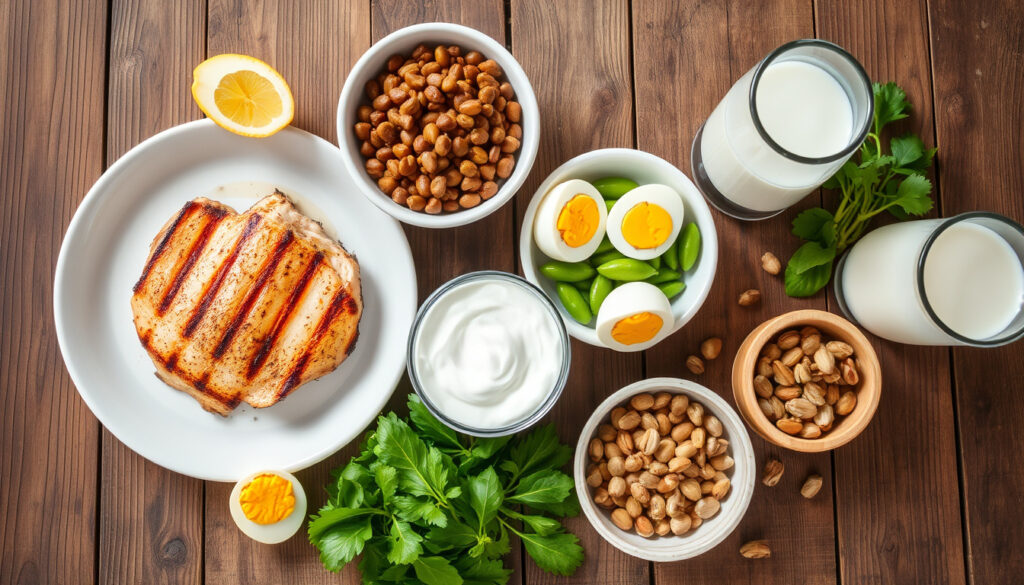
Foods High in Protein: Best Sources, Vegetables, & Drinks
Anyone who has ever felt that 3 p.m. slump after a carb-heavy lunch already understands the appeal of protein: it keeps you full, fuels muscle, and quietly runs half the repair work in your body. The practical question is which foods deliver the most protein per bite — a roasted chicken breast packs roughly 31 grams per 100g, but several plant foods come surprisingly close, and alcohol research adds one more catch worth knowing before your next post-workout drink.
Chicken breast (cooked) per 100g: ~31g ·
Egg protein: 6g per large egg ·
Greek yogurt: 10g per 100g ·
Lentils: 18g per cooked cup ·
Adult RDA protein: 0.8g per kg body weight
Quick snapshot
- Roasted chicken breast delivers ~31g protein per 100g (Nutri-db).
- One large egg provides about 6g (Harvard Health Publishing).
- A cooked cup of lentils supplies ~18g protein plus 15g fiber (Harvard T.H. Chan’s Nutrition Source).
- Post-exercise alcohol cut muscle protein synthesis by up to 37% in a controlled trial (PLOS ONE study).
- Whether any alcoholic drink contains meaningful protein beyond trace amounts.
- How moderate long-term drinking affects muscle mass in people who train consistently.
- Protein needs shift with age and activity: the adult RDA of 0.8g per kg is a floor, not a ceiling (Harvard Health Publishing).
- Spreading protein across 3-4 meals beats one protein-heavy dinner. (Harvard Health Publishing)
- Build a realistic 100g day with the four-step plan further down.
- Keep alcohol out of the post-workout window to protect muscle repair.
Twelve figures settle most protein arguments in advance; the caveat is serving size, which matters more than any single ranking.
| Measure | Value | Reference |
|---|---|---|
| Highest-protein food per 100g (cooked basis) | Seitan ~75g (dry weight); chicken breast ~31g | Nutri-db |
| Highest-protein vegetable per 100g (cooked) | Lentils ~9g; chickpeas ~9g | Harvard Health; Nutri-db |
| Egg protein | 6g per large egg | Harvard Health |
| Greek yogurt protein | 10g per 100g | Nutri-db |
| Salmon protein | 19g per 3-oz serving | Harvard Health |
| Tofu protein | 13g per 3-oz serving | Harvard Health |
| Tempeh protein | 18g per 3-oz serving | Harvard Health |
| Lentils | 18g per cooked cup; 15g fiber | Harvard T.H. Chan |
| Adult RDA protein | 0.8g per kg body weight per day | Harvard Health |
| Cooked soybeans | 18.2g per 100g | Nutri-db |
| Cooked black beans | 8.9g per 100g | Nutri-db |
| Alcohol effect on muscle protein synthesis | Up to 37% reduction in a post-exercise trial | PLOS ONE |
What is the food that’s highest in protein?
If you sort foods by protein per 100g after cooking, the winner is not a steak — it’s seitan, a wheat-gluten meat substitute made almost entirely of wheat protein. Among everyday animal foods, roasted chicken breast takes the crown at roughly 31g per 100g.
Top anmal sources: the muscle-meat club
- Roasted chicken breast: ~31g per 100g — the everyday benchmark.
- Pork tenderloin: ~30.4g per 100g.
- Pan-browned ground beef (93% lean): ~28.9g per 100g.
- Pan-broiled ground turkey (93% lean): ~27.1g per 100g.
- Canned light tuna in water: ~25.5g per 100g.
- Atlantic farmed salmon, cooked: ~22.1g per 100g.
These per-100g figures come from food-composition databse Nutri-db. They line up with Harvard Health Publishing’s serving-size math: a 3-ounce portion of chicken or turkey breast provides about 25g, salmon about 19g, baked tofu about 13g, and tempeh about 18g (Harvard Health Publishing).
Top plant sources: density gets complicated
- Seitan (wheat gluten): ~75g per 100g dry weight — the density outlier, though it absorbs water and drops once cooked.
- Hemp seeds: ~32g per 100g, so a 30g sprinkle adds about 10g.
- Cooked soybeans: ~18.2g per 100g.
- Cooked lentils: ~9g per 100g, or ~18g per cooked cup.
- Cooked black beans: ~8.9g per 100g.
The plant per-100g numbers follow the same Nutri-db comparison, the cooked-lentil cup figure is backed by Harvard T.H. Chan’s Nutrition Source, and hemp seed composition is documented in USDA FoodData Central.
The pattern: per-100g lists measure density, but you eat portions, not exactly 100g of everything. Chicken wins on convenience per bite; legumes win on volume, fiber, and price — the trade-off behind every plant-forward protein plan.
The implication: ranking guides choices, but serving sizes decide outcomes.
Which vegetables are high in protein?
If “high-protein vegetables” makes you picture a mountain of broccoli, adjust the expectation: most non-starchy vegetables land near 3g per 100g cooked. The plants that actually move your daily protein total are legumes — and the grains you serve alongside them.
Legumes: lentils, chickpeas, beans
- Cooked lentils: ~9g per 100g, or ~18g per cooked cup.
- Cooked chickpeas: ~9g per 100g — the same territory as lentils.
- Cooked black beans: ~8.9g per 100g.
Legumes sit at the top of every plant-protein ranking. The USDA’s MyPlate protein foods page groups beans, peas, and lentils with meat and poultry as protein foods (USDA MyPlate), and the per-100g data above confirms they lead the plant side.
Leafy greens: spinach, kale
- Cooked spinach: ~3g per 100g.
- Kale: the same bracket.
Greens earn their place for vitamins and minerals, not protein volume: a whole cup of cooked greens contributes fewer grams than a single egg. Eat them, but do not count on them for your protein target.
Cruciferous: broccoli, Brussels sprouts
- Broccoli: ~3g per 100g cooked.
- Brussels sprouts: roughly the same bracket.
The cruciferous group follows the same logic as leafy greens — excellent for everything else, minor as a protein source.
Grains: quinua, amaranth
- Cooked quinua: ~4g per 100g.
- Amaranth: a similar profile to quinua.
Grains are the quiet helpers: quinua and amaranth bring more protein than white rice at ~2.7g per 100g while still working as a side dish.
A meat-eater can source protein from almost any meal; a plant-forward eater has to plan around legumes and soy, because greens and grains alone will not get you to 100g.
How do I increase my protein intake?
Increasing protein intake requires structure, not a pantry full of powders: snacks that add grams without a full meal, meals that have a protein anchor, and a plan that proves the math.
Protein-dense snacks
- Greek yogurt: ~10g per 100g, or 15-20g in a typical single-serve pot.
- Hemp seeds: a 30g sprinkle adds ~10g to yogurt or oatmeal.
- Hard-boiled eggs: ~6g each — portable, cheap, and ready in advance.
- Peanut butter: a useful add-on to oats or toast, but calorie-dense, so treat it as a supplement to real protein sources.
The food-composition values for Greek yogurt and hemp seeds come from USDA FoodData Central, the official U.S. food-composition database; the egg figure matches Harvard Health Publishing’s 6g per large egg, cited above.
Add protein to meals
- Breakfast: two eggs (12g) plus Greek yogurt (6-10g) lands 18-22g before 9 a.m.
- Lunch: a chicken breast portion (~25g per 3-oz serving) — the single easiest anchor of the day.
- Dinner: a 3-ounce piece of salmon (~19g) or an extra cup of legumes in soups and stews.
These are the same foods from the rankings above, shifted from per-100g math to actual plates.
Use protein supplements
- Whey or plant protein powder: ~20-25g per scoop — the lowest-effort way to top up a short day.
- If you use one daily, pick a powder with minimal added sugar and a short ingredient list.
- That is the key distinction: supplements supplement a food-first plan; they do not replace it.
Plan a 100g protein dday
- Breakfast: 2 eggs + Greek yogurt — about 18g.
- Lunch: chicken breast + quinua — about 35g.
- Snack: protein shake — about 25g.
- Dinner: lentil soup + fish — about 25g.
- Total: roughly 103g, which clears the 100g target for most adults without a single protein bar.
A 100-gram day is two strong meals plus one shake away: no protein bar required, and no individual meal has to be extreme.
The pattern: a 100g day is built by layering — two protein-anchored meals, one shake-snack, and a legume dinner. The total does the work, not any single “superfood.”
The implication: any reader can hit 100g with ordinary portions.
What drink is high in protein?
Drinks are the weakest link of most protein plans: they empty the stomach fast and leave little satiety. A few are genuinely useful.
Milk and milk-based drinks
- Cow’s milk: ~3.5g per 100ml, so a standard 250ml glass adds ~8-9g.
- Flavored milk: same protein, extra sugar — read the label before treating it as a daily choice.
Soy milk and plant milks
- Soy milk: ~3.3g per 100ml — a 250ml glass adds ~8g.
- Frtified plant milks can reach 8-10g per glass; the label, not the carton front, is where the real data lives.
Proten shakes and smoothies
- Whey or plant protein powder: ~20-25g per scoop.
- Blend with milk instead of water to add another ~8g.
- Add Greek yogurt and peanut butter for a 30-40g smoothie that genuinely works as a meal.
Bone broth
- Bone broth: ~5g per cup — a savoriness boost with a small protein kick.
- You would need four cups to match one chicken breast, so treat it as a bonus, not a source.
The trade-off: liquids are convenient but low-density, which is exactly why shakes were invented. For everyday drinking without a scoop, milk and soy milk remain the only no-powder options that add meaningful protein.
Does drinking alcohol cancel out protein?
Cancel is too strong a verb, but the research is honest about the cost: alcohol lands directly on the biological switch that turns protein into muscle.
How alcohol affects protein synthesis
- In a randomized trial published in PLOS ONE, post-exercise alcohol intake reduced muscle protein synthesis by up to 37% compared with a no-alcohol condition.
- The reduction happened even when participants consumed protein alongside the alcohol.
The trial had healthy men train, then drink, then measure how well their muscles manufactured new protein. Alcohol suppressed that repair response by more than a third — a large enough effect to matter for anyone training for strength or size.
Impact on muscle repair after exercise
- Protein still stimulated muscle protein synthesis in the alcohol condition, but far less effectively.
- The size of the drop (up to ~37%) is meaningful for anyone chasing measurable progress.
- For recreational exercisers, the pattern matters more than the single session: repeated post-workout drinking repeatedly blunts recovery.
Best practices for alcohol and protein timing
- Protect the 2-4 hours after training as an alcohol-free window.
- Eat protein before or with alcohol on training days — the study shows protein still helps, just less.
- On rest days, a drink and a protein-rich meal are a far safer combination.
The post-workout window is where alcohol costs the most: muscle protein synthesis drops by up to 37% in the hours right after training, when the body is primed to rebuid.
The takeaway: alcohol does not erase the day’s protein; it taxes the muscle-building response to the meals around it. Timing is the entire story — and the reason a beer after a workout is the most expensive one you can order.
The pattern: timing determines the cost; the post-workout window is the highest-risk moment.
Protein per 100g: The comparison table
One table, one pattern: muscle meat and soy top the density ranking, while legumes carry the plant side. Read it by what you can actually put on a plate, not by gram-for-gram perfection.
| Food | Protein per 100g | Category | Note | ~75g (dry basis) | Plant | Highest density; hydrates into lower cooked values |
|---|---|---|---|
| Chicken breast, roasted | ~31g | Anmal | The everyday benchmark |
| Pork tenderloin | ~30.4g | Anmal | Lean when trimmed |
| 93% lean ground beef, pan-browned | ~28.9g | Anmal | Drain fat for accurate values |
| 93% lean ground turkey, pan-broiled | ~27.1g | Anmal | Lower saturated fat than beef |
| Canned light tuna in water | ~25.5g | Anmal | Pantry-stable convenience |
| Atlantic farmed salmon, cooked | ~22.1g | Anmal | Adds omega-3 fats |
| Cooked soybeans | ~18.2g | Plant | Best whole-soy density |
| Hard-boiled egg | ~12.6g | Anmal | About 6g per large egg |
| Low-fat Greek yogurt | ~10g | Dairy | Roughly double regular yogurt |
| Cooked lentils | ~9g | Plant | ~18g per cup, 15g fiber |
| Cooked black beans | ~8.9g | Plant | Same range as lentils |
Values are compiled from the per-100g data cited above, with serving-size values from Harvard Health Publishing; the point is the shape of the ranking, not decimal-point precision. The implication: a 20-gram-per-day improvement adds up to roughly 140g of protein a week — about five or six chicken breast servings.
How to get 100g of protein a day: A four-step plan
This plan turns the rankings into an actual day. No recipes, no supplements beyond a single shake, and no individual portion that feels like a challenge.
- Breakfast: hit 18g. Two large eggs (12g) plus a Greek yogurt pot (~6g) covers a quarter of the day before 9 a.m.
- Lunch: anchor the day at 35g. A chicken breast portion (~30g) plus quinua (~5g) is the highest-value single meal of the plan.
- Snack: add 25g with a shake. Whey or plant powder in water is the lowest-effort way to push the total over 100g.
- Dinner: close at 25g. Lentil soup (~18g per cup) with a fish portion (~7g) finishes the day at about 103g total.
That is roughly 103g without a single protein bar. The plan also lines up with pre-workout eating: if you train at midday, the lunch step doubles as your training fuel (pre-workout food timing guide).
What this means: the 100g target is not a bodybuilder benchmark. It is a four-step routine that fits around ordinary meals.
What’s confirmed, what’s still unclear
Confirmed facts
- Chicken breast is among the densest common animal proteins, at ~31g per 100g — confirmed across the per-100g data above.
- Eggs are a complete, high-quality protein source (Harvard T.H. Chan’s Nutrition Source).
- Lentils provide ~18g per cooked cup plus 15g of fiber, per the Nutrition Source figure cited above.
- Alcohol acutely suppresses muscle protein synthesis, by up to 37% in a post-exercise trial (PLOS ONE).
Still unclear
- Whether any alcoholic drink contains meaningful protein beyond trace amounts.
- How moderate long-term drinking affects muscle mass in people who train consistently, beyond the acute post-exercise effect.
The balance of evidence leans one way: whole foods and timing are the reliable levers; alcohol is the variable worth controlling.
What the experts say
Daily protein reccomendations vary by age, activity level, and health status.
Mayo Clinic, high-protein diet guidance
Alcohl reduces muscle protein synthesis even when protein intake is adequate.
Dr. Susan Kleiner, sports nutritionist
The through-line between both voices: protein targets are personal, and alcohol is the dietary variable people most often overlook. The number to optimize is the steady day-to-day total, not the occasional deviation.
Protein is about density, distribution, and timing — and alcohol is the one factor that quietly taxes all three. The picture is encouraging: a 100-gram day fits into four ordinary meals, plant-based eaters have real density options in legumes and soy, and the occasional drink is not a catastrophe. For anyone training for muscle, the choice is clear: anchor your day around the protein sources above, keep alcohol out of the post-workout window, and treat rest days as the place for beer — or accept that every pint after training is partially cancellng the repair work you just did.
health.harvard.edu, health.harvard.edu, health.harvard.edu, health.harvard.edu, datanutri.com
Frequently asked questions
What is the recommended daily protein intake for an average adult?
The RDA is 0.8g per kilogram of body weight per day for adults — about 54g for a 68kg person — and it rises with training, age, and health status. Mayo Clinic stresses that the right number depends on the individual (Mayo Clinice).
Is peanutt butter a good source of protein?
It is a moderate source but calorie-dense, so it works best as an add-on to meals rather than a primary protein source. Nuts and seeds, including peanutt, are part of the USDA MyPlate protein foods group (USDA MYPlate).
How can vegetarians get enough protein?
Legumes in one meal, soy or dairy in another, seeds on top. USDA MyPlate’s protein foods group explicitly includes beans, peas, lentils, nuts, and soy products (USDA MyPlate
Does cooking affect the protein content of food?
Coking does not destroy meaningful amounts of protein; it removes water and fat, which concentrates protein per 100g. That is why cooked chicken breast reads ~31g per 100g while raw chicken reads lower, even though the total protein in the serving stays essentially the same.
Can you eat too much protein?
For healthy adults, higher protein intakes are generally safe; the body adapts to moderate excess by using extra amino acids for energy. People with kidney disease should check with a doctor before increasing intake significantly (Mayo Clinic).
Are protein bars healthy?
Read the label as if you were buying cereal: aim for 15-20g protein, under 10g sugar, and an ingredient list you recognize. Many bars are candy bars with protein powder added; the four-step day plan in this guide reaches the same total without them.
What are the best protein sources for weight loss?
The ones that deliver high protein for relatively few calories: chicken breast, turkey, Greek yogurt, lentils, and white fish. They increase satiety per calorie, which makes the daily total easier to hold. For the full strategy, see our guide to How to Lose Weight: Science-Based Strategies for Lasting Results.
More related posts
 Do I Have ADHD? Signs, Symptoms, and Self-Assessment Guide
 How Did Charlie Kirk Die? Assassination, Cause, and Confusion
 Te Paki Sand Dunes: Height, Entry Fees, and Sandboarding
 Gates of Olympus Super Scatter Demo – Free 50,000x Slot
 Rose Park Hotel Auckland: Reviews, Location & Free Parking
 Fire Country Season 4: Episodes, Cast, Release & Renewal
 Tesla Model Y Price NZ 2026: Costs and Buying Guide
 Tomorrow’s Weather Forecast for Bangkok & Thailand
