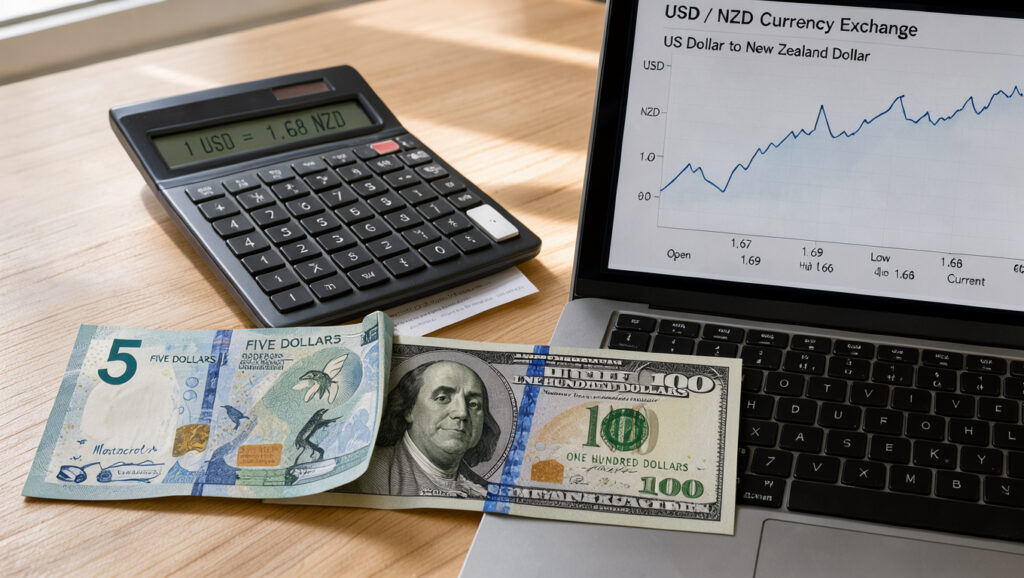
108 USD to NZD: Mid-Market vs Provider Rates Explained
Two currency calculators can give different answers for the same USD 108, and that is rarely anyone’s mistake. Ria Money Transfer lists 1 USD at 1.71108802 NZD dated 2026-09-10, while most newer readings sit higher, so the date matters as much as the provider, and telling a mid-market reference from a provider quote is most of the job.
Xe mid-market (1 USD): 1.77475487 NZD · Wise US mid-market (1 USD): 1.791 NZD · Oldest dated reading (1 USD): 1.69690 NZD · Ria reference (1 USD): 1.71108802 NZD
Quick snapshot
- Xe’s mid-market reading is 1 USD = 1.77475487 NZD, timestamped (Xe (currency converter)).
- Wise’s US page lists 1 USD = 1.791 NZD, dated 2026-10-12 (Wise (US currency converter)).
- Wise’s UK page lists 1 USD = 1.751 NZD, dated 2026-10-09 (Wise (UK currency converter)).
- Which reading applies to USD 108 today.
- What a provider actually pays out on a USD 108 transfer, because the research record holds no such quote.
- Whether any reading matches the day this article is read.
- According to Revolut’s currency converter, the oldest reading is 1 USD = 1.69690 NZD, dated 2025-05-19 (Revolut (fintech currency converter)).
- Ria Money Transfer’s reference page lists 1 USD = 1.71108802 NZD, dated 2026-09-10 (Ria Money Transfer (remittance provider)).
- Check the timestamp on any quote before comparing it with another. (Instarem (money transfer provider))
- Instarem’s page reportedly describes its mid-market rates as informational and says providers should be checked at the time of transfer (Instarem (money transfer provider)), dated 2023-07-06.
Six dated readings and two margin ranges share one pattern: the date of a reading moves the NZD figure, and the provider margin moves what the recipient actually gets.
| Reading | What USD 108 becomes |
|---|---|
| Amount | USD 108 |
| Mid-market reading, Xe (currency converter), dated 2026-10-29T20:35:00Z | 1 USD = 1.77475487 NZD, so USD 108 comes to NZD 191.67 |
| Mid-market reading, Pluang (Indonesian fintech converter) | 1 USD = 1.7586 NZD, so USD 108 comes to NZD 189.93 |
| Reference rate, Ria Money Transfer (remittance provider), dated 2026-09-10 | 1 USD = 1.71108802 NZD, so USD 108 comes to NZD 184.80 |
| Dated 2025-05-19, according to Revolut (fintech currency converter) | 1 USD = 1.69690 NZD, so USD 108 comes to NZD 183.27 |
| Typical UK high-street bank margin on a large personal transfer, Cambridge Currencies (currency broker) | 3% to 4% |
| Typical commercial margin for major currencies, Airwallex (business payments provider) | 0.5% to 1% |
How much is $100 USD in NZ dollars?
USD 100 converts to NZD 175.86 at Pluang’s mid-market reference of 1 USD = 1.7586 NZD. That single figure is the cleanest starting point, and it only describes the day it was captured.
The bigger question is which 108 figure to use, because the readings in the table do not agree.
How much is 108 US dollars in New Zealand dollars today?
- Pluang’s reading turns USD 108 into NZD 189.93.
- According to Revolut’s currency converter, 1 USD = 1.69690 NZD dated 2025-05-19 turns USD 108 into NZD 183.27, and that reading is older than the 2026 readings in this piece.
A converter number without a date is an estimate you cannot audit, so check the timestamp before you quote the figure to anyone.
The implication: Put the date next to every USD 108 figure you use. Without a timestamp, two readings of the same amount look like rival answers, when they are snapshots taken on different days.
Is the NZD weakening?
The research behind this piece does not show a trend. Its readings come from different providers on different days, so each one is a snapshot rather than a direction.
A trend needs a series from a single source over time, and that series is not in the record. Without it, the spread between readings reflects timing and provider methodology as much as movement in the currency.
- Cambridge Currencies calls its margin figures illustrative and says the actual rate depends on amount, currency pair and market conditions.
The pattern: The record holds daily snapshots, not a trend, so any claim that the NZD is weakening needs a dated series from one source behind it.
Does the US dollar go far in New Zealand?
Purchasing power depends on what things cost in New Zealand, and the research behind this piece does not measure local prices. A converted figure tells you how many NZD arrive, not what those NZD buy.
Fees change the arrival amount on larger transfers, so the converted figure is only the first number to check.
- On Wise (provider comparison page), a listed option with a 6.02 USD fee delivers NZD 1,771.48 for USD 1,000, while another with a 4.99 USD fee delivers NZD 1,698.46, which is NZD 73.02 less.
- That comparison uses USD 1,000, not USD 108, so read it as a method rather than a quote for your amount.
The trade-off: A strong converted figure only helps if the fee leaves enough NZD on the other side of the transfer.
Will the NZ dollar get stronger in 2026?
No verified 2026 NZD forecast appears in the research behind this piece, and none is offered here. The readings in the table describe the recent past, not the year ahead.
Any outlook needs a named source before it counts as evidence, and the sources gathered here do not supply one.
- A forecast counts only when a named institution publishes it with a date.
- The euro question needs EUR/NZD data, which the research record does not include.
- No official New Zealand rate series is in the record, so the drivers of the NZD cannot be tied to a central bank source here.
Any 2026 call on the NZD should name the institution behind it and the date it was published, because a converter page carries neither.
What this means: Anyone planning a 2026 conversion is betting on an outcome the record cannot support. A decision that depends on the NZD rising should rest on a named forecast, not a converter page.
Is now a good time to buy NZD?
The research gives no timing signal and no personal financial advice. What it does show is that the number on a converter page and the number on your payment can differ.
Airwallex says its converter rate is a live snapshot, and the executable rate is locked only when you confirm the transaction.
- Confirm the executable rate inside the provider’s own transfer flow before you commit.
- Compare the quote with a mid-market reading dated the same day.
- Check the margin the provider adds on top of the mid-market rate.
Banks and providers quote below the converter headline, so a converter figure is the best case, not the payout. WorldFirst says banks often add a margin to the mid-market rate (WorldFirst (payments provider)).
The trade-off: Waiting for a better quote costs time and keeps you exposed to the same market moves, so a timestamped quote in hand usually beats another converter reading.
Confirmed facts
- Xe says its converter rate is for informational purposes only and is not the rate received when sending money.
- WorldFirst says conversion rates differ between providers because of markups, fees and pricing models.
What’s unclear
- Which reading applies to USD 108 today.
- What provider quote a USD 108 transfer receives, because the research holds none.
- Whether the NZD gains or loses ground against the USD or the euro in 2026.
A mid-market reference is not a rate anyone can transact at, so it works as a reference point rather than a price.
Cambridge Currencies (currency broker), paraphrased from its USD to NZD page
The rate on a converter is a live snapshot, and the executable rate is locked only when you confirm the transaction.
Airwallex (business payments provider), paraphrased from its converter page
The reading you pick sets the NZD you plan around, and the date on that reading matters as much as the provider behind it. A payer who skips a locked, timestamped quote takes whatever converter reading the day brings, and Airwallex says the executable rate is set only when the transaction is confirmed.
Related reading: BNZ SWIFT code for New Zealand bank transfers · how to calculate interest on a home loan
xe.com, wise.com, pluang.com, usd.currencyrate.today, xe.com
Frequently asked questions
What is the mid-market USD to NZD rate?
The sources gathered for this piece hold several dated mid-market readings, but none can be confirmed as today’s figure. Check the date on any reading before you use it.
Why do bank and card rates differ from the mid-market rate?
The mid-market rate is the midpoint between interbank buy and sell prices. According to the Everydaybudd currency converter guide, banks reportedly charge 3% to 6% spreads on currency exchange (Everydaybudd (financial education site)).
Which sources publish official NZD exchange rate data?
None of the sources gathered for this piece is a central bank or government rate series for USD to NZD, so the figures here come from commercial converters and providers.
How do I calculate NZD from a USD amount by hand?
Multiply the USD amount by the NZD-per-USD reading, then write down the date of that reading next to the answer. The table above applies this method to USD 108.
Is a converted amount guaranteed for a set time?
No. Instarem’s page reportedly describes its mid-market rates as informational and subject to regular fluctuation, and it advises checking providers at the time of transfer.
More related posts
 Properties for Sale in Christchurch, Dublin: 2025 Guide
 Ted Danson Black Face: 1993 Friars Club Roast Explained
 Patrick Tuipulotu Re-Signs with Blues and NZ Rugby Until 2028
 Alex Warren Carry You Home: Meaning, Lyrics & Release Info
 Members of Red Hot Chili Peppers – Current Lineup and Full History
 Mariners vs Blue Jays: ALCS Game 7 Score, Recap & 2026 Odds
 Westpac to ANZ Transfer Time in NZ: Processing Guide
 Most Expensive LEGO Sets: Retail & Auction Prices
