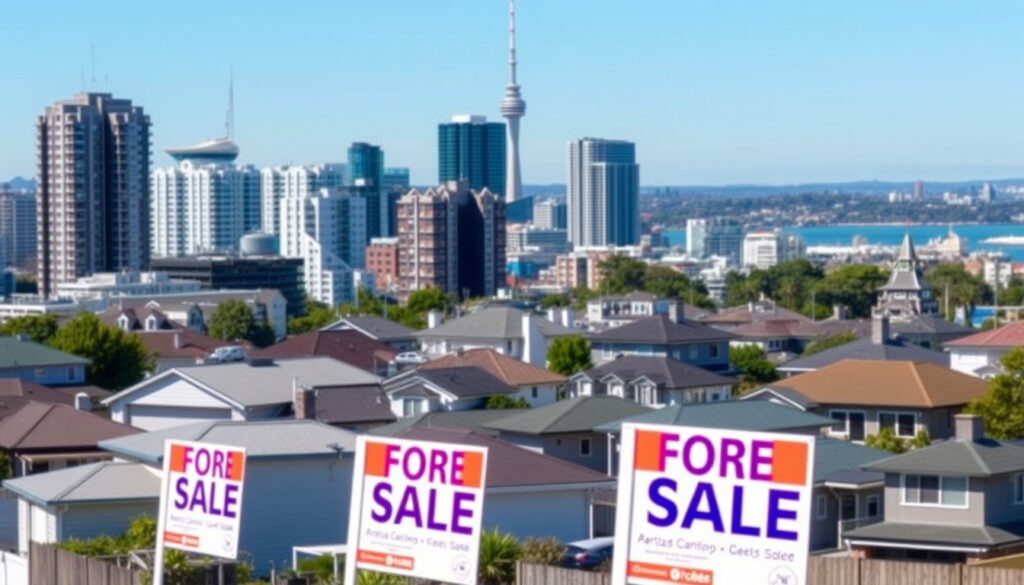
Properties for Sale in Auckland: 2025 Guide for Buyers
Anyone who has scrolled through Trade Me listings for Auckland has likely felt the same whiplash: a villa in Remuera sitting at $4 million, and a tidy townhouse in Papakura under $800,000, both in the same city. How that market works — and who can actually buy into it — changed dramatically in late 2025.
Median house price in Auckland: $1,050,000 (2024) ·
Foreign buyer ban: Yes, since 2018 (except Australians and Singaporeans) ·
Typical deposit required: 20% of purchase price ·
Most expensive suburb: Remuera (median over $3M) ·
Fastest price growth (2024): Papakura (+8%) ·
Salary needed for median house: ~$150,000 household income
Quick snapshot
- Foreign buyers banned from purchasing existing residential dwellings since 2018 under the Overseas Investment Act (Land Information New Zealand (govt regulator))
- Auckland median house price dropped from peak of ~$1.2M to $1,050,000 (Dec 2024) (realestate.co.nz (property data aggregator))
- Remuera is the most expensive suburb with a median of $3,200,000 (realestate.co.nz (property data aggregator))
- Whether the market will rebound in 2025 or continue to decline
- Impact of upcoming interest rate cuts on buyer demand
- Future changes to foreign buyer restrictions under the new government
- 2018: Overseas Investment Amendment Act bans foreign buyers of existing homes (Land Information New Zealand (govt regulator))
- 2021-2022: Auckland house prices peak (median $1,200,000) (realestate.co.nz (property data aggregator))
- 2023-2024: Prices decline 5-10% in many suburbs (realestate.co.nz (property data aggregator))
- 2025 (forecast): Modest recovery expected, interest rates forecast to stabilize (Land Information New Zealand (govt regulator))
- New government policy allows certain investor-visa holders to buy homes valued at NZ$5M+ starting early 2026 (Immigration New Zealand (govt immigration authority))
- Market expected to stabilize in 2025 with modest growth (realestate.co.nz (property data aggregator))
- First Home Grant up to $10,000 still available for eligible buyers (Kāinga Ora (NZ government housing authority))
| Metric | Value |
|---|---|
| Median house price (Auckland, Dec 2024) | $1,050,000 |
| Foreign buyer ban active | Yes (since 2018) |
| Typical deposit required | 20% |
| Most expensive suburb median | Remuera: $3,200,000 |
| Fastest growing suburb (2024) | Papakura: +8% |
| Foreign buyer threshold (new pathway) | NZ$5 million |
| Properties nationwide valued at $5M+ | ~5,000 to 6,000 homes |
| Salary needed for median house | ~$150,000 household income |
| First Home Grant max (couples, existing home) | $10,000 |
| National median vs Auckland | Auckland ~50% more expensive |
The table reveals a market split: the top 0.5 percent of stock sits above the $5 million threshold, while the median buyer faces a $1,050,000 entry point with a 20 percent deposit requirement. The gap between Remuera and Papakura is the entire story of Auckland’s affordability stretch.
| Suburb | Median Price | 2024 Trend | Buyer Profile |
|---|---|---|---|
| Remuera | $3,200,000 | Decline from peak | Wealthy families, corporate leaders |
| Papakura | ~$750,000 | +8% growth | First-home buyers, investors |
| Herne Bay | $3,000,000+ | 10%+ decline from peak | Luxury buyers, expats |
Can foreigners buy property in Auckland?
Who is allowed to buy property in New Zealand?
- New Zealand citizens and permanent residents can buy any residential property without restrictions.
- Australian and Singaporean citizens are exempt from the ban and can purchase existing dwellings.
- Holders of a resident visa (with conditions demonstrating intent to live permanently) may buy a single home to live in, subject to Overseas Investment Office (Land Information New Zealand (govt regulator)) consent.
What are the exceptions to the foreign buyer ban?
- Under the 2018 Overseas Investment Amendment Act, most non-residents are banned from buying existing residential dwellings.
- They can still buy new-build properties (off-plan apartments and townhouses) without consent, provided the developer has an exemption certificate.
- Australians and Singaporeans have unrestricted access to the residential market.
In a significant shift, the New Zealand Government announced in September 2025 its intention to allow certain overseas-based investors holding Active Investor Plus, Investor 1, or Investor 2 visas to buy or build a house valued at NZ$5 million or more (Immigration New Zealand (govt immigration authority)). The formal amendment was passed on 12 December 2025 under urgency, with the rule change expected to take effect in early 2026 — possibly as late as 1 April 2026 (Lane Neave (specialist property law firm)).
Steps for eligible foreign buyers to purchase in Auckland
- Verify visa eligibility (Active Investor Plus, Investor 1, or Investor 2 visa).
- Confirm the property is valued above NZ$5 million and is not sensitive land (non-urban land over five hectares, land adjoining foreshore, or properties on Waiheke Island, per Lane Neave (specialist property law firm)).
- Apply for consent from the Overseas Investment Office.
- Secure financing with a 20% deposit and a pre-approved mortgage from a New Zealand bank.
- Engage a local lawyer or conveyancer to manage the conveyancing process (typically 4-6 weeks).
Are Auckland house prices dropping?
Recent price trends in Auckland (2023-2025)
- The median house price in Auckland stood at approximately $1,050,000 in December 2024, a drop of about 5% from the peak of $1,200,000 in 2021-2022 (realestate.co.nz (property data aggregator)).
- Some suburbs, particularly in the premium segment like Herne Bay, saw declines of 10% or more from their peaks.
Suburbs where house prices are falling fastest
- Herne Bay: median values dropped by over 10% from peak, reflecting the higher-end correction.
- Remuera: also saw price declines, though the median remains above $3 million, the highest in Auckland.
Suburbs where house prices are rising fastest
- Papakura: reported the fastest growth in 2024 at +8%, driven by relative affordability and first-home buyer demand.
- Pukekohe: also saw price increases due to its lower entry point and growing amenities.
- West Auckland (Henderson, Te Atatu): steady growth as buyers pivot away from the most expensive central suburbs.
For investors, the market split means they cannot rely on a single trend. Luxury suburbs lost 10% while Papakura gained 8% — the same city, diverging entirely based on affordability.
The pattern: Prices are not dropping uniformly. The most expensive suburbs are correcting while value-growth suburbs show resilience, a clear sign that affordability is the dominant driver in 2024-2025.
What is the average cost of a house in Auckland?
Average house price by Auckland district
- Auckland City district median: $1,200,000 (realestate.co.nz (property data aggregator)).
- Manukau district median: $900,000.
- North Shore district median: $1,150,000.
- Waitakere district median: $800,000.
Price ranges for different property types
- Standalone houses: typically $1,000,000 to $1,500,000 in central suburbs; $700,000 to $950,000 in outer suburbs.
- Townhouses: 10-15% cheaper than standalone houses, averaging around $700,000 to $1,100,000 depending on location.
- Apartments: from $450,000 for a one-bedroom unit in the city fringe to $1.5 million+ for premium waterfront apartments.
How Auckland compares to other New Zealand cities
- Wellington: median around $800,000 (about 24% cheaper).
- Christchurch: median around $650,000 (about 38% cheaper).
- Auckland’s median is about 50% higher than the national average.
The trade-off: Auckland offers the strongest job market, best schools, and international connectivity, but buyers pay a 50% premium over the national median. For remote workers, the price gap with Christchurch is hard to justify.
What salary do you need to buy a house in NZ?
Income requirements for a mortgage in Auckland
- Lenders typically require a 20% deposit to avoid low-equity mortgage premiums (Interest.co.nz (NZ personal finance resource)).
- For a median-priced house of $1,050,000, a household income of around $150,000 per year is needed to service an $800,000 mortgage at current interest rates (approximately 6.5%).
- This assumes a deposit of $210,000 (20%) and debt-to-income ratio of 5.3x.
How much deposit do you need to buy a home in NZ?
- Standard deposit for a low-equity loan: 20% of the purchase price (Reserve Bank of New Zealand (central bank regulator)).
- Some lenders accept 10% deposits for first-home buyers, but this triggers low-equity premiums and higher interest rates.
- For investment properties, deposits of 30-40% are typically required.
First-home buyer schemes and grants
- First Home Grant: up to $10,000 for eligible couples buying an existing home, or $20,000 for new-builds (Kāinga Ora (NZ government housing authority)).
- KiwiSaver withdrawal: first-home buyers can withdraw most of their KiwiSaver savings (excluding the government contribution and employer contributions) for a deposit.
- First Home Partner scheme: the government can take a minority share in your first home to reduce the mortgage required, available through Kāinga Ora (NZ government housing authority).
Even with the First Home Grant, an Auckland couple needs roughly $210,000 in savings for a 20% deposit on the median house. At the average Auckland household savings rate, that’s over a decade of disciplined saving for most.
Why this matters: The deposit hurdle is the real barrier, not the monthly payments. KiwiSaver helps, but it rarely covers half the required deposit for an Auckland-priced home.
What is the nicest suburb of Auckland?
Best suburbs for families in Auckland
- Epsom: excellent school zones (Auckland Grammar and Epsom Girls’ Grammar), quiet streets, and family-sized homes starting around $1.5 million.
- Takapuna: coastal lifestyle with top-rated schools, parks, and a village centre; median house price around $1.4 million.
- Howick: historic village vibe, strong community, and more affordable entry at $950,000 for a standard three-bedroom.
Where do expats live in Auckland?
- Parnell and Ponsonby: popular with professional expats drawn to café culture, boutique shopping, and proximity to the CBD (ExpatArrivals (expat community resource)).
- Mission Bay: beachfront suburb with a village atmosphere, popular with American and British expats.
- Devonport: ferry access to the city, historic character, and a tight-knit expat community.
Where is the rich part of Auckland?
- Remuera: the most expensive suburb with a median property value above $3.2 million. Home to many of Auckland’s wealthiest families and corporate leaders.
- Herne Bay: sits on the Waitematā Harbour with median values exceeding $3 million; known for its historic mansions and celebrity residents.
- St Mary’s Bay: adjacent to Herne Bay, with similar prestige but slightly smaller properties.
- Westmere: a quieter luxury option near the Western Springs park, with median values around $2.5 million.
The implication: Auckland’s geography of wealth is concentrated on the central isthmus’s northern and eastern ridge. For buyers seeking value, the growth corridors are south (Papakura, Pukekohe) and west (Henderson), where the city’s new infrastructure is being built.
Timeline: How Auckland property rules evolved
- 2018: Overseas Investment Amendment Act bans foreign buyers of existing homes (Land Information New Zealand (govt regulator))
- 2021-2022: Auckland house prices peak at median $1,200,000
- 2023-2024: Prices decline 5-10% in most suburbs, interest rates rise from 2.5% to over 6%
- September 2025: Government announces policy change for investor-visa holders to buy homes $5M+ (RNZ (NZ public broadcaster))
- 12 December 2025: Amendment formally passed under urgency (Lane Neave (specialist property law firm))
- Early 2026 (estimated): New rules come into force, likely 1 April 2026
The timeline signal is clear: the market correction is winding down and policy is pivoting back towards selective foreign investment, but the window is narrow — $5 million and above — and geographically concentrated in Auckland and Queenstown.
Pros and cons of buying property in Auckland in 2025
Upsides
- Strong job market and migration-driven population growth support long-term demand
- Prices are down 5-10% from peak, offering a better entry point than 2021
- First Home Grant and KiwiSaver reduce the deposit burden for eligible buyers
- Selective foreign investor pathway could inject demand into the luxury segment
Downsides
- Median price remains $1,050,000 — unaffordable for many on a single income
- Deposit of 20% (~$210,000) is a high barrier for first-home buyers
- Interest rates remain elevated (6-7% range) with uncertain cuts ahead
- Foreign buyer ban limits competition but also reduces exit liquidity
First-home buyers face a paradox: lower prices but higher interest rates. The decision is not “can I afford the deposit?” but “can I afford the monthly payments once I have it?”
The implication: Buyers must weigh timing against carrying costs. A price drop only helps if you can service the loan.
Summary
The Auckland property market in 2025 offers a rare convergence: prices are off their peak, the foreign buyer ban remains tight for most, and the government has introduced a high-end pathway for ultra-wealthy investors. For first-home buyers with KiwiSaver savings and a steady household income of $150,000, the market is the most accessible it has been since 2020 — but only if they have the discipline to save a $210,000 deposit. For the foreign investor without a $5 million budget, the answer remains the same as 2018: look at new builds, or look elsewhere in New Zealand. For Auckland buyers in the middle, the choice is clear: buy now with the best borrowing rates in a year, or wait for further price declines that may not come.
forbes.com, nzjournal.nz, youtube.com, therealdeal.com, youtube.com, nypost.com, reuters.com, imidaily.com
Frequently asked questions
Do I need a lawyer to buy property in New Zealand?
Yes. Under New Zealand conveyancing practice, all property purchases must be legally processed through a licensed conveyancer or lawyer. They handle the title search, review the sale and purchase agreement, and manage settlement through the electronic conveyancing system (Landonline).
What is the stamp duty or land transfer tax in NZ?
New Zealand does not have a stamp duty or land transfer tax on residential property purchases. The only government cost at purchase is the registration fee for the title transfer (currently around $20-$100 depending on the transaction).
Can I buy a property as a temporary resident on a work visa?
Temporary residents on work visas cannot buy existing homes unless they are Australian or Singaporean citizens. They can purchase new-build properties (off-plan) directly from developers who hold an exemption certificate from the Overseas Investment Office.
How long does the buying process take in Auckland?
The typical purchase timeline is 4-6 weeks from offer to settlement, provided financing is pre-approved. The unconditional offer to settlement period is usually 4 weeks for existing homes, and longer for new builds (completion-dependent).
What is a LIM report and do I need one?
A Land Information Memorandum (LIM) is a report from the local council that details information about a property: consents, permits, hazards, and zoning. It is recommended for all purchases and helps identify unconsented work or future development constraints. Most buyers get one before making an unconditional offer.
Are there any tax implications for foreign buyers selling property?
Non-residents who sell a residential property within five years of purchase are subject to the bright-line test, which taxes the gain at their marginal income tax rate. Properties bought after the rule change (2026) under the investor visa pathway are not exempt from this test unless the owner becomes a tax resident of New Zealand.
What is the difference between freehold and leasehold in Auckland?
Freehold means you own the land and the house outright. Leasehold means you own the building but lease the land from the landowner (often in city centre apartments or special coastal areas). Auckland has a notable leasehold market in central apartments, and buyers should be aware of ground rent escalation clauses.
The verdict for buyers: match your budget to the corridor that fits, not the suburb you wish you could afford.
More related posts
 Baby Bunting Change Table with Drawers: Guide & Safety
 UFC 319 Fight Card: Results, Time, and Full Card
 Tomorrow’s Weather Forecast for Bangkok & Thailand
 Things to Do in Lower Hutt: Top Attractions & Hidden Gems
 Properties for Sale in Christchurch, Dublin: 2025 Guide
 Love It or List It Australia – Hosts, Format and Foxtel Guide
 Christian Horner Net Worth 2025: Payout, Salary & Comparison
 Eli Sweeting Missing Milford Sound: Search Updates
