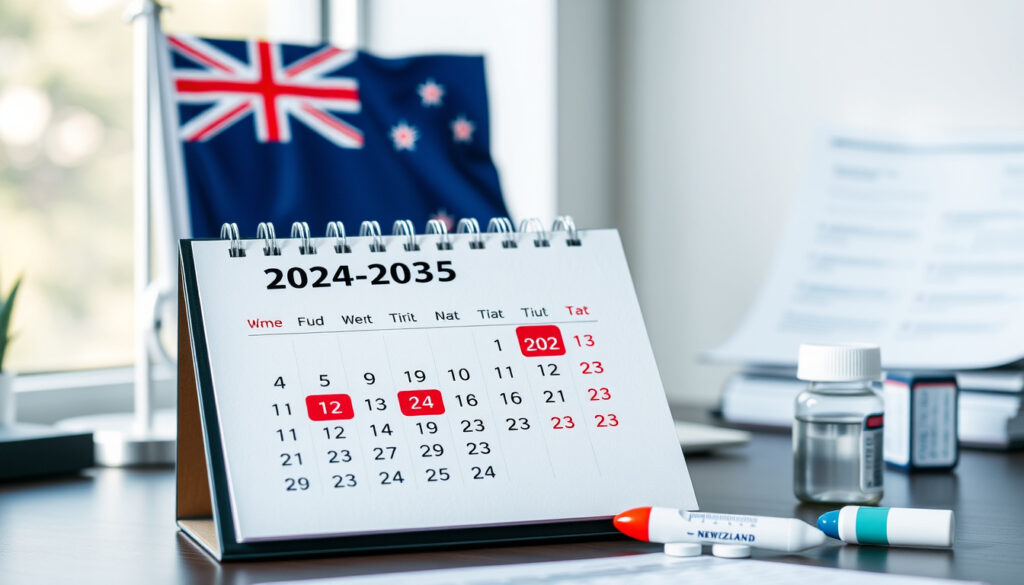
How Many Sick Days Per Year in NZ? 2024-2025 Guide
New Zealand workers are entitled to 10 paid sick days per year after six months of continuous employment — double the previous entitlement of five days, effective July 24, 2021. Many employees still encounter confusion around eligibility thresholds, proof requirements, and what happens to unused days.
Annual sick leave entitlement: 10 days ·
Applies to: full-time and qualifying part-time employees ·
Accumulation limit: up to 20 days ·
Eligibility: 6 months continuous employment ·
Change effective: July 24, 2021
Quick snapshot
- 10 paid days per year for qualifying employees (Employment New Zealand (Official Government))
- Accumulates to a maximum of 20 days (Business.govt.nz (Official Government))
- Cannot be lawfully denied if entitlement is met (People & Culture)
- No confirmed changes to sick leave entitlements scheduled for 2025 or 2026
- How the transition from days-based to hours-based accrual will affect existing balances
- Specific implementation date for Holidays Act reforms not yet announced
- 5 → 10 days: increase took effect July 24, 2021 (Global People Strategist)
- Government consulted on Holidays Act reforms in September 2024 (MBIE (Ministry of Business, Innovation and Employment))
- No confirmed 2025 or 2026 entitlement increase as of this writing (Global People Strategist)
- Holidays Act reforms may shift sick leave to hours-based accrual from day one
- 12.5% upfront leave compensation proposed for casual and additional hours workers
- Current 10-day entitlement remains standard until any legislative change
| Entitlement | Value |
|---|---|
| Standard entitlement | 10 paid days per year |
| Eligibility period | 6 months continuous employment |
| Maximum accumulation | 20 days |
| Notice required | As soon as practicable |
| Proof threshold | Employer discretion after 3 consecutive days |
| Medical certificate cost | Employer pays if they require it before 3 days |
| Pay calculation | Relevant daily pay or average daily pay |
| ACC top-up rate | 1 day sick leave per 5 days on ACC |
How many sick days do you get per year in NZ?
New Zealand employees are entitled to 10 paid sick days per year after completing six months of continuous employment with the same employer (Employment New Zealand (Official Government)). This represents a doubling of the previous entitlement, which was five days before July 24, 2021 (Global People Strategist). The entitlement applies to the employee, their spouse or partner, and any dependents living with them or who rely on them for care.
Full-time employees
- Standard entitlement: 10 days per year, accumulating up to 20 days maximum
- Sick leave renews on the employee’s anniversary date, not the calendar year
- Paid at relevant daily pay or average daily pay, whichever is higher
- If working part of a day before going home sick, it can count as a full sick day (Employment New Zealand (Official Government))
Part-time and casual employees
- Part-time workers still receive the full 10 days — the Holidays Act describes entitlement in days, not hours
- Casual employees can qualify after working an average of 10 hours per week for six months, with at least one hour each week or 40 hours each month (Employment New Zealand (Official Government))
- Independent contractors are not entitled to paid sick leave under the Holidays Act (MyHR NZ)
- Employers can offer better terms than the legal minimum if they choose
The catch: the six-month waiting period means new employees are genuinely vulnerable during their first half-year. Some employers voluntarily offer sick leave earlier, but there’s no legal obligation to do so until the threshold is met.
How many days can you have off sick without a doctor’s certificate in NZ?
New Zealand law does not set a fixed number of days you can be sick before an employer can ask for proof. Under the Holidays Act 2003, employers are entitled to request “reasonable evidence” of illness, but they must cover the cost of any medical certificate they require (People & Culture). In practice, the three-day mark is the informal industry norm — most employers will ask for a medical certificate after three consecutive days off, but they can request one earlier if they’re willing to pay for it.
Employer policies
- Employers can set reasonable policies requiring proof of illness, but must cover certificate costs
- Self-certification is common for single-day or two-day absences
- Employers cannot unreasonably refuse sick leave if the employee has an entitlement and days available
Extended absences
- After three days, employers typically require a medical certificate
- For ongoing illness, employers may request updated certificates at reasonable intervals
- Employees on ACC for more than five days can use sick leave to top up ACC payments from 80% to 100% of their usual salary at a rate of one day per five days on ACC (Employment New Zealand (Official Government))
What this means: the three-day figure is an employer convention, not law. An employer who demands a medical certificate on day one must pay for it. One who doesn’t request proof at all is within their rights — but cannot penalise a genuine absence.
Can an employer deny sick leave in NZ?
An employer cannot lawfully refuse to grant sick leave if the employee is entitled to it and has days available. The Holidays Act 2003 (sections 63, 65, and 66) governs this entitlement, and refusing legitimate sick leave constitutes an unlawful employment practice (Community Law). That said, employers can ask reasonable questions about timing, notice, and evidence — and there are narrow circumstances where a delay in approving leave might be justified.
Legal protections
- Employers cannot refuse sick leave to which an employee is entitled under the Holidays Act
- Retaliating against an employee for taking legitimate sick leave is unlawful
- Employees can contact Employment New Zealand or Community Law for free guidance on disputes
Valid reasons for delay
- Insufficient notice in genuinely urgent situations (though notice should be given as soon as practicable)
- Requesting clarification on entitlement if the employee has recently started
- Employer may verify the employee’s anniversary date before approving accumulation above 10 days
The implication: if your employer has outright refused to grant you sick leave when you have days available and a genuine health reason, that’s a serious breach. Employment New Zealand provides free mediation services for these disputes (Employment New Zealand (Official Government)).
When did sick leave change to 10 days in NZ?
New Zealand’s sick leave entitlement doubled from five days to ten days on July 24, 2021, as part of the Holidays Amendment Act (Global People Strategist). The change was phased in during 2021, with large employers required to comply by the end of that year and smaller employers given slightly more time. There is no confirmed change to the 10-day entitlement scheduled for 2025 or 2026 as of this writing.
Pre-2021 rules
- Employees received five paid sick days per year
- Accumulation was capped at 15 days
- The six-month eligibility period remained consistent
2021 changes
- Entitlement doubled to 10 paid days per year
- Maximum accumulation increased to 20 days
- Phased rollout across employer sizes during 2021
Future entitlements
- No confirmed changes to 10-day standard as of 2024–2025
- Holidays Act reforms currently in consultation phase (September 2024 targeted consultation) may eventually shift sick leave to hours-based accrual from day one
- Proposed reforms suggest 0.0385 hours per contracted hour worked, carrying over up to 160 hours (equivalent to 20 days) (Minter Ellison)
The pattern: 2021 was a significant expansion, but the system is not changing again in the immediate future. Workers should treat 10 days as the current, stable entitlement.
What can sick leave be used for in NZ?
Sick leave in New Zealand covers more than just the employee’s own illness. Under the Holidays Act, employees can use their sick leave entitlement for their own illness, injury, or surgery — including mental health conditions — as well as to care for a spouse, partner, or dependent who is ill or injured (People & Culture). There is also some scope for using sick leave in bereavement situations, though this is not always straightforward.
Personal illness
- Physical illness, injury, or surgery of the employee
- Mental health conditions qualify — employers cannot require disclosure of diagnosis
- Dental appointments and procedures that cause incapacity may qualify depending on circumstances
Family care
- Caring for a spouse, partner, or dependent who is unwell
- Taking a child to medical appointments
- Emergency situations involving immediate family members
Bereavement and other uses
- Sick leave can sometimes be used for bereavement when the employee is genuinely incapacitated by grief
- Separate bereavement leave exists under the Holidays Act — employees should check their entitlement separately
- Sick leave cannot be used for non-qualifying reasons (e.g., childcare for a well child, holiday travel)
The trade-off: the broad definition of “dependents” covers many situations that might otherwise require unpaid leave, but employees who stretch this definition risk disputes with their employer. When in doubt, communicate clearly.
How to take sick leave in New Zealand: a step-by-step guide
Understanding your entitlement is one thing; actually taking the leave without friction is another. Here is how to navigate the process as an employee, and what to watch for as an employer.
Step 1: Check your eligibility and balance
Confirm you have completed six months of continuous employment with your current employer and that you have sick days remaining. Your balance should appear on your pay slip or HR system. If you’ve recently changed jobs, your previous entitlement does not transfer — the six-month clock restarts.
Step 2: Notify your employer as soon as possible
You are required to give notice “as soon as practicable” — not necessarily before your shift starts, but before your employer would reasonably expect you to be at work. A call, text, or email to your direct manager or HR is sufficient for the initial notification.
Step 3: State your expected duration
Give your employer an estimate of how long you expect to be off. This helps them arrange cover and manage rosters. You can update them if the situation changes, such as needing an extra day once you visit a doctor.
Step 4: Provide reasonable evidence if requested
After three consecutive days off (or earlier if your employer requests and pays for it), expect to provide a medical certificate. For shorter absences, a verbal or written explanation from you or a whānau member is generally sufficient.
Step 5: Confirm your pay
Sick leave is paid at your relevant daily pay — the pay you’d have earned on that day — or your average daily pay, whichever applies. Your employer cannot reduce your sick day pay below what you would have normally received.
Step 6: Track your remaining balance
Unused sick leave carries over to the next year up to a maximum of 20 days. If you’ve hit the 20-day cap, additional days off will be unpaid unless your employer agrees to alternative arrangements.
Most disputes over sick leave come down to communication and timing, not the law itself. Employees who notify promptly and keep their employer informed tend to avoid problems. Employers who cover certificate costs and apply policies consistently stay on the right side of the Holidays Act.
Key dates in NZ sick leave history
Holidays Act 2003 enacted, establishing the original sick leave framework at five days per year for qualifying employees
Holidays Amendment Act passed, doubling sick leave from five to ten days per year and increasing maximum accumulation from 15 to 20 days
Entitlement increase took effect for large employers, with phased rollout through the remainder of 2021
Government undertook targeted consultation on a draft Holidays Act reform Bill, including proposed shift to hours-based sick leave accrual from day one (MBIE (Ministry of Business, Innovation and Employment))
What we know — and what we don’t
Confirmed
- 10 days annual entitlement for employees who have completed six months of continuous employment
- Applies to the employee and their dependents (spouse, partner, dependents)
- Accumulation capped at 20 days; can be exceeded by mutual agreement
- Medical certificate typically required after three consecutive days; employer pays if they request it earlier
- Cannot be lawfully denied if entitlement and days are established
- ACC top-up: one day sick leave per five days on ACC to bring pay to 100%
Uncertain
- Specific implementation date for Holidays Act reforms not yet announced
- How existing days-based balances will convert to hours under proposed reforms
- Whether any 2025 or 2026 entitlement increase will be confirmed
- Detailed rules for casual employee qualification in edge cases
- How mental health-related absences are treated where diagnosis is not disclosed
New Zealand’s sick leave system is generous compared to many countries, but the six-month waiting period creates a real gap for new employees. Anyone starting a new job should track their start date and know that their first entitlement arrives at the six-month mark — not before.
What people are saying
Employees are entitled to 10 paid days of sick leave each year after six months of continuous employment with the same employer.
Employment New Zealand (Official Government)
Every employee would be entitled to 10 days of sick leave each year after six months of continuous employment, covering their own illness or injury, or to care for a spouse, partner, or dependent.
The proposed Holidays Act reforms include moving from a weeks-based entitlement system to an hours-based accrual model, with sick leave accruing from day one at a rate of 0.0385 hours per contracted hour worked. The proposed reforms also include a 12.5% upfront leave compensation payment in lieu of annual and sick leave accrual for casual and additional hours workers.
Sick leave is a statutory entitlement under the Holidays Act 2003. Employers cannot refuse sick leave if an employee is entitled to it and has days available. The right to paid sick leave applies across full-time, part-time, and fixed-term contracts exceeding six months.
People & Culture
Related reading: KiwiSaver Proposals · Why Am I So Tired
Frequently asked questions
How many sick days per year in NZ full-time?
Full-time employees in New Zealand are entitled to 10 paid sick days per year after completing six months of continuous employment with the same employer. The entitlement renews on the employee’s anniversary date, not the calendar year.
When does sick leave roll over in NZ?
Unused sick leave carries over to the next year up to a maximum of 20 days. If you have accumulated the full 20 days, additional days off will be unpaid unless your employer agrees to alternative arrangements. Employers and employees can mutually agree that sick leave accumulates beyond 20 days.
Is sick leave entitlement changing in NZ in 2025 or 2026?
There is no confirmed change to the 10-day sick leave entitlement scheduled for 2025 or 2026. The government is consulting on broader Holidays Act reforms that may eventually shift sick leave to an hours-based accrual system, but no specific implementation date has been announced.
Can an employer refuse sick leave in NZ?
An employer cannot lawfully refuse sick leave if the employee is entitled to it and has days available. If an employer refuses legitimate sick leave, the employee can contact Employment New Zealand for free mediation or advice. Retaliating against an employee for taking legitimate sick leave is also unlawful.
Do part-time employees get fewer sick days in NZ?
No. Part-time employees receive the same 10-day entitlement as full-time employees. The Holidays Act describes sick leave entitlement in days, not hours. A part-time worker on a 20-hour contract is still entitled to 10 paid sick days per year, not a pro-rata proportion.
How does sick leave work with ACC in NZ?
ACC covers 80% of an injured worker’s usual salary after the first week of injury. If an employee is on ACC for more than five days, they can use sick leave to top up the remaining 20%, bringing their pay to 100%. The rate is one day of sick leave per five days on ACC.
What is the sick leave entitlement for casual employees in NZ?
Casual employees can qualify for sick leave after working an average of 10 hours per week for six months, with at least one hour each week or 40 hours each month. Once qualified, they receive the same 10-day entitlement as full-time and part-time employees.
More related posts
 Wellington Phoenix vs Perth Glory Prediction, Stats & Results
 Hallway Table NZ Kmart: Sizes, Styles & Styling Tips
 1 Cup of Flour in Grams: Conversion Guide (120-125g)
 How to Write a Song: A Beginner’s Guide to Songwriting
 Toll Road Payment NZ: How to Pay Online & Avoid Late Fees
 Alice in Wonderland Characters: List, Meanings, Symbolism
 Willie McLean Rugby League: Biography, Family & Career
 Manchester United vs West Ham Stats: Head-to-Head History
