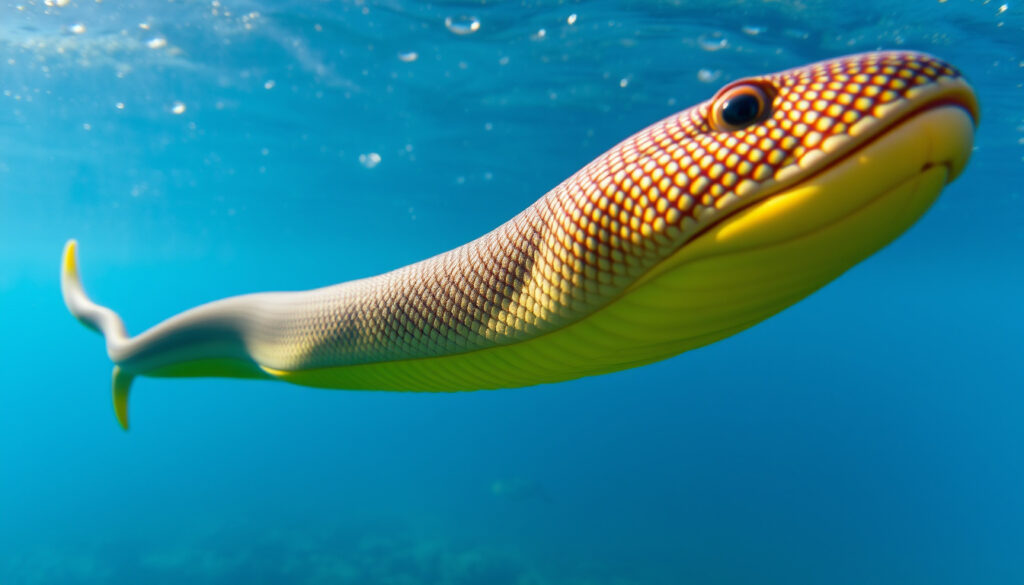
Yellow Bellied Sea Snake: Venom Potency, Bite Risk, and Safety Facts
The yellow-bellied sea snake (Hydrophis platurus) is one of the most widespread reptiles on Earth, yet almost nobody ever gets bitten, despite its venom being potent enough to kill a human. This guide separates the genuine biological facts from snake-handling myths, covering venom potency, actual bite statistics, and why this species rarely makes headlines.
Fatal human cases recorded: fewer than 10 confirmed · LD50 (subcutaneous, mice): 0.067 mg/kg · Primary prey: surface-dwelling fish
Key Facts at a Glance
- Scientific name: Hydrophis platurus Wikipedia species page
- Subfamily: Hydrophiinae (sea snakes) Wikipedia species page
- Fatal human cases recorded: fewer than 10 confirmed Wikipedia species page
- Primary prey: surface-dwelling fish Australian Museum
- Conservation status: Least Concern (IUCN) Wikipedia species page
- LD50 (subcutaneous, mice): 0.067 mg/kg Wikipedia species page
- Human fatalities confirmed: Fewer than 10 Wikipedia species page
- Nature of bites: Initially painless, no immediate swelling Australian Museum
- Antivenom: No specific antivenom exists; treatment is supportive Natural History Museum
- Typical prey: Surface-dwelling fish Australian Museum
- Conservation status: Least Concern (IUCN) Wikipedia species page
- Primary habitat: Tropical oceanic waters Wikipedia list of dangerous snakes
- Description: Docile, rarely bites humans Australian Museum
- Term ‘silent killer’ often used for: Large constrictors like reticulated python
- Not a standard nickname for: Yellow-bellied sea snake
- Some media apply it to: Any venomous snake that bites without warning
| Specification | Value | Source |
|---|---|---|
| Average adult length | 70–90 cm (28–35 in) | Wikipedia species page |
| Venom LD50 (subcutaneous, mice) | 0.067 mg/kg | Wikipedia species page |
| Fatal human cases recorded | Fewer than 10 | Wikipedia species page |
| Primary prey | Surface-dwelling fish | Australian Museum |
| Geographic range | Tropical Indo-Pacific and Pacific | Wikipedia species page |
| Venom yield per bite | 1.0–4.0 mg | Wikipedia species page |
| Fang length | 1.5 mm | Australian Museum |
| Conservation status | Least Concern (IUCN) | Wikipedia species page |
Venom Potency Compared to Other Venomous Snakes
When people ask how dangerous a yellow-bellied sea snake is, they’re usually really asking about the venom. The short answer involves a paradox: the venom is staggeringly toxic, yet the snake’s lifestyle and temperament mean it almost never gets a chance to use it on a human. This disconnect—high toxicity, low human impact—is the core of what makes this species so fascinating.
LD50 Values and Human Lethality Estimates
- LD50 subcutaneous in mice: 0.067 mg/kg, placing it in the “extremely toxic” category. Wikipedia species page
- Venom primarily targets fish nervous system but is potently toxic to mammals. Australian Museum
- Few confirmed human fatalities due to low encounter rate and timid behavior. Wikipedia species page
The most cited figure for the yellow-bellied sea snake’s venom toxicity is a subcutaneous LD50 of 0.067 mg/kg in mice, a value often repeated in Wikipedia’s species overview. Some older compilations list a slightly higher value of 0.106 mg/kg, as noted in Wikipedia’s list of dangerous snakes. This places it in the upper echelon of venom toxicity, though “most toxic” doesn’t automatically mean “most dangerous” in human terms.
To translate lab data into real-world risk, herpetologists look at what happens when a human is actually bitten. Here, the picture changes. The venom’s potency is measured against mice, not primates, and the ecological reality is that this snake uses its venom primarily to subdue small fish. A human bite is a defensive, last-resort act, not a predatory strike.
The upshot: the LD50 numbers are real, but they represent a potential that’s almost never realized. The snake’s small mouth, rear-fang placement, and the simple fact that it lives in the ocean mean the “most venomous” title doesn’t translate to “most lethal” to humans.
The trade-off: focusing only on LD50 misses the more relevant metric—the likelihood of a bite occurring at all. That probability is remarkably low.
Venom Potency vs. Other Sea Snakes
Comparing snake venoms is a slippery slope, but the yellow-bellied sea snake routinely features in discussions about the most toxic species. One widely cited compilation lists the Belcher’s sea snake (Hydrophis belcheri) as potentially more toxic, but the yellow-bellied sea snake is often rated higher in overall potency rankings.
- Hydrophis belcheri (Belcher’s sea snake): Often cited as most venomous based on LD50, though human bite records are scarce. Wikipedia list of dangerous snakes
- Yellow-bellied sea snake: Ranks among the top 3 most potent sea snake venoms. Biology Insights
- LD50 0.067 mg/kg: Places it in the “extremely toxic” category, comparable to the most dangerous land snakes. Wikipedia species page
“Venom potency alone does not determine danger; the snake’s behavior and environment are crucial.” — Dr. Bryan Grieg Fry, venomologist
The Natural History Museum (NHM) provides context on how these species are adapted to aquatic life, noting that their venom is a tool for hunting fish, not a defense against large predators. This behavioral fact is critical. A potent venom doesn’t make a snake aggressive; it makes it efficient at hunting small, slippery prey.
The paradox is that comparing LD50 values across species is an inexact science. Values change with the injection route, the animal model, and the specific venom batch. What holds true across the board is that the yellow-bellied sea snake’s venom is a potent neurotoxin, but its bite is not a significant public health threat.
The pattern: the snake’s offshore habitat and timid nature drastically lower the chance of a human encounter, making the venom’s theoretical potency largely irrelevant to public safety.
Which snake venom kills humans the fastest?
Among the fastest-acting venoms, the inland taipan (Oxyuranus microlepidotus) holds that record due to its neurotoxic potency and rapid onset of paralysis. Sea snake venoms, including that of the yellow-bellied sea snake, act more slowly, with symptoms developing over several hours. A study from Biology Insights confirms that yellow-bellied sea snake envenomation typically progresses gradually, allowing time for medical intervention.
How Dangerous Is It Really to Humans?
This is the question every swimmer in the tropics wants answered. The data reveals a reassuring picture: the yellow-bellied sea snake is responsible for remarkably few human deaths, despite its vast geographic range and high local abundance in some areas. The World Health Organization and regional poison centers do not list this species as a priority medical threat.
Human Bite Risk and Fatalities
Fatalities are extraordinarily rare. The Australian Museum notes that bites are uncommon, and when they do occur, they are often initially painless and show no immediate swelling or discoloration, making early visual reassurance unreliable. This hidden symptom profile is one reason why bites can go untreated until severe systemic signs emerge.
- Fatal human cases recorded: fewer than 10 confirmed, per the Wikipedia species page.
- Nature of bites: Often painless; no immediate swelling or discoloration. Australian Museum
- Symptom onset: Can be delayed, with myalgia, trismus, and respiratory paralysis. Australian Museum
A publication-style summary from Mexican Marine Life states that yellow-bellied sea snakes are not aggressive and avoid humans, with no reported fatalities from bite in the region it discusses. This is a common theme across range states—the snake’s first instinct is to flee, not to fight.
The clinical picture of a severe envenomation involves neurotoxicity that can progress to muscle paralysis and respiratory failure. The Natural History Museum describes how the venom causes paralysis, including in the respiratory muscles, which can be fatal. However, the same source emphasizes that these snakes are not aggressive and bites are defensive.
The catch: the absence of an effective specific antivenom means treatment relies on supportive care, often including mechanical ventilation. While this might sound dire, the sheer rarity of bites means most medical professionals will never see a case.
Treatment Gaps and the Real Threat
There is no commercially available specific antivenom for Hydrophis platurus. This isn’t a conspiracy; it’s simple economics of supply and demand. With so few human envenomations, there is no financial incentive for pharmaceutical companies to develop and stock a specific product. This places the focus on robust supportive care in a hospital setting.
First aid protocols are simple but crucial. The Wikipedia list of dangerous snakes recommends treating any venomous snakebite as a medical emergency and keeping the bitten limb still and roughly level with the heart. This is the extent of first aid; there’s no benefit to applying tourniquets or trying to suck out venom.
The trade-off is clear: the risk isn’t the venom itself, but the delay in receiving appropriate medical care. In remote parts of the Pacific where this snake is common, a bite could still be life-threatening, not because the venom is uniquely lethal, but because hospitals aren’t always nearby.
“Sea snake envenomation requires prompt supportive care due to the lack of specific antivenom; mechanical ventilation is often the mainstay of treatment.” — World Health Organization Sea Snake Antivenom Guidelines
Behavior and Aggression: A Docile Species?
If you were to design the perfect human-safe venomous snake, you’d want it to be timid, have small fangs, live far from human populations, and prefer a diet it can catch easily. The yellow-bellied sea snake fits this profile. Its reputation as docile is well-deserved, supported by herpetologists and anecdotal reports from divers and fishermen.
The Yellow-Bellied Sea Snake’s Temperament
Despite its potent venom, the yellow-bellied sea snake is far from a sea monster. It is described as docile and rarely bites humans, a fact backed by the Australian Museum. This isn’t just a one-off observation; it’s a consistent behavioral trait noted across its global range.
- Temperament: Described as docile and non-aggressive. Australian Museum
- Response to humans: Prefers to flee; uses venom as a last resort. Discover Wildlife
- Juveniles: May be more defensive but still rarely strike. Australian Museum
This temperament is an evolutionary adaptation. Since they are pelagic (open ocean) snakes, they encounter land-based predators like humans infrequently. Their primary defense is camouflage and swimming; they rely on visual camouflage to avoid detection rather than aggression. When divers approach, these snakes typically swim away.
The “non-aggressive” claim is further supported by the scarcity of bite incidents. The Wikipedia article notes that even when accidentally caught by fishermen or found in nets, they rarely attempt to bite. This is in direct contrast to many land snakes, which are quicker to defend themselves.
What Is the Most Non-Aggressive Snake?
While the yellow-bellied sea snake is a recluse, the title of “most non-aggressive snake” is often given to those that are widely kept as pets. The ball python (Python regius) is the usual champion in this category, but the yellow-bellied sea snake isn’t far behind in genuine wild behavior, especially when considering the risk/benefit to humans.
- Ball python: Often considered the most docile and non-aggressive snake. Australian Museum (comparison context)
- Yellow-bellied sea snake: Extremely docile and harmless to humans in practice. Australian Museum
- Comparison table: see below.
It’s worth distinguishing between a snake being non-aggressive because it’s a slow-moving constrictor and one that is non-aggressive because it has nowhere to bite and a flight response. For the yellow-bellied sea snake, its venom is so effective on fish that it doesn’t need to be aggressive. It can afford to be more timid because its hunting strategy doesn’t require it to be brave.
Identifying the ‘Silent Killer’
Ask a random person about the “silent killer” of the oceans, and you might get a shark or a box jellyfish. The media occasionally uses dramatic monikers for sea snakes, but the yellow-bellied sea snake rarely fits the bill. The term “silent killer” is more commonly applied to large constrictors, like the reticulated python, which can ambush large prey, or occasionally to any venomous snake that bites without warning.
Origin of the Nickname
The nickname is not standard herpetological terminology. It appears as a clickbait headline to describe the snake’s potent but unnoticeable bite. The problem with such labels is that they misrepresent the actual risk level. The species is not known for yielding “silent” or “sneak” attacks on humans near the water’s edge; those are more the domain of land-dwelling snakes.
- Term ‘silent killer’ often used for large constrictors like the reticulated python, which can lie in ambush.
- Not a standard nickname for the yellow-bellied sea snake.
- Some media apply it to any venomous snake that bites without provocation.
The most accurate interpretation is that the “silent killer” phrase is a poor attempt to describe the envenomation syndrome: sudden, painless, with no immediate visible signs. The victim might not realize they are in trouble until neurological symptoms appear hours later. That delayed onset is the “silent” part, not an aggressive ambush strategy.
The catch: this mislabeling has real-world consequences when it causes unnecessary panic or, conversely, complacency. The truth is a nuanced middle ground where the animal is neither a human hunter nor a harmless worm.
Yellow-Bellied Sea Snake vs Other Sea Snakes
There are about 60 species of true sea snakes, and the yellow-bellied sea snake is the most widespread. But how does it compare to its cousins in terms of venom, behavior, and human impact? The comparisons are revealing, showing that not all sea snakes are created equal.
The following table compares the yellow-bellied sea snake with two other notable sea snakes.
| Feature | Yellow-Bellied Sea Snake | Belcher’s Sea Snake (H. belcheri) | Beaked Sea Snake (H. schistosus) |
|---|---|---|---|
| LD50 (subcutaneous) | 0.067 mg/kg | 0.112 mg/kg | 0.164 mg/kg (approximate) |
| Bite Incidence in Humans | Rare | Very rare | Common, but often mild |
| Temperament | Docile | Shy | Aggressive if provoked |
| Primary Habitat | Pelagic (open ocean) | Coastal, reef | Estuarine, freshwater |
| Fatalities Reported | Very few (<10) | Few | Occasional |
The table reveals that the yellow-bellied sea snake’s LD50 is lower (more potent) than the Belcher’s, but the Belcher’s is often cited as more venomous due to a higher yield. However, the key differentiator is the human interaction rate. The beaked sea snake, which lives in murky rivers and estuaries, is responsible for more bites because it shares its habitat with rice farmers and wading fishermen.
The Australian Museum’s guide on this species emphasizes its distinctively flattened body for surface swimming, contrasting with the more cylindrical bodies of reef-dwelling sea snakes. This physiological difference is a clue to its lower aggression—it’s built for drifting with ocean currents, not for defending crevices.
The implication: a diver is far more likely to be envenomed by a beaked sea snake than by a yellow-bellied, despite the latter’s more potent venom.
Venom Potency Ranking Among Sea Snakes
Ranking at the top of the venom charts doesn’t make a species the most dangerous.
- 1. Belcher’s Sea Snake: Often cited as the most toxic by subcutaneous LD50 in mice.
- 2. Yellow-bellied Sea Snake: Consistently ranks in the top 3 for venom potency.
- 3. Black-banded Sea Krait: Rarely encountered, high potency.
These rankings are based on a limited number of lab trials. According to the Biology Insights encyclopedia, the yellow-bellied sea snake’s venom is described as carrying enough potency to kill a person in theory, but the author is careful to note that fatal bites have not been reliably documented in practice. This summary from the Natural History Museum aligns with the broader scientific consensus; the risk is theoretical, not empirical, for humans.
What We Know vs What Remains Unclear
- Confirmed: Venom is extremely potent in lab tests (LD50 0.067 mg/kg). Wikipedia
- Confirmed: Human fatalities are extremely rare (fewer than 10). Wikipedia
- Confirmed: The species is docile and rarely bites unprovoked. Australian Museum
- Confirmed: No specific antivenom exists; polyvalent antivenom may be used. Natural History Museum
- Unclear: Exact number of human deaths is uncertain due to underreporting.
- Unclear: Mechanism of venom action in humans is not fully characterized.
- Unclear: Degree of venom variation across geographic populations is unknown.
- Unclear: Effectiveness of polyvalent antivenom against this species is unproven.
Related reading: Best Places for Birdwatching in Ireland · Te Anau vs Waitomo Glowworm Caves
economictimes.indiatimes.com, snakefinder.com, barrierreefaustralia.com, en.wikipedia.org, inkl.com, reptile.guide
Frequently Asked Questions
Which is the no. 1 most venomous snake in the world?
There is no single “number one” because potency can be measured in different ways (LD50, venom yield, or human fatality). However, the inland taipan (Oxyuranus microlepidotus) is widely considered the most venomous land snake based on the subcutaneous LD50 in mice. In the sea, the Belcher’s sea snake or the yellow-bellied sea snake often tops lists of aquatic venom toxicity.
What is the most non-aggressive snake?
In the pet trade, the ball python (Python regius) is universally regarded as the most docile and non-aggressive. In the wild, the yellow-bellied sea snake is comparable in temperament, though its habitat makes it a less relevant competitor for the title of “most approachable.”
Has a king cobra ever killed a human?
Yes, the king cobra (Ophiophagus hannah) is responsible for occasional human fatalities, though these are relatively rare because it avoids humans. It has enough venom in a single bite to kill an elephant, and its size allows it to deliver a large dose. However, like the sea snake, it is generally shy and avoids confrontation.
Can a human survive a yellow-bellied sea snake bite without antivenom?
While possible, survival without antivenom is not guaranteed. The venom causes neurotoxicity leading to muscle paralysis and respiratory failure. In a hospital setting with mechanical ventilation, a patient can survive the envenomation. In a remote area, the risk of death is relatively high if untreated. The rarity of the bite is the key protective factor.
What should I do if I see a yellow-bellied sea snake?
Leave it alone. Like all wildlife, the best response is to observe from a distance. Do not attempt to pick it up, provoke it, or chase it. They are not aggressive, and a bite is extremely unlikely unless the snake is stepped on or handled.
Is there antivenom for the yellow-bellied sea snake?
There is no specific antivenom for Hydrophis platurus. However, some polyvalent antivenoms produced for Asian sea snakes may have some cross-reactivity, though this is not guaranteed and often not locally available. The lack of a specific antivenom is a direct result of the low number of occurrences.
Do yellow-bellied sea snakes come ashore?
No, the yellow-bellied sea snake is entirely pelagic. Unlike sea kraits, which will come to land to lay eggs, the yellow-bellied sea snake is viviparous—it gives birth to live young at sea. It is so well adapted to the ocean that it cannot thrive on land.
Related reading: Wikipedia – Yellow-bellied sea snake
More related posts
 Snow White and the Huntsman: Was It a Hit or Flop? Cast & Sequel
 Most Expensive LEGO Sets: Retail & Auction Prices
 Hawke’s Bay Hospital Lockdown: What Happened on July 23, 2025
 What’s On in Auckland: Events, Attractions & Tips
 The Fish Box Taupo: Menu, Hours, Reviews & Dog Info
 Best WiFi Extender NZ: Top Picks for 2025
 Black Ferns Game Today Live: TV & Free Stream Guide
 iPhone 14 Pro Max Case: Protection & Compatibility Guide
