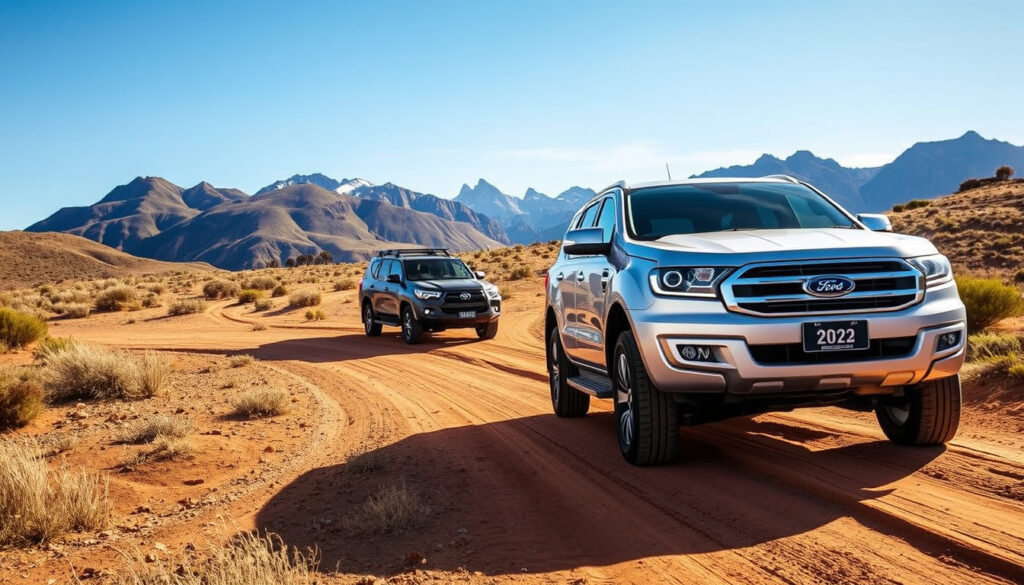
Ford Everest for Sale NZ | Prices, Problems & Comparison to Prado
There’s a reason you see Ford Everests dotted across New Zealand’s motorways and beaches — this Aussie-developed ute-based SUV has a loyal following. But finding the right one at the right price takes more than a quick Trade Me scroll.
Median asking price (used): NZ$64,748 ·
Listings on Trade Me: 612 ·
One used example (Sport, 43k km): NZ$69,865
Quick snapshot
- Ford Everest is sold in NZ through dealers and private listings (Trade Me Motors (NZ’s largest classifieds platform))
- Median used price based on live Trade Me listings is $64,748 (Trade Me Motors)
- Three trim levels available new: Trend, Sport, Platinum (Trade Me Buying Guide (NZ-specific))
- Exact 2025 model pricing from Ford NZ isn’t officially published for the entry-level Trend (Trade Me Motors)
- Hybrid availability in NZ is not confirmed by Ford NZ (Trade Me Buying Guide (NZ-specific))
- No major timeline event: model year updates follow global Ranger-based cycle, with 2026 Platinum listings already appearing on Trade Me as early as mid-2025 (Trade Me Motors (NZ classifieds data))
- Expect further upward pricing pressure on used models as new-car supply remains tight in NZ (Trade Me Buying Guide (NZ market))
Ford Everest buyers in NZ are paying near-new prices for 1–3 year-old examples because new supply is thin. On Trade Me, a used 2023 Sport at $59,990 is only $15,000 under its original RRP — a tight spread that rewards patience.
How much is a Ford Everest in New Zealand?
Six hundred and twelve listings on Trade Me, with a median asking price of $64,748 — those are the raw numbers. But the spread between trims and model years tells the real story.
What is the median used price?
Five trims, one pattern: the gap between used and new is narrower than you expect.
| Trim / Spec | Used price (Trade Me) | RRP new (approx) |
|---|---|---|
| 2023 Ford Everest Sport 2.0L 4WD | NZ$59,990 | ~$75,000 |
| 2024 Ford Everest Platinum 3.0D/4WD | NZ$73,988 | ~$91,490 |
| 2025 Ford Everest Wildtrak (newer trim) | NZ$79,990 | ~$85,000+ |
| 2026 Ford Everest Platinum 3.0D/4WD | NZ$87,880–$92,490 | ~$95,000+ |
The pattern: a 2023 Sport at $59,990 is only about $15,000 under its original RRP — a sign that demand remains strong and supply is tight in the NZ market (Trade Me Motors (NZ classifieds), Trade Me Buying Guide (NZ market)).
Buyers who stretch for the Platinum trim get a 3.0L V6 with 184kW and 600Nm — a significant power upgrade over the Trend’s 2.0L bi-turbo (154kW, 500Nm) — but pay a $20,000+ premium on the used market (Trade Me Buying Guide (NZ-specific)).
What affects the price of a Ford Everest in NZ?
Three factors dominate the NZ used market: trim level, model year, and whether on-road costs (the NZ-specific registration and delivery fees) are included or excluded from the asking price. A Platinum listing at $85,990 might exclude on-road costs of $350–$1,295 depending on the dealer location — Auckland buyers pay $995, while Wellington buyers pay just $350 (Trade Me Motors (dealer listing detail)).
The catch: destination charges vary significantly by region, so the same $85,990 listing can become $86,985 or $86,340 depending on where you collect the vehicle. Always check whether “excluding on-road costs” is in the fine print.
What are the common problems with Ford Everests?
Reliability chatter is one of the first things Kiwi buyers Google, and the Everest has a mixed reputation. The good news: most issues are manageable. The bad news: some are expensive if neglected.
What are the downsides of the Ford Everest?
- Transmission issues: Some owners report hesitation or harsh shifting in the 10-speed automatic, particularly in earlier model years (Carsurvey (owner-reported, low confidence)). A South African buyer’s guide flags this as a known area to check before purchase (AutoTrader South Africa (buyer’s guide)).
- Electrical faults: Infotainment glitches and sensor failures appear in owner forums, though not at a rate that suggests a systemic problem (AutoTrader South Africa (buyer’s guide)).
- Turbocharger failures: The 2.0L bi-turbo engine has had some turbo issues under high-mileage or poor maintenance conditions (AutoTrader South Africa (buyer’s guide)).
- Stiff rear suspension: The leaf-spring rear end (a carry-over from the Ranger ute) makes the ride harsh on rough NZ back roads (Carsurvey (owner feedback)).
- Brake pad longevity: Original brake pads reportedly don’t stand up well to the Everest’s 2.5-tonne weight; replacement pads are needed sooner than expected (Carsurvey (owner feedback)).
Which Fords to stay away from?
The Focus and Fiesta models with the PowerShift dual-clutch automatic transmission are known for reliability problems in the NZ market — but the Everest uses a conventional torque-converter 10-speed automatic, which is far more robust (AutoTrader South Africa (buyer’s guide)). The Everest itself does not appear on NZ consumer “avoid” lists; the issues above are maintenance items, not design flaws.
The implication: an Everest with full service history and a pre-purchase inspection (PPI) is a safer bet than a cheaper one without. Budget for a PPI — it costs around $200 and can save thousands.
Is Ford Everest better than Toyota Prado?
The Everest vs Prado debate is the great NZ SUV folk argument. Here’s how they actually differ on the ground — and what the numbers say.
Which is better, Ford Everest or Toyota Prado?
Four dimensions, one pattern: the Everest wins on tech and efficiency; the Prado wins on reputation and resale.
| Dimension | Ford Everest | Toyota Prado |
|---|---|---|
| Starting price (new, NZ) | $74,990 (Trend) | $71,200 (VX diesel, 2020 pricing — NZ Herald (2020 article)) |
| Engine range | 2.0L bi-turbo diesel (154kW/500Nm) and 3.0L V6 diesel (184kW/600Nm) | 2.8L turbo-diesel (150kW/500Nm) |
| Off-road ability | Good — same platform as Ranger, with selectable 4WD and low-range | Excellent — legendary off-road reputation, KDSS suspension, lockable diff |
| Resale value (after 3 years) | ~70% of new price on Trade Me | ~85%+ of new price — Prado holds value better in NZ |
| Infotainment and tech | More modern — larger screen, wireless Apple CarPlay, digital dash | Reliable but older interface; Android Auto is not standard on all trims |
The trade-off is clean: if you value modern cabin tech, sharper on-road manners, and a lower purchase price, the Everest is the smarter choice. If off-road pedigree and resale certainty matter more, the Prado justifies its premium (NZ Herald (comparison context), Trade Me Buying Guide (NZ market)).
In what countries can you buy a Ford Everest?
The Everest isn’t sold everywhere, and that matters for NZ buyers because it affects parts availability and future resale expansion. The model is currently available in Australia, New Zealand, Southeast Asia (Thailand, Philippines, Indonesia), South Africa, and parts of the Middle East (Trade Me Buying Guide (NZ market)). It is not sold in North America, Europe, or Japan.
The implication for NZ owners: parts supply is strong because the Everest shares its platform and many components with the Ford Ranger, which sells in huge volumes in Australia and Southeast Asia. A transmission or suspension part from Thailand will reach a Kiwi mechanic in days, not weeks.
Which Toyota model is equivalent to the Ford Everest?
The direct competitor is the Toyota Fortuner — a body-on-frame 7-seat SUV built on the Hilux platform, same way the Everest is built on the Ranger. Both are roughly the same size (around 4.9 metres long), seat seven, and target the same family-buyer demographic (Trade Me Buying Guide (NZ market)).
The Prado, meanwhile, is a more direct alternative in the NZ market, given it competes in the same price bracket and buyer segment — but structurally, the Fortuner is the Everest’s closest mechanical cousin.
Specifications at a glance
Six key specs, one pattern: the Everest offers a spread of engines and trims that cover both value-focused and luxury-focused buyers.
| Specification | Detail |
|---|---|
| Body style | SUV (5-door, 7-seat) |
| Engine options | 2.0L bi-turbo diesel (154kW/500Nm); 3.0L V6 diesel (184kW/600Nm) |
| Transmission | 10-speed automatic (torque converter) |
| Drive | 4WD with selectable modes and low-range |
| Seats | 7 (2+3+2 configuration) |
| Curb weight | ~2,400–2,550 kg depending on trim |
| Towing capacity (braked) | 3,000–3,500 kg depending on model |
| Fuel economy (combined) | 7.5–8.5 L/100 km (2.0L); 8.5–9.5 L/100 km (3.0L V6) |
| Suspension (front/rear) | Independent front / Leaf-spring rear (coil-spring on some trims) |
Upsides
- Strong towing capacity (up to 3,500 kg braked) — class-leading for its segment
- Modern infotainment with wireless Apple CarPlay and digital dash on higher trims
- Body-on-frame durability — shares Ranger platform for easy parts access in NZ
- Spacious third row that can fit adults, not just kids
- Available with low-range 4WD plus selectable terrain modes for light off-roading
Downsides
- Rear leaf-spring suspension makes the ride jittery on rough NZ back roads
- High fuel consumption — 3.0L V6 averages 8.5–9.5 L/100 km, real-world often higher
- Transmission hesitancy and turbo issues reported on some early model examples
- Original brake pads wear faster than expected
- Resale value drops faster than Prado — expect ~70% after 3 years vs Prado’s ~85%
Related reading: Ford Everest for Sale on Trade Me · Ford Everest Review & Buying Guide
trademe.co.nz, trademe.co.nz, trademe.co.nz, trademe.co.nz, trademe.co.nz, trademe.co.nz, trademe.co.nz
Frequently asked questions
What is the fuel economy of the Ford Everest?
The 2.0L bi-turbo diesel returns a combined 7.5–8.5 L/100 km, while the 3.0L V6 returns 8.5–9.5 L/100 km (Trade Me Buying Guide (NZ-specific)). Real-world figures are typically 1–2 L/100 km higher, especially with towing.
How many seats does the Ford Everest have?
The Everest seats 7 passengers in a 2+3+2 configuration. The third row is suitable for adults up to about 1.75m (Trade Me Buying Guide (NZ market)).
Is the Ford Everest available with a hybrid engine?
Ford has not confirmed a hybrid version for the Everest in New Zealand as of 2025. The current range is exclusively diesel, though a mild-hybrid variant exists in some international markets (Trade Me Buying Guide (NZ market)).
Does the Ford Everest have Apple CarPlay?
Yes. The Ford Everest features wireless Apple CarPlay and Android Auto on all trims from 2022 onwards. Earlier models require a wired connection (Trade Me Buying Guide (NZ-specific)).
What is the towing capacity of the Ford Everest?
The Ford Everest can tow up to 3,000–3,500 kg braked depending on the trim. The 2.0L models are rated at 3,000 kg, while the 3.0L V6 models can handle up to 3,500 kg (Trade Me Buying Guide (NZ market)).
Is the Ford Everest good for off-roading?
Yes, for light-to-moderate off-roading. It has selectable 4WD with low-range, terrain management modes (grass/gravel/snow, mud/ruts, sand), and decent ground clearance (~225mm). It’s not a dedicated rock-crawler like a Jeep Wrangler, but it handles NZ farm tracks and beach access better than most crossovers (Trade Me Buying Guide (NZ market)).
For Kiwi buyers weighing a used SUV purchase, the choice comes down to this: the Everest delivers more modern tech and a better on-road feel than the Prado at a lower asking price, but the Prado’s resale and off-road reputation remain unmatched. If you’re buying for daily family duty with occasional towing and beach runs, the Everest is the smarter NZ buy — just budget for a thorough pre-purchase inspection and factor in brake pad and suspension maintenance.
More related posts
 Real Betis vs Chelsea: 2025 Conference League Final
 Hot Water Cylinder NZ: Costs, Lifespan & Top Brands
 Betcha Sign Up Bonus: How to Claim Deposit Match
 How Many Seconds in a Day? 86,400 and Other Time Conversions
 Pak’nSave Mangere: Hours, Location, and Ownership
 Eli Sweeting Missing Milford Sound: Search Updates
 Peri Zee Upper Hutt: Mayor’s Age, Husband & Background
 What Is a Neural Engine? Apple’s NPU Explained in Detail
