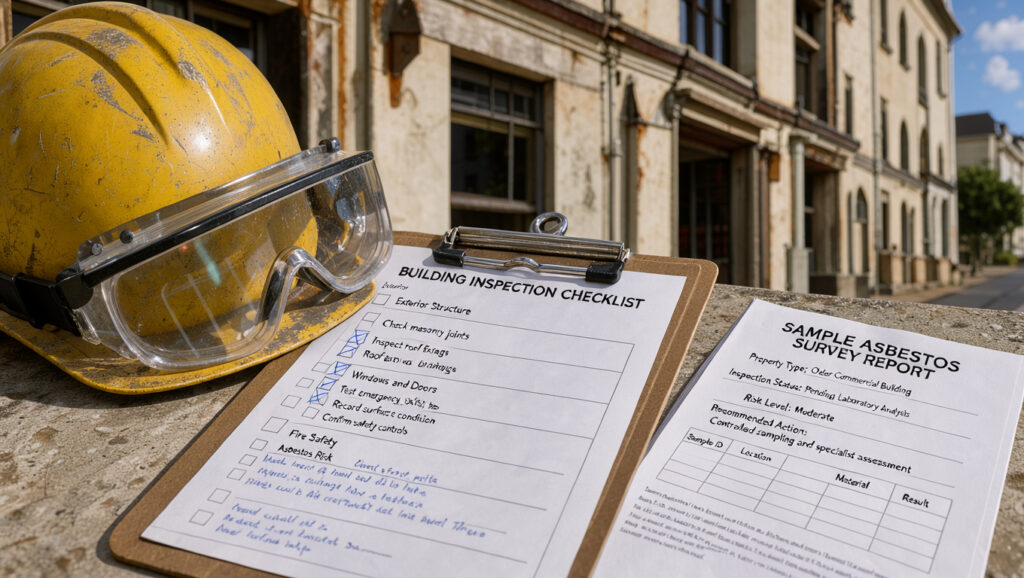
Asbestos Management Plan Auckland: Requirements and Steps
If you manage a workplace or building in Auckland, the asbestos question usually arrives as a worry long before it becomes a document. Regulation 13 of the Health and Safety at Work (Asbestos) Regulations 2016, as published by New Zealand Legislation (official legal text), requires a written plan wherever asbestos is identified or likely to be present, and the sections below separate the claims that WorkSafe New Zealand and Auckland Council back firmly from those that still need checking.
Governing regulations: Health and Safety at Work (Asbestos) Regulations 2016 (New Zealand) · Workplace regulator: WorkSafe New Zealand · Local authority: Auckland Council · Review interval: five years after last review (WorkSafe New Zealand (PCBU guidance))
Quick snapshot
- A written plan is required where asbestos or ACM is identified or likely to be present (New Zealand Legislation (official legal text)).
- The PCBU with management or control of the workplace must ensure the plan is prepared and kept up to date (New Zealand Legislation (consolidated PCO text)).
- A copy must be readily accessible to workers, worker representatives and other PCBUs (New Zealand Legislation (official legal text)).
- Whether an age-based presumption applies to older buildings; the verified trigger is identification or likely presence (New Zealand Legislation (official legal text)).
- Whether any Auckland-specific plan rule exists beyond national law; the research set confirms Auckland rules only for removal work (Auckland Council (AC2262 removal guidance)).
- Commercial template formats vary, with no single official format beyond WorkSafe’s own template (WorkSafe New Zealand (official AMP template)).
- Licensed asbestos removal requires written notice to WorkSafe at least 5 days before work starts (New Zealand Legislation (official legal text)).
- Auckland Council requires a licensed removal plan for asbestos-contaminated material greater than 10 square metres (Auckland Council (AC2262 removal guidance)).
- Auckland Council recommends contacting a licensed removalist before demolition or construction on pre-1990s buildings (Auckland Council (AC2262 removal guidance)).
- Review the plan when asbestos is removed, disturbed, sealed or enclosed (New Zealand Legislation (official legal text)).
- Review the plan when control measures are reviewed or the plan is no longer suitable (WorkSafe New Zealand (PCBU guidance)).
- Complete Questions 1–7 of WorkSafe’s template (WorkSafe New Zealand (official AMP template)).
Nine verified figures carry most of the weight here, and one pattern runs through them: the national rules set the duties, while the Auckland figures cover removal work only.
| Item | Verified detail |
|---|---|
| Governing regulations | Health and Safety at Work (Asbestos) Regulations 2016 (New Zealand Legislation (official legal text)) |
| Plan trigger | Written plan where asbestos or ACM is identified or likely to be present (New Zealand Legislation (official legal text)) |
| Review interval | Five years after last review (WorkSafe New Zealand (PCBU guidance)) |
| Review trigger | Asbestos removed, disturbed, sealed or enclosed (New Zealand Legislation (official legal text)) |
| Notice before licensed removal | At least 5 days to WorkSafe (New Zealand Legislation (official legal text)) |
| Auckland licensed removal plan threshold | Greater than 10 square metres (Auckland Council (AC2262 removal guidance)) |
| Auckland pre-demolition trigger | Pre-1990s buildings: contact a licensed removalist (Auckland Council (AC2262 removal guidance)) |
| Mandatory template questions | Questions 1–7 (WorkSafe New Zealand (official AMP template)) |
| Workplace regulator | WorkSafe New Zealand (WorkSafe New Zealand (approved code of practice)) |
What should readers know first about asbestos management plan auckland?
An asbestos management plan is the working record of how asbestos in a building is found, managed and watched over time. Its job is ongoing control, not a single report. Under Regulation 13, the plan must record the identification of asbestos or ACM, the decisions made on managing the risk and the reasons for them, and the procedures for incidents or emergencies (New Zealand Legislation (official legal text)).
Who the plan covers
- Workplaces where asbestos or ACM is identified or likely to be present (New Zealand Legislation (official legal text)).
- Multi-location workplaces, which need site-specific documents for each location (WorkSafe New Zealand (official AMP template)).
- Plans in hard copy or electronic form, provided the required information is included and readily accessible (WorkSafe New Zealand (PCBU guidance)).
WorkSafe’s approved code lays out the plan’s lifecycle in five stages (WorkSafe New Zealand (approved code of practice)).
- Identify asbestos and ACM.
- Assess the risks and identify controls.
- Develop the asbestos management plan.
- Set a process for accidents and emergencies.
- Review the plan’s effectiveness.
The implication: a plan is only as current as its last review, so the trigger events matter as much as the five-year count.
A plan locked in a head office drawer does not meet the duty to keep it readily accessible to workers, worker representatives and other PCBUs (New Zealand Legislation (official legal text)). Put the copy where the people on site can reach it.
The implication: an inaccessible plan leaves the duty unmet, even when its contents are complete.
Which official sources confirm key claims about asbestos management plan auckland?
Three layers of official material cover this topic, and each does a different job. The Regulations set the legal duty, WorkSafe’s documents show how the regulator reads that duty, and Auckland Council’s guidance adds the one local threshold found in the research.
Primary legislation and regulations
- Regulation 13 requires a written plan where asbestos or ACM is identified or likely to be present (New Zealand Legislation (official legal text)).
- Regulation 13(4) lists the plan contents: identification, decisions and reasons, incident procedures, and worker information including any health monitoring (New Zealand Legislation (official legal text)).
- The consolidated text requires a PCBU to ensure exposure to airborne asbestos is eliminated so far as reasonably practicable, or minimised so far as reasonably practicable where elimination is not possible (New Zealand Legislation (consolidated PCO text)).
Regulator guidance and local council information
- WorkSafe’s template asks for a plan that is short, simple and easy to understand, with Questions 1–7 completed (WorkSafe New Zealand (official AMP template)).
- Location can be shown through an asbestos record, signage on the nearest door, labels, or marking on a site plan (WorkSafe New Zealand (official AMP template)).
- Auckland Council’s AC2262 guidance sets the licensed removal threshold above 10 square metres (Auckland Council (AC2262 removal guidance)).
- According to the University of Auckland, its Asbestos Register is the authoritative record for the university’s own sites, and asbestos work is carried out by university-approved contractors (University of Auckland (institutional asbestos standard)).
University standards are useful models for structure, but they are not the legal test for a private building owner or construction firm. Cite the Regulations first and institutional examples second.
What is the latest verified information about asbestos management plan auckland?
The current baseline is the 2016 Regulations, and every verified date in this research points back to that legal core. Search snippets and dates do not establish current law, so each date below links to the page that states it.
Current regulatory baseline
- The Health and Safety at Work (Asbestos) Regulations 2016 are the governing workplace asbestos rules (New Zealand Legislation (official legal text)).
- The approved code of practice for management and removal of asbestos sets the plan lifecycle and requires a timetable for review (WorkSafe New Zealand (approved code of practice)).
- Auckland’s licensed removal threshold is greater than 10 square metres (Auckland Council (AC2262 removal guidance)).
Dates that need checking before publication
- Confirm the five-year review rule against the current text on New Zealand Legislation (New Zealand Legislation (official legal text)).
- A law firm commentary dated April 2020 reported that plans must be reviewed at least every five years, according to Anthony Harper (Anthony Harper (NZ law firm commentary)).
A 2020 commentary shows the rule was stable, but it is not the current text. Treat the legislation page as the final word.
The implication: the verified baseline rests on the 2016 Regulations, and anything newer needs checking against the official text rather than secondary commentary.
What is still unclear or unverified about asbestos management plan auckland?
Several practical questions have no clean answer in the research set. That gap matters because a plan built on an assumed rule can look complete while missing a duty.
Confirmed facts
- WorkSafe New Zealand is the national regulator for workplace asbestos duties (WorkSafe New Zealand (approved code of practice)).
- The 2016 Regulations are the governing workplace asbestos rules (New Zealand Legislation (official legal text)).
- An asbestos management plan records where asbestos is and how it is managed on an ongoing basis (New Zealand Legislation (official legal text)).
What’s unclear
- Whether an age-based presumption applies to older buildings. The verified trigger is identification or likely presence, not building age (New Zealand Legislation (official legal text)).
- Whether any Auckland Council requirement for plans exists beyond national rules. None was found; the Auckland evidence covers removal only (Auckland Council (AC2262 removal guidance)).
- How detailed a commercial template must be. Formats vary, and no single official format beyond WorkSafe’s template is verified (WorkSafe New Zealand (official AMP template)).
- Penalty amounts for non-compliance. The research set does not include them.
The Regulations are clear on when a plan is required, yet the Auckland layer stops at removal thresholds. Anyone who checks only the council site risks missing the national duty.
The catch: a generic template can look complete while leaving out a Regulation 13(4) item, so check the contents list line by line against the regulation text.
What are the most common user questions on asbestos management plan auckland?
Readers usually ask two things: who writes the plan and what it has to contain. Both answers come from the Regulations, while the WorkSafe template supplies the practical layout.
Who prepares and maintains the plan
- The PCBU with management or control of the workplace must ensure the plan is prepared and that its information is kept up to date (New Zealand Legislation (consolidated PCO text)).
- Finding asbestos is a separate step. WorkSafe’s template calls for a separate demolition and refurbishment survey before that work begins (WorkSafe New Zealand (official AMP template)).
Mandatory contents of the plan
- Identification of asbestos or ACM (New Zealand Legislation (official legal text)).
- Decisions on managing the risk, with the reasons for them (New Zealand Legislation (official legal text)).
- Procedures for incidents or emergencies (New Zealand Legislation (official legal text)).
- Information for workers, including any health monitoring (New Zealand Legislation (official legal text)).
The pattern: the contents list is short, but each item answers a question a worker will ask first, so write to the list rather than to the template layout.
“The Health and Safety at Work (Asbestos) Regulations 2016 require an up-to-date Asbestos Management Plan for a workplace where asbestos or asbestos-containing material (ACM) is identified, or is likely to be present.”
WorkSafe New Zealand, national workplace regulator (WorkSafe New Zealand (official AMP template))
“The regulations require AMPs to include information about where the asbestos is located, how it will be managed, training, health monitoring, and incident procedures.”
Anthony Harper, NZ law firm commentary (Anthony Harper (NZ law firm commentary))
Writing a plan is less about producing a document than about keeping a record true. The Regulations tie the plan to specific events, including removal, disturbance, sealing or enclosure, and to a five-year review (WorkSafe New Zealand (PCBU guidance)). For building owners and PCBUs in Auckland, the choice is clear: write the plan against the Regulation 13 contents list and set the review date now, or rely on memory and verbal assurances about what is in the building.
The sourced claims in this guide trace to five publishers: New Zealand Legislation, WorkSafe New Zealand, Auckland Council, the University of Auckland and the law firm Anthony Harper. Auckland-specific rules rest on one council document, so confirm its current version before relying on the 10-square-metre threshold.
worksafe.govt.nz, worksafe.govt.nz, worksafe.govt.nz, worksafe.govt.nz, worksafe.govt.nz, worksafe.govt.nz, worksafe.govt.nz, worksafe.govt.nz, worksafe.govt.nz
Frequently asked questions
How often should an asbestos management plan be reviewed?
The plan must be reviewed five years after the last review, and also when asbestos is removed, disturbed, sealed or enclosed (New Zealand Legislation (official legal text)).
Who is the regulator for workplace asbestos in Auckland?
WorkSafe New Zealand is the national regulator for workplace asbestos duties, and its guidance applies in Auckland (WorkSafe New Zealand (approved code of practice)).
Is an asbestos register the same as a management plan?
The research set does not define a separate register under the Regulations. According to the University of Auckland, its Asbestos Register is the authoritative record for its own sites (University of Auckland (institutional asbestos standard)).
How does a management plan differ from a removal control plan?
The management plan documents asbestos locations and ongoing management for a workplace. A removal control plan is prepared by the licensed removalist for a specific removal job (New Zealand Legislation (official legal text)).
Do small removal jobs need a licensed removalist in Auckland?
Auckland Council’s guidance requires a licensed removal plan above 10 square metres. The research set does not confirm rules for smaller removals (Auckland Council (AC2262 removal guidance)).
How is the plan updated after a survey or removal?
Removal, disturbance, sealing or enclosure of asbestos is a review trigger, so the plan should be revised to reflect the new condition of the building (New Zealand Legislation (official legal text)).
More related posts
 Dricus Du Plessis Next Fight: Rumors & UFC Return
 Bonnie Blue World Record Video: The 1057 Men Story
 Patrick Tuipulotu Re-Signs with Blues and NZ Rugby Until 2028
 Men Ca ual Shoe NZ: Be t Brand , Sale & Online Guide
 Madison De La Garza: Baby Loss, Demi Lovato, and New Film Career
 Learning Spanish Classes Near Me: Dublin Guide
 What Do Cockroaches Eat? Diet, Food Sources and Feeding Habits
 When Does Daylight Savings End in NZ? 2026 Date & Tips
